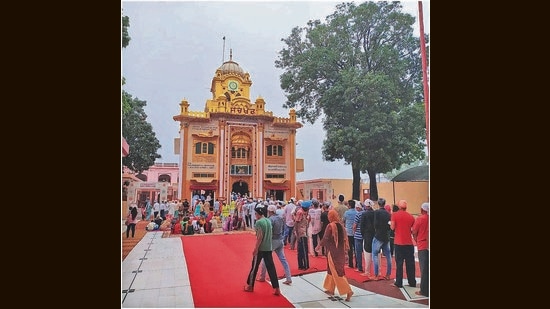
With campaigning for the Jalandhar Lok Sabha byelection picking up, politicians of all hues are descending on Dera Sachkhand, a sect of the Ravidassia community, in the heart of Punjab’s Doaba belt, hoping to win over the Dalit vote.
The byelection on May 10 was necessitated after the death of sitting Congress MP Santokh Singh Chaudhary due to a heart attack while taking part in the Punjab leg of the Bharat Jodo Yatra of Congress leader Rahul Gandhi on January 14. Chaudhary and his brother Ch Jagjit Singh, who died in 2015, were also close to the sect leadership as their father Gurbanta Singh, a former Punjab minister, helped the dera authorities in setting up the sect’s headquarters in the ’70s.
The dera, situated in Ballan village 8km from Jalandhar, draws its strength from the sheer number of Dalit followers, a significant vote bank in this constituency. Dalits constitute 32% of the population in Punjab, the highest among all states. Most of the Scheduled Castes (SC) population is concentrated in Doaba, accounting for 45%of the population.
Doaba sends 23 representatives to the 117-member Punjab assembly and the dera holds sway in 19 seats.
{{/usCountry}}Doaba sends 23 representatives to the 117-member Punjab assembly and the dera holds sway in 19 seats.
{{/usCountry}}Pivotal role in 2022 assembly elections
“Politicians have been making a beeline to the dera to ensure social mobility for Dalits. In such times, deras can’t be ignored due to their socio-political role,” says Chandigarh-based political expert Ronki Ram.
Amritsar-based expert on Dalit issues professor Paramjit Singh Judge disagrees and said he believes that the dera has no political aim as it is primarily focused on achieving its goal of making Ravidassia, a separate religion.
“There is an illusion that dera Ballan influences the Doaba region politics. However, in the coming Jalandhar byelection, it can influence to some degree and impact voting trends at micro-level among Dalits, since most of the candidates of all parties belong to the same caste,” Singh said.
The dera played a pivotal role in the 2022 assembly elections as the Congress managed to hold its ground in Doaba despite the Aam Aadmi Party wave. Of the 23 assembly seats in the region, the AAP and the Congress won 10 segments each, while the Shiromani Akali Dal, the Bahujan Samaj Party and the BJP won one seat each. The Congress won five of the nine assembly segments in the Jalandhar parliamentary constituency, while the AAP bagged the rest.
In the 2002 and 2017 elections, Congress made a clean sweep in Doaba.
So, it wasn’t surprising to find political leaders, cutting across party lines, heading to the dera. Delhi chief minister Arvind Kejriwal accompanied Punjab CM Bhagwant Singh Mann to meet dera head Niranjan Dass on March 25 and handed over a cheque of ₹25 crore to the district administration to build the Guru Ravidass Bani Research Centre at Ballan. The Congress was quick to point out that the government had “re-released” the grant announced by former CM Charanjit Singh Channi in December 2021. It claimed Channi had announced a grant of ₹50 crore for the research centre and released the first instalment of ₹25 crore on December 31, 2021. The opposition party that is pulling out all stops to retain the Jalandhar Lok Sabha seat has accused the Aam Aadmi Party of “taking undue credit by first stopping the release of payment after coming to power and then performing the charade of sanctioning the same amount for the same project”.
While Punjab Congress president Amarinder Singh Raja Warring, leader of opposition Partap Singh Bajwa and Channi have already paid a visit to the dera, Shiromani Akali Dal president Sukhbir Singh Badal was not to be left behind as he called on Sant Niranjan Dass recently.
State president of Bahujan Samaj Party Jasvir Singh Garhi said the dera has no political wings.
“I have a long association with the dera and didn’t go there to seek votes. I don’t know about other leaders but our visit was aimed at only seeking blessings from the dera head,” said Garhi, who along with SAD-BSP coalition candidate Dr Sukhwinder Kumar Sukhi visited the dera on Thursday.
Phillaur MLA Vikramjit Singh Chaudhary, son of Congress candidate Karamjit Kaur Chaudhary, said their family’s association with the dera is not political at all as his grandfather had a close association with dera’s first head.
“The opposition leaders are using this dera for their political gains. No one visited till my father was alive but the leaders thronged the dera premises soon after the Jalandhar byelection was announced post his death on January 14,” he said.
Milestone in sect’s journey
Dera Sachkhand has emerged as the ’prime protector’ for followers of Guru Ravidas, particularly after the murder of its deputy leader Sant Ramanand at Vienna in Austria in May 2009 that triggered violence between radical Sikhs and Dalits. The fifth and present head, Niranjan Dass, was also injured in the attack.
Ronki Ram, who has researched on deras of Punjab, says, “This dera has done extensive work for the development and social uplift of the Ravidassia community due to which they are largely connected and influenced by it.”
Sant Ramanand’s murder by radical Sikhs led to the setting up of the Ravidassia Dharam and now they have their own holy book, Amrit Bani: Satguru Ravidass Granth.
The announcement of the new religion was made by sect head Niranjan Dass in January 2010 from the birthplace temple of Guru Ravidass in Varanasi, Uttar Pradesh. That temple is considered a milestone in the sect’s journey.
However, the dera’s diktat to follow their holy book has created rifts within. A former leader of the dera, Surinder Dass, established a different dera in the nearby Kathar village and followed Guru Granth Sahib.
Five heads since inception
The dera was set up in 1895 by Sant Pipal Das, a native of Bathinda’s Gill Patti village. His preaching was based on the Sikh holy book, Guru Granth Sahib, which includes Guru Ravidass’s religious-reformatory verses.
Sant Sarwan Dass, the son of Sant Pipal Dass, was the second head of the dera from 1928 to 1972. Under his leadership, the Shri Guru Ravidass Janam Asthan Mandir was built at Seer Govardhanpur in Varanasi.
Sant Hari Dass became the third head of the dera from 1972 to 1982.
Sant Garib Dass succeeded him and led the dera from 1982 to 1994. Under his leadership, the dera opened hospitals, schools and industrial training institutes.
Sant Niranjan Dass took over as its fifth head in August 1994. He is involved in philanthropist works for Dalits.