Last weekend, Mohali got 303 mm rainfall in 72 hours, which is usually the amount it gets in the entire monsoon.
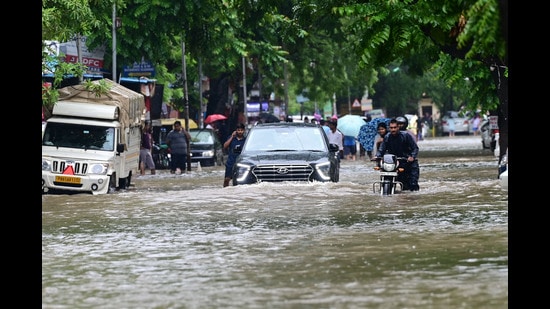
At sea, like the authorities, residents of Sectors 70, 71, Phase 4, 5, 3B1, 3B2, and Phase 11 tried in vain to prevent water from entering their houses.
While residents of old parts of the city struggled to salvage the situation, their counterparts in the newly built 10 blocks of Aerocity near Chandigarh International Airport were no better off for the entire area was waterlogged and without power for three days. Residents were even forced to charge their mobile phones in their cars.
This when Mohali city allocates a budget of ₹1 crore for cleaning road gullies before the onset of monsoon every year. On the ground, a spell of rain is enough to disrupt traffic as roads get inundated.
For the record, there are 17,000 road gullies with 9,000 falling under the jurisdiction of the public health department and 8,000 under the municipal corporation. Both the authorities failed to clean 15% of the road gullies before the monsoon arrived this time.
Audit, augment drainage system
{{/usCountry}}Audit, augment drainage system
{{/usCountry}}According to Narinder Singh Kalsi, former executive engineer at Punjab Urban Development Authority (PUDA), the sector-dividing roads in the affected areas were originally at a lower level than the internal roads. However, officers concerned raised the level of these sector-dividing roads by more than two feet, disregarding the plinth level of the houses, which is 1.5 feet. As a result, with the rising level of the main roads, water accumulates and enters the houses.
Punjab former town planning director MS Aujla, who is also a resident of Mohali, admits it’s the same story every year because the drainage system cannot handle the fallout of intense rainfall.
The authorities should consider a long-term solution and increase the capacity of the drainage system. It is crucial to conduct an audit of the drainage system, taking climate change and extreme events into account.
The trouble spots
Mataur village, Sector 70
Mataur village in Sector 70 is a nightmare during the monsoon due to its congested streets, choked drains and lack of space to construct additional drains. At some places, people have encroached upon drains or gullies, while at others, they have been blocked by construction material.
Phases 3B1, 3B2, 4, 5 and 11
Structural flaws cause a monsoon mess in Phases 4 and 5. Many houses here are in low-lying areas and no agency has any remedy to stop water flowing into them. Residents also blame unplanned carpeting of roads, which raises their plinth level and causes water to collect on the sides.
Waterlogging is a routine affair in Phases 3B1 and 3B2. Geographers say the natural lay of the land makes it prone to flooding as water from Chandigarh flows down to this part of Mohali.
Phase 11 gets inundated due to poor cleaning of Lakhnour Choe. Since the choe is choked, water level rises and enters houses.
Officials’ take
Discussing preventive steps
This time, the rainwater was excessive, and all low-lying areas were flooded. Sewers were overflowing, but repairs have been carried out. A meeting will be held to discuss preventive measures.
Balwinder Singh, chief engineer, Greater Mohali Area Development Authority (GMADA).
Caught unawares
We were caught unawares by the heavy rain. Our teams have been working tirelessly since then to clean all road gullies. I have asked the engineering department to find a permanent solution for waterlogged areas. ₹2 crore has been approved for Phase 11 alone.
Amarjit Singh Sidhu, Mohali mayor
Residents’ take
Singapore dreams washed away
Though GMADA assured us that it is developing Aerocity township on the pattern of Singapore, the recent rain has exposed its tall claims. People were confined to their homes and there was water everywhere. We went without power for three days. Criminal action should be taken against the officers concerned.
Vinod Sharma, president, Aerocity Welfare Society
Hold officers responsible
It’s strange that every year, they start cleaning road gullies at the last minute. The officers concerned should be held responsible for the mess. There was no waterlogging here 20 years ago because the roads were not above the plinth level. The authorities have been flouting norms by laying pre-mix without digging up roads so the height of the roads keeps increasing.
Mohinder Pal Singh, president, Residents Welfare and Development Committee, Sector 79.