
 E-Paper



Month on, unified portal roll out delays ration distribution in Ludhiana district
Staff are being trained to use the new portal; once done, trials & clearance will be carried out and foodgrains will be moved from godowns to depots, says official


Despite a month into the ongoing quarterly cycle, the beneficiaries entitled to receive subsidised wheat grains under the Pradhan Mantri Gareeb Kalyan Anna Yojana (PMGKAY) continue to await their supplies, amid the rollout of a unified online portal for wheat allocation and distribution, officials familiar with the matter said.
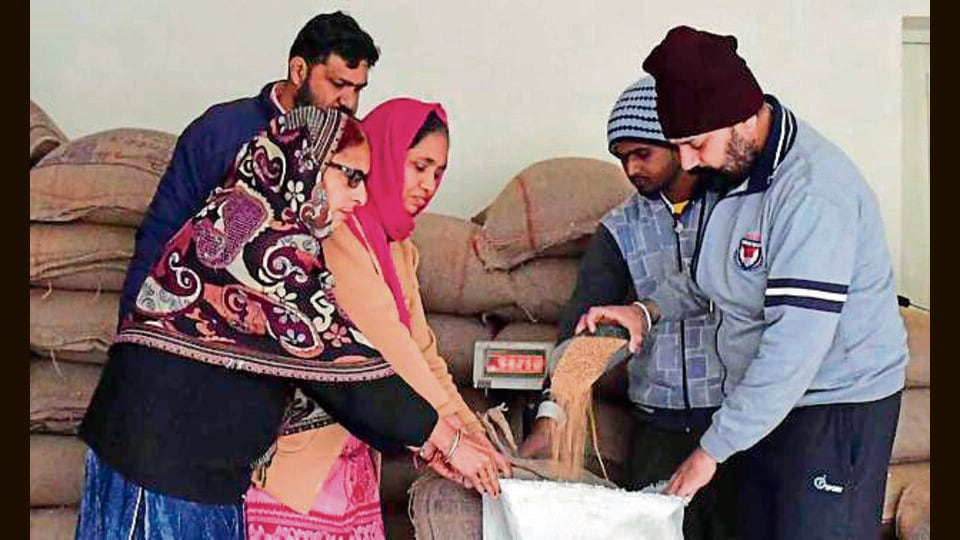
Under the PMGKAY, each eligible beneficiary is entitled to 15 kg of free wheat per quarter, distributed through government run ration depots, officials said. The distribution follows a fixed cycle. In the first or second week of each month, an allocation order specifying the quantity of wheat is released. Beneficiary details are then updated in biometric machines at depots to enable authentication.
Following this, wheat is subsequently lifted from government storage godowns and transported to ration depots, where beneficiaries receive their rations. However, as allocations for the ongoing quarter have yet to be issued, the entire process has remained stalled.
A senior official said that the disruption is linked to the transition to a new unified portal named “integrated Aadhar enabled supply chain management”, in place of three interconnected portals that used to manage allocation, lifting and distribution of subsidised foodgrains. These included ercms.punjab.gov.in that handled ration card and ration depots data; feast.punjabgov.in that managed stock movement and depot-wise distribution; and epos.punjabgov.in, overseeing beneficiaries data in biometric machines.
“The integration of these systems into a single unified portal has been introduced earlier this week, and officials are being trained since Wednesday. After this, trials and clearances will be required to move foodgrains from godowns to depots. We are assuming that the allocation will be completed within the next week”, the official added.
‘Govt should have ensured poor families do not suffer during transition’
Meanwhile, beneficiaries across Ludhiana have highlighted the difficulties caused by the prolonged delay.
Paramjeet Kaur from Dholewal Chowk, said, “Earlier, even if there were small delays, we eventually got our wheat. Now, no one at the ration depot can tell us when the supply will arrive. If the government has changed the system, they should have ensured that poor families do not suffer during the transition.”
Jagtar Singh, a beneficiary from Kot Mangal said, “Every month we plan our household expenses assuming the ration will come. This time, it has been over a month and there is still no wheat. Buying wheat from the market has increased our expenses, and forced us to cut down on vegetables or milk.”
Karamjit Singh Arreccha, Punjab president and national general secretary of the All India Fair Price Shop Dealers Federation, said,” This is the first time we have seen such a prolonged delay in allocations. Beneficiaries come to depots daily, but we are forced to turn them away. If allocations are not released on time, it defeats the very purpose of a welfare scheme meant to ensure food security for the poorest.”
When contacted, district food and supplies controller Sartaj Singh Cheema said, “The allocation is pending across the State and not limited to Ludhiana. The delay is at the backend. We are fully prepared to initiate distribution as soon as the allocations are issued.”


