A centre that once struggled to become fully functional now provides treatment and therapy to more than 250 children, drawing families from across India and even abroad, as it expands its multidisciplinary services for autism and other neurodevelopmental disorders.
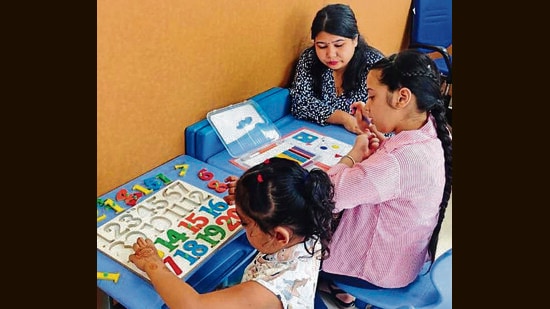
The journey of the centre of excellence for autism and neurodevelopmental disorders in Sector 79, Mohali, to its present scale has been gradual. Conceived by the Punjab government in 2016, its foundation stone was laid by then chief minister Parkash Singh Badal on November 26 that year and the facility was inaugurated on December 15, 2021. However, it remained non-operational after the inauguration. The outpatient department (OPD) services finally began on April 2, 2025 initially once a week, before clinical services were expanded in April 2026 with the joining of doctors and therapists.
It started with seven students and has now grown into a team-based facility receiving 25 to 30 families every day. Families from Punjab, Himachal Pradesh and Uttarakhand visit the centre, while 17 families associated with the facility do not hold Indian passports. Families from Canada, Australia and Saudi Arabia have also sought treatment for their children.
360-degree approach
{{/usCountry}}360-degree approach
{{/usCountry}}Autism is a neurodevelopmental disorder that affects how individuals perceive, communicate and interact with the world. Dr Chhaaya Prasad said that one family travelled from Saudi Arabia with their four-year-old child, who had been constantly regressing. The centre carried out a holistic assessment of the child, covering different areas of development, and prepared a home-based intervention plan for the parents.
“We first complete a holistic 360-degree assessment before telling parents where the problem lies. We then prepare a plan that parents can follow at home,” she said.
The centre has a 23-member team comprising three psychiatrists, three developmental paediatricians, dentistry specialists, an ENT specialist from Dr B R Ambedkar State Institute of Medical Sciences (AIMS) Mohali, two nursing staff, two special educators, two speech therapists, two physiotherapists and an occupational therapist, besides supporting staff and interns. The institute also works with Amity University and social organisations.
Its standard approach is to assess a child comprehensively before recommending interventions. The aim is to identify developmental, behavioural, communication and other needs rather than focus on a single symptom.
Dr Nidhi Malhotra said early identification can help children make better progress with sustained support. “It is better that we detect the problem early. Every child can become a better version of themselves with the help of parents and constant support,” she said.
From diagnosis to hope
The centre’s impact is also reflected in children who require long-term support. Pranav, a 16-year-old boy, had never been able to stand on his legs. Within three months of admission, the centre helped him stand and begin walking, according to the institute.
For a family from Baltana, progress has also come after a long search. The parents of their four-year-old child told HT they had taken him to several places but had not seen improvement. Since their arrival to the Mohali centre, they have noticed that he has started listening to them.
The centre also runs a parent empowerment programme every Friday, helping families understand their children’s needs and manage interventions at home. A recent session focused on curriculum planning and educational participation for children with special needs.
More than 3,000 therapy sessions have been conducted at the centre so far. However, parents and the institute say the growing number of children has also exposed gaps in manpower, funding and awareness. With more than 200 children receiving services, the centre needs additional special educators and other specialised staff to meet demand.
The multidisciplinary model brings developmental paediatrics, psychiatry, physiotherapy, occupational therapy, speech and language therapy, audiology, special education and social work together, reducing the need for families to visit multiple facilities.
The centre is also expanding its infrastructure, with six rooms each for boys and girls prepared and arrangements being explored for parent accommodation.
Anandpur Sahib member of the parliament (MP) Malvinder Singh Kang had also recently reviewed the outpatient department, parent empowerment wing, vocational training unit and school-readiness block. AIMS Mohali director-principal Dr Navdeep Saini briefed him on staffing and infrastructure requirements.
Member of the legislative assembly (MLA) Kulwant Singh said he would seek an additional ₹4-5 crore from the Punjab government for the facility. Janta Land Promoters Private Limited has also contributed ₹1 crore, according to Singh.
For families, however, the centre’s progress is ultimately measured through changes in their children from a child beginning to listen to parents to a teenager taking his first steps.
The centre is open from Monday to Saturday, 9 am to 5.30 pm. For assistance, people can call the landline helpline at +91 172 292 7006 or the mobile helpline at +91 75895 60956.