Before most of the tricity is awake, the day begins for the 100-odd dogs at the Punjab Home Guards Canine Training and Breeding Institute, tucked away amid fields, forest tracks and open ground in Dera Bassi, around 40 km from Chandigarh.
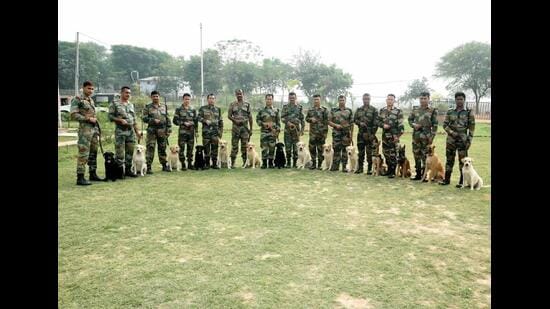
Sitz (sit), platz (lie down) and such (search) are among the German commands the dogs learn to follow, allowing handlers to direct them during field operations without others easily understanding their instructions.
From narcotics raids and explosives detection to election security, the dogs are trained to respond to these commands while identifying real substances rather than artificial substitutes. Some have also been deployed for election-related security duties, including the Lok Sabha elections.
“In the beginning, we trained 48 dogs, and all of them are now deployed in different departments,” said Simrat Pal Sidhu, alias Newton Sidhu, who spearheaded the initiative. “We do not train them on pseudo items. We use real substances and materials so that the dogs can identify them during actual operations.”
The idea took shape in 2015 after Sidhu, who had worked in cybersecurity since 1999 and with various government departments, met Mike Morgan, a US-based canine trainer with 28 years of experience training dogs for the American forces. A report by a Union home ministry-appointed committee had highlighted a shortage of trained canines in India, prompting Sidhu to approach the then Punjab government for a joint venture, particularly to meet the state’s requirement for narcotics-detection dogs.
{{/usCountry}}The idea took shape in 2015 after Sidhu, who had worked in cybersecurity since 1999 and with various government departments, met Mike Morgan, a US-based canine trainer with 28 years of experience training dogs for the American forces. A report by a Union home ministry-appointed committee had highlighted a shortage of trained canines in India, prompting Sidhu to approach the then Punjab government for a joint venture, particularly to meet the state’s requirement for narcotics-detection dogs.
{{/usCountry}}The institute, a government undertaking under Punjab’s department of home affairs and justice, now trains dogs for state and paramilitary forces. Its 43-acre campus can accommodate 104 dogs, with 48 kennels for those under training and five for pups, besides medical rooms and quarantine facilities.
At 5.30 am, handlers begin the daily routine, walking the dogs, cleaning kennels, serving food and grooming them. By 9.15 am, training resumes with temperature checks, health records, obedience exercises and scent imprinting. The day ends with dinner and lights out at 9.30 pm.
It trains Belgian Malinois, working-line Labrador Retrievers and German Shepherds for narcotics and explosives detection, tracking, illicit liquor and mobile phone detection, guarding and therapy duties.
Explosive-detection dogs are imprinted with scents from six chemical explosive families, including TNT, RDX, PETN, ammonium nitrate and nitromethane. They are conditioned to work amid vehicle exhaust, fuel fumes, traffic horns, gunshots and explosions.
Narcotics training follows a food-reward method, with dogs exposed to drug odours, derivatives, paraphernalia and residual traces. The institute is licensed by the Bureau of Narcotics to maintain controlled substances for training.
Currency-detection dogs are trained to search luggage, vehicles, buildings and open areas, as well as environments such as airports, aircraft, boats and ships.
The dogs are sourced from the US, Canada, Austria, Poland and Germany, with the institute claiming to be the only organisation in India legally authorised to import canines. The cost of a trained dog ranges from ₹2 lakh to ₹4 lakh, depending on the assignment, while therapy dogs can fetch up to ₹6 lakh.
From excise raids to VIP security
The institute says it has supplied 168 trained dogs to government departments, including for the chief minister’s security. Twelve are deployed with the Haryana prison department, while one is part of the security arrangements for the Dalai Lama.
In Ludhiana, Belgian Malinois Urus, five, Golden Labrador Tommy, six, and Labrador Jolly, four, were part of an excise operation that led to the detection of around 3.30 lakh litres of lahan, according to the institute.
In Barwala in Haryana, Urus and Tommy, along with German Shepherd Shruti, three, and Belgian Malinois Lio, four, helped detect around 30,000 litres of liquor stored in tanks. The institute supplies dogs to paramilitary and state police forces, the Union ministry of external affairs, excise and taxation departments, and prison departments.
It is also in talks with the governments of Afghanistan and Namibia to supply dogs for narcotics and explosives detection and anti-poaching operations.