Over 80% of Chandigarh’s weekly Apni Mandis lack basic facilities such as public toilets, waste bins, washing areas and dedicated parking, leading to persistent plastic littering, traffic congestion and serious public health concerns, a new study by the Institute for Development and Communication (IDC) has revealed.
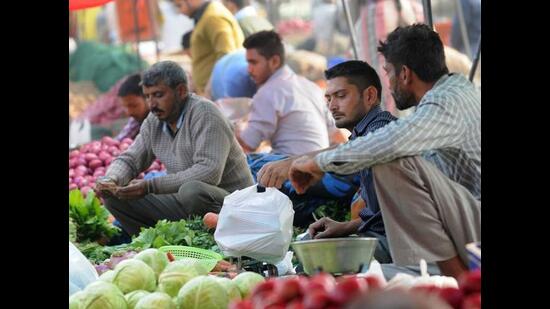
The report, ‘Plastic Waste Generation and Management in Apni Mandis,’ Chandigarh, authored by project co-ordinator Japneet Kaur, is based on surveys of 500 vendors, 750 customers and 110 nearby households across 11 apni mandis across city, showcases a troubling picture of infrastructural neglect despite the city’s planned urban framework.
This study was assigned to the Institute for Development and Communication (IDC) by Toppan Speciality Films Pvt. Ltd., with the objective of assessing market functioning by examining consumer satisfaction, vendor practices, waste management systems, infrastructure adequacy, and the impact of market activities on nearby residential areas.
Inadequate waste mgmt infra
Waste management infrastructure is critically inadequate — only one market surveyed had installed waste bins, while segregation of plastic and organic waste was virtually absent. Overflowing garbage and plastic carrybags scattered across open grounds were common sights.
Around 49.1% vendors are aware of eco-friendly, non-plastic packaging alternatives to plastic bags, while 50.9% remain unaware. This near-even split indicates that information about biodegradable or reusable options has not uniformly reached all vendors across markets.
{{/usCountry}}Around 49.1% vendors are aware of eco-friendly, non-plastic packaging alternatives to plastic bags, while 50.9% remain unaware. This near-even split indicates that information about biodegradable or reusable options has not uniformly reached all vendors across markets.
{{/usCountry}}The single largest obstacle identified by vendors is the higher cost of eco-friendly alternatives, cited by 54.5% of respondents. Vegetable vending operates on thin margins, and any increase in packaging cost directly affects profitability. Vendors indicated that biodegradable bags and paper-based packaging are significantly more expensive than thin plastic carrybags, making them financially unviable in competitive weekly markets.
Beyond cost, 26.4% of vendors reported customer resistance as a major barrier.
Traffic congestion emerged as a persistent problem. More than half the markets reported frequent or constant road congestion, with no market describing the issue as “rare”. Around 82% lacked dedicated parking areas, resulting in illegal roadside parking and access bottlenecks.
Waste management infrastructure is even weaker as 87.5% of apni mandis do not have waste bins and they do not practice waste segregation. There is 100% absence of designated washing areas across all 11 apni mandis that were surveyed. Visible litter was reported as ‘often’ or ‘always present’ in 93.8 % of markets.
Plastic dependency remains high. Thin carrybags and disposable packaging are widely used due to low cost and customer demand. The report notes that weak enforcement of plastic bans and absence of segregation systems have made mandis major generators of visible plastic litter.
Sanitation gaps are compounded by irregular waste collection. Residents reported stray animals scattering garbage at night, unpleasant odours and hygiene deterioration in surrounding neighbourhoods.
Customers value fresh produce and competitive pricing but expressed dissatisfaction with cleanliness, parking and toilet facilities. The study warns that declining hygiene standards may push consumers toward organised retail and app-based grocery platforms.
‘Policy-practice gap’
The research highlights a “policy-practice gap”: while municipal rules mandate segregation at source and plastic regulation, implementation remains weak at the market level.
Chandigarh’s apni mandis are rotational, weekly/day markets in different sectors that bring farmers directly into the city to sell produce. They source mainly from nearby peri-urban and rural suppliers (villages in Mohali, Patiala, Zirakpur/Derabassi and other nearby Punjab/Haryana supply points) and from local wholesalers.
The research covers major vegetable markets and Apni Mandis in Chandigarh, across selected sectors, namely, Sectors 40, 15, 43, 46, 45, 34, 56, 49, 29, Ram Darbar, and Dhanas.
The recommendations
- The report calls for market-level infrastructural reform rather than penalising individual vendors.
- Mandatory installation of source-level waste segregation systems in all markets.
- Setting up decentralised composting units for biodegradable waste.
- Improved timing and frequency of municipal waste collection.
- Provision of public toilets, drinking water and washing facilities in every mandi.
- Dedicated parking and traffic management plans to reduce congestion.
- Incentive-based mechanisms to reduce single-use plastic use rather than relying solely on fines.
- Strengthening monitoring, data collection and municipal accountability.
- Integrating weekly mandis into Chandigarh’s broader urban food and sustainability policy framework.
Top findings
- Over 80% of apni mandis lack basic civic infrastructure, including public toilets, waste bins, washing areas and dedicated parking facilities.
- 87.5% of apni mandis do not have waste bins and do not practice waste segregation, while 93.8% reported visible litter as “often” or “always” present.
- There is a 100% absence of designated washing areas across all 11 surveyed apni mandis.
- Around 82% of these mandis lack dedicated parking, and more than half reported frequent or constant traffic congestion.
- Vendor awareness of eco-friendly packaging is split — 49.1% are aware of alternatives, while 50.9% are not — but adoption remains low due to economic constraints.
- The biggest barrier to shifting away from plastic is higher cost (54.5%), followed by customer resistance (26.4%), reinforcing continued plastic dependency.