The issue of the restoration of wrongly partitioned and alienated thousands of acres of shamilat deh (village land reserved and used for a common purpose) to gram panchayats in Haryana following a landmark April 7 Supreme Court (SC) judgment resonated in the state assembly on Wednesday with the Leader of Opposition, Bhupinder Singh Hooda demanding that the state government should file a review petition in the apex court.
The April 7 judgment had ruled that the village common land can neither be repartitioned amongst the proprietors nor sold.
Strangely, chief minister ML Khattar did not outrightly reject Hooda’s demand for filing a review petition in the Supreme Court and instead assured that the state government’s legal team was looking into it and would give its opinion. Khattar’s stance looked out of place as the state government itself had challenged before the Supreme Court the orders of the Punjab and Haryana high court which struck down the amendments of 1992 in the Punjab Village Common Land (Regulation) Act, 1961. The apex court bench of justice Hemant Gupta and V Ramasubramanian in its April 7 judgment held that the amending Act of 1992 is valid and does not suffer from any vice of constitutional infirmity. “The entire land reserved for common purposes by applying pro-rata cut had to be utilised by the gram panchayat for the present and future needs of the village community and that no part of the land can be re-partitioned amongst the proprietors,’’ the apex court said.
The SC said that with the aforesaid discussion and findings, the appeals filed by the state of Haryana and panchayats are allowed and those filed by the proprietors are dismissed. Consequently, the writ petitions filed before the High Court shall also stand dismissed, the SC said.
{{/usCountry}}The SC said that with the aforesaid discussion and findings, the appeals filed by the state of Haryana and panchayats are allowed and those filed by the proprietors are dismissed. Consequently, the writ petitions filed before the High Court shall also stand dismissed, the SC said.
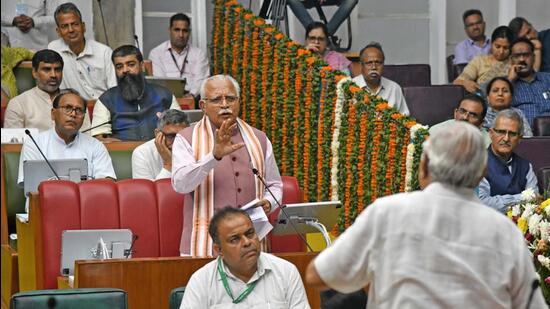
{{/usCountry}}Intervening during an address by the chief minister, Hooda asked what was the Haryana government’s stance in the Supreme Court. “Are you planning to file a review petition,” Hooda asked Khattar.
The chief minister said the state government was taking legal advice on the matter. “Our legal committee will give its opinion. Had we not acted, such piece of land would have changed hands,’’ Khattar told the House. The CM said that acting on SC’s orders, the state government has stopped the sale-purchase transactions of such land. “Right now, we are seeking mutation of such lands in favour of gram panchayats. Mutation would not change the title,” Khattar said. Hooda insisted that instead of executing mutations in favour of panchayats, the state government should prohibit the execution of sale deeds (registry) of such chunks. The chief minister though said prohibiting the execution of sale deeds would not be possible in view of the complexities involved.
Hooda also suggested that the only way to resolve the matter was by amending the Consolidation Act. “There is a flurry of activity in the districts as deputy commissioners have been given instructions regarding restoration of such lands. Please examine the matter before acting. This is going to create tension in villages,” Hooda said.
The significance of SC ruling can be gauged from the fact that thousands of acres of village common land in the state which was sold off by shareholders or gram panchayat for monetary gains would now get freed.
The SC in its judgment had held that the entire land reserved for common purposes by applying pro-rata cut had to be utilised by the gram panchayat for the present and future needs of the village community. “No part of the land can be repartitioned amongst the proprietors and such land would not be available for sale,” the apex court had ruled. It said the argument of the proprietors that the land which is not capable of being used for common purposes of the inhabitants of a village shall be reverted to the proprietors is untenable and unsustainable. “The land has been put to the common pool by applying pro-rata cut. Once a pro-rata cut has been applied, the management and control of such land vest with the panchayat. There is no question of reverting the land to the proprietors,” the bench said. Also, the panchayat will not have title over the land but as part of management and control, the panchayat is at liberty to put the land for use for common purposes, the SC said. “Neither the Punjab Village Common Lands Act, 1961, nor the Consolidation of Holdings Act, 1948, contemplates redistribution of land to the proprietors. It is an irrevocable act which cannot be undone. Therefore, once land vests with the panchayat, it can be used for common purposes of the community and will never revert back to the proprietors,’’ the SC said, dismissing the appeals filed by proprietors. It ordered that writ petitions filed before the HC will also stand dismissed. The findings recorded by different benches of the HC are clearly erroneous and not sustainable, the SC said.