Last Monday around 4 pm, the world seemed to come to a standstill. A pick-up van screeched to a halt on the road in front of the Chandigarh Police headquarters (HQs) in Sector 9. Exercising admirable restraint and patience, the driver waited for a tortoise to cross and reach the relative safety of the sprawling bungalow (no. 351). As luck would have it, Lalit Mohan Bansal, a sub-divisional engineer SDE with the Chandigarh engineering department and a bird watcher and naturalist to boot, was heading towards his office after a field inspection. He noticed the van in the middle of the road.
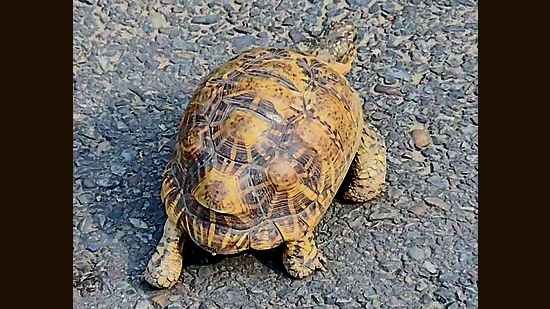
“A determined tortoise was making its way across. Concerned over its safety and lack of suitable habitat in the vicinity, I halted my car and approached the tortoise. However, it made off hither and thither to evade my well-intentioned efforts, frequently ducking its neck into the carapace! I requested the security guard outside the house for a cardboard box. He took some time as he could not locate one. All this while, the personnel deployed at the gates of the police HQs were watching. They do not let traffic come to a halt outside the HQs due to security reasons but on my request, they gave us a thumbs-up signal to proceed without us having to move our vehicles. The guard came back with a box and we managed to guide the tortoise into it,” Bansal told this writer.
The tortoise was a rarity, a vulnerable species and had lived up to its name! Identified as an Indian star tortoise, the species is declining because of illegal trafficking for the pet trade. It is a mystery as to how the tortoise surfaced in Sector 9. There is a possibility it had been kept illegally as a pet by a wealthy resident and had either escaped or been released.
{{/usCountry}}The tortoise was a rarity, a vulnerable species and had lived up to its name! Identified as an Indian star tortoise, the species is declining because of illegal trafficking for the pet trade. It is a mystery as to how the tortoise surfaced in Sector 9. There is a possibility it had been kept illegally as a pet by a wealthy resident and had either escaped or been released.
{{/usCountry}}“I placed the tortoise in my car and poured a bit of water into the box, just in case it was thirsty. I took it to the water body behind the Nagar Van. The tortoise swam away and I felt a wave of relief coming over me. It was finally at a better and safer place,” added Bansal.
The brooks and blooms of Kargil
A quarter of a century has passed since the Kargil war and bears and ibexes roam fearlessly in the quiet heights. An array of flowers stir in the cool, murmuring winds and milky waters roar and tumble from the high thaws. Alpine birds flit between the rocks like kids playing musical chairs and their sweet whistles enchant the ear.
Back in the summer of 1999, tiny wild flowers blooming from low shrubs and adapted to the high altitudes were the only signs of nature’s glories. The flowers could be glimpsed hugging the cliffs, mountain slopes and especially the sides of snow-melt brooks in the war zone. In the barren, icy desert of Kargil heights, no trees grow. Animals and birds had fled the shelling and bullets in the heights. But flowers would peep out cautiously amid the firing from in between the spaces and crevices dominated by rocks, boulders as big as rooms, and slipping shale.
The flowers had defied more than just the hazards of a shell landing right on top of their tiny heads or a trampling under the boots of Indian troops charging up the inclines. Due to intense exchanges of artillery fire on the ridgelines and slopes, cordite residues had slowly poisoned the snows of the Batalik heights and the streams tumbling from them. It was the streams spreading like a giant tree’s roots down the slope that were relied upon by flowering shrubs for nurturing.
There was a positive side to this war hell engulfing the austere splendour of Batalik. The poisoned snows played a vital part in the Indian war effort by degrading the enemy’s fighting potential. Pakistani soldiers holed up on the towering heights would melt snow for water consumption. As the war progressed in India’s favour and the summer deepened, the snows began to melt and slip away, and whatever residues were left on the tops were affected by cordite poisoning. Pakistani supply lines of food, water and ammunition came under stress due to interdiction by the Indian Army. Neither could the enemy come down to the nullahs thousands of feet below to fetch water as our Army was camping along them.
Thirst set in with a vengeance upon the embattled Pakistani soldiers. It proved to be one of the last nails in the Pakistani coffin.
(vjswild2@gmail.com)