Use of technology has revolutionised the judicial system and effective working of courts and tribunals across the country over the years. Asserting that technology is deeply intertwined with the foundations of our Republic, Chief Justice of India DY Chandrachud on Saturday said not only did the use of technology make our courts more accountable and responsive, it also brought people closer to the courtrooms.
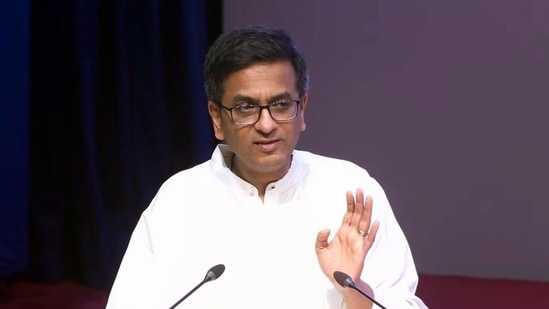
The Chief Justice was the chief guest at the three-day National Conference on “The landscape of technology in courts in India and the Way forward”, which kickstarted at the Chandigarh Judicial Academy on Saturday. Justice Surya Kant and justice Rajesh Bindal of the Supreme Court were the guest of honours.
“Technology being a tool to access justice is not just a modern convenience or a trendy topic. It is deeply intertwined with the foundations of our Republic. The use of technology is therefore intrinsically linked to the values of transparency, democracy and equitable access to justice which lie at the cornerstone of our Republic,” said the CJI.
Also Read | ‘Scandalous’: CJI DY Chandrachud lambasts high court's unusual criticism of Supreme Court
Recounting his past experience as a chairperson of the e-committee of the Supreme Court, the CJI said he had closely watched the evolution in the discourse of this subject over the last four years. “We have progressed from discussions around recognising the need for information technology to delving into its intricacies and best practices,” he said.
{{/usCountry}}Recounting his past experience as a chairperson of the e-committee of the Supreme Court, the CJI said he had closely watched the evolution in the discourse of this subject over the last four years. “We have progressed from discussions around recognising the need for information technology to delving into its intricacies and best practices,” he said.
{{/usCountry}}“Today, technology is acknowledged as an indispensable catalyst for accessible justice. This paradigm shift is indeed heartening,” he said, adding that we were no longer now discussing whether we should adopt technology but rather how best we can harness it.
“I still remember the time when I was a young judge of the Mumbai High Court and the then Chief Justice VN Khare had convened a conference on technology. There were about 20 judges and everyone had a desktop in front of them. They were trying their best to tell us how to open our desktops. Most of the chief justices and judges had their desktops completely blank. No one knew how to even open it,” he said. “It was probably around 2004, that was where we began. How well we have transformed as institutions or as individuals over the years!”
Also Read | Lok Adalat aims to bring justice to every home: CJI
The Chief Justice of India added that a quintessential example of technology augmenting transparency in our judicial system is the live streaming of cases and the facility of hybrid hearings. “Virtual hearings are no longer an exception born out of necessity of Covid but are a normative practice in judiciary across the country, from the apex court to all tribunals,” he said.
“Over the last four years, the Supreme Court has heard over 8 lakh cases through video conferencing or the hybrid gearing facility. This shift amplifies transparency and accountability for all stakeholders- litigants, lawyers and the public. With hybrid, lawyers can appear in courts throughout the country ensuring that the best legal representation is accessible to our citizens,” he said.
“Even litigants can log onto their hearings and witness proceedings first hand. They are no longer dependent on their intermediaries or the version of hearings narrated by their lawyers. This increased openness also holds us judges accountable for our words, actions and demeanour. In many ways, by embracing technology, we have transformed the theoretical court system into a practical reality,” the CJI said.
“Innovative initiatives like the National Judicial Data Grid (NJDG) have revolutionised transparency in our judicial system. With just a few clicks, it provides real time data on cases pendency, institution and disposal rates,” said the CJI, inviting chief justices to use the facility of NJDG.