Living at a place surrounded by a few trees and a bit of wilderness offers us ample opportunities to observe the wild around us. Mornings arrive wafted over birdsong to nudge us out of our beds. The morning cacophony of raucous jungle babblers, mynahs, crows, parrots, tailor birds, sun birds, grey hornbills and koel is actually an avian ensemble with each songster playing its part.
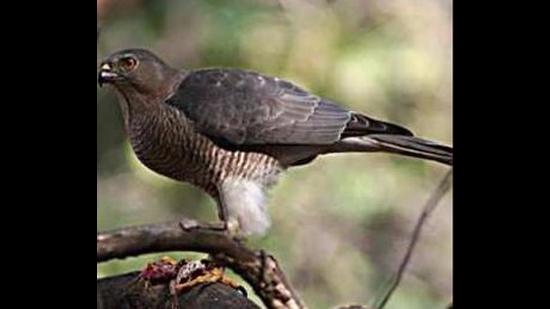
However, things take a serious turn when the shikra (Accipiter badius), a small hawk, immortalised in Punjabi psyche by Shiv Batalvi’s poem by the same name comes visiting. Shikra, derived from the Urdu word shikari or hunter, is a small raptor from the family to which Punjab’s state bird, the northern goshawk or baaz, belongs. Shikra is a widespread resident in the open wooded country and urban spaces in India, except in the North-East. It feeds on small birds, lizards and mice, but is also known for its speed, stealth, opportunism and pluck to take on birds larger than itself.
The morning of the shikra in April this year was quite eventful. Scattered rain had followed a dusty, windy night in the early hours of that memorable morning. The air was thick with petrichor. I was pulled out of bed, for a change, not by the birdsong but by the loud ululation of a babbler in its death throes. A female shikra with a jungle babbler in its deadly talons was sitting on the ground in our backyard. Unnerved by the babbler’s wailing, I ran impulsively towards the place of slaughter. The hunter loosened its grip and flew away. The babbler sprang up like a tennis ball and hustled into the nearest lime shrub. It was alive and kicking much to my relief.
But the shikra came back within a minute, looking for the kill. Perched on a guava branch, it surveyed the area with its keen, angry, orange-yellow hawk eyes. It looked at me for a while, perhaps cursing me silently for depriving it of its breakfast. Not finding the quarry, it flew away, only to come back again. This time, it sat on a branch of the same lime where its prey, the babbler had galloped. It kept coming and going many more times before finally disappearing behind a distant peepal.
{{/usCountry}}But the shikra came back within a minute, looking for the kill. Perched on a guava branch, it surveyed the area with its keen, angry, orange-yellow hawk eyes. It looked at me for a while, perhaps cursing me silently for depriving it of its breakfast. Not finding the quarry, it flew away, only to come back again. This time, it sat on a branch of the same lime where its prey, the babbler had galloped. It kept coming and going many more times before finally disappearing behind a distant peepal.
{{/usCountry}}In Batalvi’s poem, the shikra is an ambiguous metaphor for love, longing, betrayal and sheer animal will. There is ambiguity even about its gender; it has a plume on its head and anklets in its feet. The narrator-lover in the poem bemoans: “Choorie kuttan tan oh khaunda naahi/ ve assan dil da maas khawaya/ Ikk udari aisimari, oh muhr watni na aaya.” (I crush choorie for him, /But he doesn’t take! /So, I fed him the flesh of my heart!/He took such a flight, /Never to come back again.)”
Our shikra was a similar embodiment of terror and beauty. Like the narrator of the poem, I also believe that our shikra, having been denied the animal flesh that rightfully belonged to it, will never come back again. There was some finality about its departing flight that saddened me.
The entire episode left me in a state of dilemma: In saving a defenceless bird, had I not denied its hard-earned meal to a powerful raptor? Is human intervention in nature’s ways, even if motivated by sympathy and humanitarian concerns, justified? There are no easy answers. With the number of overlapping zones of human and animal habitation increasing every day, we will be facing many more such unresolvable dilemmas. swarajraj@yahoo.com
The writer is a Patiala-based professor of English