The decision of Chandigarh administration to allot 10-acres to Haryana government, by trading a 12-acre chunk in bordering Panchkula, for constructing an additional state assembly building has legal as well as political ramifications.
Experts said that since the assets in Chandigarh, the joint capital of Haryana and Punjab, were apportioned between the two states in the ratio of 60:40 as per the population ratio of 54.84 to 37.38 for Punjab and Haryana respectively under Punjab Reorganisation Act, the fresh land allotment will get tested on the question of validity in terms of apportionment of assets. The land swap will also entail redrawing the territorial boundaries of Chandigarh.
Punjab and Haryana high court lawyer, Keshavam Chaudhri said Punjab Reorganisation Act enacted by Parliament relates to the reorganisation of the existing state of Punjab including delineation of boundaries and constituencies between Haryana, Punjab and Chandigarh. “The consequences of swapping of land as proposed by the Haryana government would have far-reaching ramifications. It would directly affect Punjab in as much as Chandigarh is a Union territory as well as a common capital of Punjab and Haryana,” he said.
Chaudhri said the Supreme Court in a recent judgment held that Chandigarh administration shall not resort to formulate rules or bye-laws without prior consultation of the Heritage Committee and prior approval of the Central government. “Therefore, such kind of swapping would be tantamount to circuitously violating the spirit of the apex court order. Also, the land swap would open a pandora box, allowing other neighbouring states to seek similar swaps. It would directly affect the composition of legislative assemblies which is made by dividing the state into territorial constituencies based upon the ratio of population vis-à-vis number of seats allotted to it and would further affect Parliamentary constituencies which are based upon geographical compact areas, physical features, existing boundaries of administrative units and public convenience as per Article 170 of the Constitution and Delimitation Act 2002,” said Chaudhri.
{{/usCountry}}Chaudhri said the Supreme Court in a recent judgment held that Chandigarh administration shall not resort to formulate rules or bye-laws without prior consultation of the Heritage Committee and prior approval of the Central government. “Therefore, such kind of swapping would be tantamount to circuitously violating the spirit of the apex court order. Also, the land swap would open a pandora box, allowing other neighbouring states to seek similar swaps. It would directly affect the composition of legislative assemblies which is made by dividing the state into territorial constituencies based upon the ratio of population vis-à-vis number of seats allotted to it and would further affect Parliamentary constituencies which are based upon geographical compact areas, physical features, existing boundaries of administrative units and public convenience as per Article 170 of the Constitution and Delimitation Act 2002,” said Chaudhri.
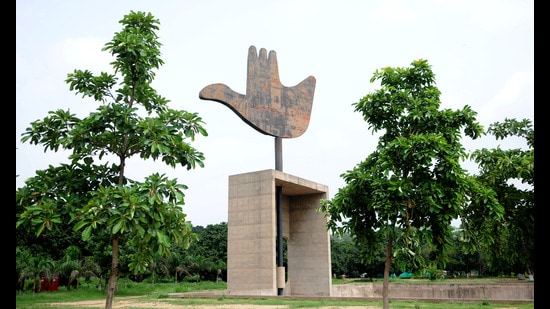
{{/usCountry}}Experts said that shifting the Vidhan Sabha from Capitol Complex, a UNESCO world heritage, will also weaken Haryana’s claim on Chandigarh. The Capitol Complex encapsulates the three pillars of democracy- the executive, the legislature and the judiciary.
A former Haryana IAS officer who dealt with a number of inter-state issues said that Haryana has not claimed the 40% of its assets as per the apportionment under the Punjab Reorganisation Act. “So swapping a piece of state’s land for a chunk in Chandigrah is like buying one’s own property. Secondly, if one moves out of the existing Vidhan Bhawan, one is giving up one’s claim on Chandigarh,” he said. A better way out would be to have an additional assembly building where non-essential staff and offices can be shifted, he said.
Haryana officials said the state plans to construct a new and bigger Vidhan Sabha along with creating space and facilities to hold meetings of the assembly committees and office infrastructure.
“The state government will continue to have the possession of existing Vidhan Sabha in Capitol Complex. Some special sessions and the first session of the year which is addressed by the Governor, the budget session can be held in the new assembly premises. The regular sessions can be held in the existing assembly building,” an official said.
Noted lawyer, ML Sarin said the issue arising from this decision has legal implications and needs deliberation. “Can Chandigarh acquire a property in Haryana territory? Can Haryana get a new assembly building without moving out of the existing Vidhan Bhawan in Capitol Complex,” Sarin asked.
Former Haryana chief minister Bhupinder Singh Hooda said the land swap would also mean spending ₹600 crore. “Chandigarh is ours. And we are buying land here. What’s the logic? Why are we weakening our claim on Chandigarh. We can build low height additional structure close to Vidhan Bhawan as has been done by high court to increase space,” Hooda said.
Reacting to the move, Rajya Sabha MP Tarlochan Singh said it is high time that the issue of Chandigarh is resolved by the Central government and goodwill is restored.
“What is being done is not healthy for the people and government of the two states. If Haryana wants a new assembly, they can have it in their territory,” he said.
Five-time Haryana MLA Karan Singh Dalal said building a new Vidhan Sabha in Chandigarh would be unfair for the future generations. “Haryana should move out of Chandigarh. We should develop a new capital symbolising the state’s culture and ethos. Kurukshetra is the right place for new Capital of Haryana.