As an unprecedented hailstorm hit Sangrur last month, the months of hard work that farmers had put in got washed away in a matter of few hours.
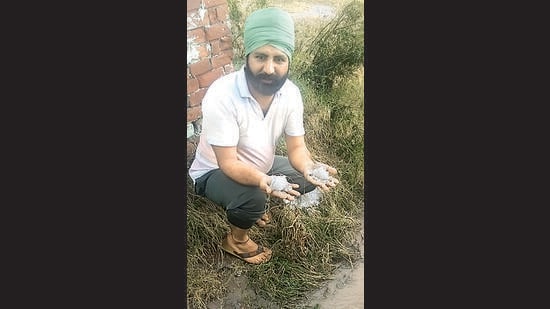
Harpreet Singh, 29, a resident of Hariau village, says, “I own only two acres and have taken eight acres on an annual lease of ₹60,000. The rain and hailstorm have completely damaged the wheat crop on 6 acres while 80% of the crop on the rest of the land was also affected.”
Harjinder Singh, 34, a resident of Gidriayani village, said, “The fields are still waterlogged. I have 25 acres where I have sown vegetables, flowers and wheat. All crops have been completely damaged.
‘Our debts keep mounting’
Our debts keep mounting with every crop loss, says 46-year-old Harjit Singh of Hassanpur Prohta village in Patiala, pointing to his damaged wheat crop that has been flattened by the recent downpour.
“70% of my wheat crop has been destroyed by rain,” he says dejected.
“This year too, I won’t be able to earn well and my debts will further increase,” he reveals.
Amrik Singh, 56, a farmer of Baran village in Patiala, said, “Due to rain and hailstorm, the roots of wheat crops have decomposed in some parts where the water is still accumulated.”
When asked about the losses he has incurred, he says, “We have to spend on high quality grain, medicinal products and incur other expenses throughout the crop cycle. But one spell of untimely rain, and our entire crop gets destroyed.”
{{/usCountry}}When asked about the losses he has incurred, he says, “We have to spend on high quality grain, medicinal products and incur other expenses throughout the crop cycle. But one spell of untimely rain, and our entire crop gets destroyed.”
{{/usCountry}}Tarn Taran farmer stares at 50% dip in yield
Tajinderpal Singh, a farmer from Rasoolpur village of Tarn Taran district, had sown wheat over 16 acres and it was ready to harvest when it was damaged due to rains and high-velocity winds. Singh said his entire crop has been lodged. “The rain will not only impact the yield, but also lower the grain quality,” he said.
“We used to earn around ₹40,000 per acre, but it may dip to ₹20,000 this year. The untimely rains have not only delayed harvesting, but will also increase the cost. Operators of the combine harvester will charge extra from the farmers as operating the machine in current situation will be difficult for them and it will need extra fuel,” he added.
Chief agriculture officer Surinder Singh said, “As per the assessment, crop over 30,000 hectares has been impacted by the rain. More damage was done by the rain in the past couple of days.”
‘Wet fields, flattened crops delay harvesting’
“Freak weather conditions have wreaked havoc as the key rabi crop has seen widespread damage. There is hardly any village in the region that was unaffected by the crop damage caused by rains, winds and hailstorm,” said Baldev, a progressive farmer. “Earlier, incidents of crops flattening were reported but it was expected that wheat plants will revive. But strong winds and rains in the last couple of days will now have a damaging effect on the crop,” Moga chief agriculture officer Manjeet Singh said.
“Gidderbaha and Malout blocks are the worst hit due to unfriendly weather conditions. Crop loss assessment is underway at war footing,” Muktsar chief agriculture officer Gurpreet Singh said.
According to of Bathinda chief agriculture officer Dilbag Singh, the flattened crop is likely to suffer up to 10% yield loss.
‘Will barely be able to recover input cost’
“Rain and strong winds have damaged 50-60% of standing crop on major chunk of the land. In some fields, the entire crop has been as damaged,” he said.
“The losses will mount if it rains for the next couple of days. On an average, wheat production is between 18-20 quintal per acre if conditions favour. But as per present scenario, I expect the yield to be around 8-9 quintals per acre. This will only cover the input cost. Moreover, the damaged crop cannot be used for fodder too,” he said.
The input cost from sowing to harvesting of wheat is around ₹15,000 per acre. “A farmer earns between ₹40,000- ₹45,000 per acre and after coving the expenses, the profit comes out to be ₹25,000 and ₹30,000 per acre. ₹15,000 per acre compensation announced by the state government will only cover the input cost and that too if the damage is considered more than 75% by officials during girdawari,” he added.
‘Govt compensation can’t mitigate our losses’
“A major chunk of wheat crop in my field has been flattened, and there is no hope of revival. The expected yield is likely to be reduced by 70% on the affected six acres,” he said.
Singh says he had incurred an input cost of nearly ₹1.10 lakh and was expecting an income of 4.25 lakh this year. “The financial loss is huge. It cannot be compensated with the amount announced by the state government,” he said.
Third consecutive crop loss has shattered all our hopes
“It is the third consecutive crop loss that I am facing. I don’t see any chances of earning profit this year as the entire crop has been lodged, resulting in considerably low yield.”
“We spend around ₹35,000 rupees per acre, which includes rent of the land, cost of seeds, sowing, irrigation, etc. This year we expected to reap 22-25 quintals of wheat per acre which would have fetched us around ₹50,000 but now that the yield has dropped by 5-6 quintals. We will barely make ₹30,000 per acre, that too if the rain stops,” he added, stating a loss of ₹5,000 per acre.
Harmandeep Singh, Jaspreet Singh, Surjit Singh, Vishal Joshi, Parteek Singh Mahal, Navrajdeep Singh and Dinkle Popli