
 E-Paper



Wildbuzz | The fascinating ibis, warts and all
Red-naped ibis is one of the least studied of the ibises of the world, along with the forest ibises of Africa.


On the jungle flank of Sukhna Lake’s rowing canal, a clamour of screams and banshee wails erupted, carrying far across the waters. To the uninitiated ear, the vocalisations in broad daylight may have sounded eerie or, evocative of a hapless creature pinned down by a predator and squealing and wailing in utter vain to the far heavens above.
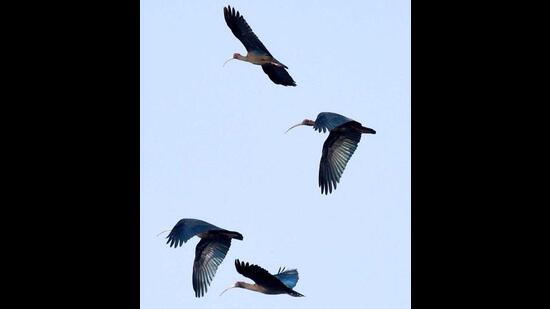
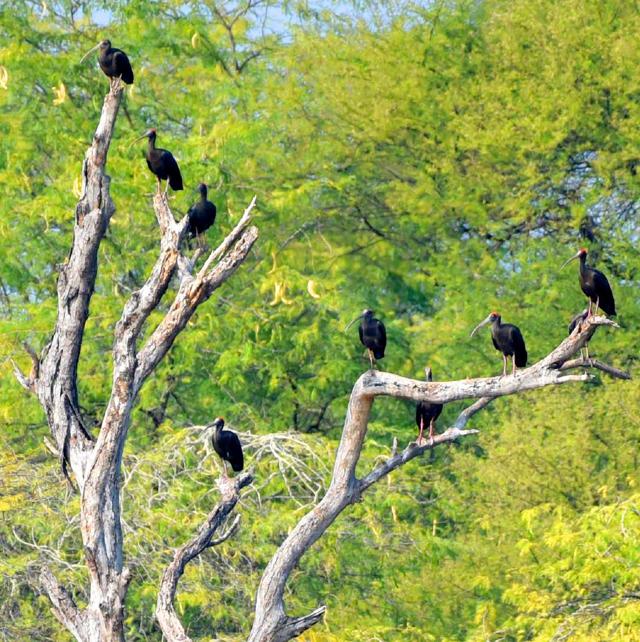
But the sounds originated from neither of the imagined; instead, these were aired by a flock of big, blackish birds that have quickly grown in strength at the Sukhna. The flock perches on a dry tree on the canal bank and flies in V-shaped formations emitting the strange battle cries. Forest guards report this bird’s spooky clamour, sometimes, during the night.
The flock was of Red-naped ibises (RNI), which were two in 2018 but multiplied at the hospitable Sukhna to 18. Encountered elsewhere in fallow and stubble fields, on margins of wetlands, in breeding colonies along canals, the ibis is a common-enough species but a fascinating one at that. Though the other two ibis species in India are allied with wetlands, the RNI is not overly dependent on water and can be found thriving far away from it, somewhat analogously to the equally-adaptative White-throated kingfisher.
The RNI is distinguished by long legs and a curved bill, crowned with a lump of red warts on a naked black head. They can be seen in cities, drilling wet lawns in sprawling parks for grubs. Noted environment lawyer from Delhi, Mahendra Vyas, was left astounded when he saw virtually each of the electricity poles at Delhi Airport occupied by an ibis due to rich pickings in flanking and verdant airport lawns, over-irrigated with treated sewage water.
Perhaps, ibises seem to “wail” because bird-watchers don’t seem too interested in the commoners! “RNI is one of the least studied of the ibises of the world, along with the forest ibises of Africa. It is a pity, we seem more interested in rare birds rather than those we see commonly. From our research, we can say that landscapes altered for human use have, to an extent, left a positive impact on the RNI. For example, in some southern states, ibises nest in electricity and mobile towers even though trees are available, probably because these vantage points are free of observation interferences such as branches and leaves. Also, because it is hotter in these states, ibises could have adapted to these towers for the weather comfort afforded by height,” international award-winning scientist KS Gopi Sundar, who is International Crane Foundation SarusScape programme manager and IUCN Stork, Ibis and Spoonbill Specialist Group co-chair, told this writer.
The ibis can gobble virtually anything, hence its ability to thrive. An omnivore, its diet includes insects, frogs, small vertebrates as well as grains. It has no qualms about rummaging rubbish dumps. At carrion dumps, ibis bills nimbly pick on larvae found on rotting meat. “The ibis feeds on carrion flesh only when it is still fresh and tender because its bill is not adapted to eating carrion,” added Sundar.
Last winter, I witnessed an ibis trampling over the reputation of the globe’s fastest creature and a predator par excellence, the migratory Tundra peregrine falcon. The ibis ducked, weaved and soared over the canal with the falcon in a hot but fruitless pursuit. The incident summoned to mind a nugget of natural history from the British era. The RNI was then known as the Warty-headed or Black ibis or King curlew and the British were fond of hunting. “It (ibis) makes for an excellent chase with a Bhyri (trained falcon), flying strongly and rapidly, and often escaping from its pursuer. The (ibis) flesh is very good, at times really excellent,” wrote TC Jerdon, a pioneering ornithologist, in ‘Birds of India’, Vol. III, c 1864.
While the ibis is still hunted in Pakistan, it has mercifully escaped poachers’ eye in contemporary India.
vjswild1@gmail.com


