The Capital on Sunday recorded its first “severe” air day of 2024, as a combination of low wind speed, frigid temperatures and the impact of biomass combustion across the city the previous day led to a spike in pollution levels.
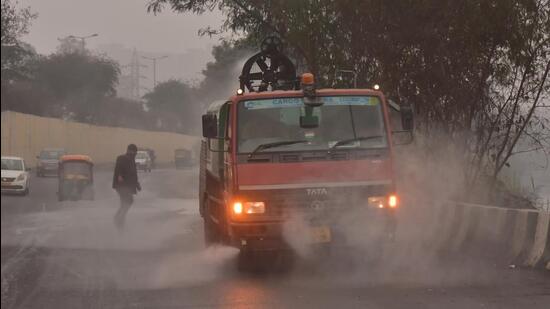
Delhi’s 24-hour average air quality index (AQI) was recorded at 447 (severe) at 4pm on Sunday. It was 399 (very poor) at the same time on Saturday. The last time Delhi’s AQI was above 400 was on December 24 (411).
The sudden deterioration in air quality prompted the Commission for Air Quality Management (CAQM) to hold an emergency meeting on Sunday morning and stage 3 measures under the Graded Response Action Plan (Grap) were invoked across Delhi-NCR with immediate effect.
Invoked for the third time this winter season, the eight measures include a ban on BS- III petrol and BS-IV diesel four-wheelers plying across Delhi, Gurugram, Faridabad, Ghaziabad, and Gautam Budh Nagar.
The measures also effectively ban private construction in Delhi-NCR.
In a statement, the CAQM sub-committee on Grap said AQI had touched as high as 458 at 10am on Sunday, but Stage 4 was not invoked as it was unlikely to stay above 450 for too long. “...AQI of Delhi has witnessed a spurt due to unfavourable climatic conditions, like very low wind speed, rise in the moisture levels, low mixing heights and local pollution sources including large scale open burning in the last about 24 hours. The sub-committee further deliberated that the spike in Delhi’s average AQI (> 450) may not last for long as per the forecast made by IMD and the Indian Institute of Tropical Meteorological shows it is likely to be between 401 and 450 for a few days. Therefore, the sub-committee has decided to invoke the eight-point stage-3 of Grap in NCR with immediate effect, to prevent further deterioration,” the statement said.
{{/usCountry}}In a statement, the CAQM sub-committee on Grap said AQI had touched as high as 458 at 10am on Sunday, but Stage 4 was not invoked as it was unlikely to stay above 450 for too long. “...AQI of Delhi has witnessed a spurt due to unfavourable climatic conditions, like very low wind speed, rise in the moisture levels, low mixing heights and local pollution sources including large scale open burning in the last about 24 hours. The sub-committee further deliberated that the spike in Delhi’s average AQI (> 450) may not last for long as per the forecast made by IMD and the Indian Institute of Tropical Meteorological shows it is likely to be between 401 and 450 for a few days. Therefore, the sub-committee has decided to invoke the eight-point stage-3 of Grap in NCR with immediate effect, to prevent further deterioration,” the statement said.
{{/usCountry}}Stage 3 measures were first enforced by CAQM on November 3, when AQI surpassed the 400 mark for the first time this winter (402). The restrictions were lifted 27 days later, on November 29, when the AQI fell below the 300-mark after rain.
The second spell of stage 3 measures came on December 22, when it turned “severe” after nearly a month. The measures were lifted on January 1.
Even though the curbs put a blanket ban on all construction and demolition activities across NCR, they specifically exempt all projects related to rail services, Metro, airport, ISBT, national security or defence, projects of national importance and healthcare facilities from being carried out. Linear projects such as highways, roads, flyovers, over bridges, power transmission and pipeline laying are allowed, in addition to sanitation projects, the order said.
In the case of private constructions, non-polluting and non-dust generating activities such as plumbing work, interior decoration, electrical work and carpentry-related work are permitted, CAQM’s order said.
A transport department official said the department will strictly implement CAQM’s order. “We will deploy over 100 teams — same as last time, to ensure the implementation of the restrictions under Grap Stage 3.” Those found violating the order can be fined ₹20,000 each,” said the official.
Dipankar Saha, former head of CPCB’s air laboratory said these conditions are common at this time of the year due to low temperatures, which makes the atmosphere stable. “This prevents the dispersal of pollutants and winds also become calm. Add to that the biomass burning and one can see a spike in pollution,” said Saha.
Stay updated with all top Cities including, Bengaluru, Delhi, Mumbai and more across India. Stay informed on the latest happenings in World News along with Delhi Election 2025 and Delhi Election Result 2025 Live, New Delhi Election Result Live, Kalkaji Election Result Live at Hindustan Times.
Stay updated with all top Cities including, Bengaluru, Delhi, Mumbai and more across India. Stay informed on the latest happenings in World News along with Delhi Election 2025 and Delhi Election Result 2025 Live, New Delhi Election Result Live, Kalkaji Election Result Live at Hindustan Times.