Air quality in the Capital deteriorated on Thursday, with the city’s average Air Quality Index (AQI) rising 48 points to 280 from 232 a day earlier, as unfavourable meteorological conditions slowed the dispersal of pollutants.
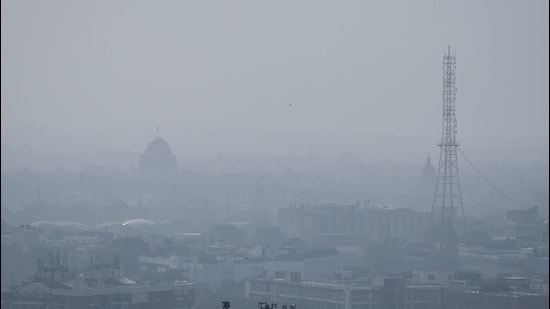
The AQI remained in the “poor” category on Thursday, with forecasts indicating further deterioration from Friday. According to the Central Pollution Control Board, 16 monitoring stations recorded “very poor” air when the day’s official reading was taken at 4pm on Thursday, while three were in the “moderate” category. The remaining stations largely reported “poor” air quality.
Meanwhile, the Capital also recorded its lowest minimum temperature of the season so far on Thursday, with the mercury at Safdarjung dropping to 10.6 degrees Celsius, 1.7 degrees below normal. The minimum was 0.4 degrees lower than Wednesday’s 11 degrees Celsius, according to the India Meteorological Department.
An analysis of weather-balloon readings from Safdarjung by HT showed weather conditions on Thursday were less favourable for pollution dispersal than on Wednesday. By 4:30pm, solar heating had mixed pollutants vertically up to around 1,250 metres, close to the typical height of 1,300 metres for late November. However, winds through this layer averaged around 9 kmph, significantly below the usual 15 kmph, limiting horizontal dispersal.
Real-time source apportionment data attributed 33.3% of Delhi’s pollution to biomass burning, followed by waste burning at 19.7% and vehicular emissions at 18%. The air quality is expected to deteriorate further, with the AQI likely to enter the “very poor” category from Friday.
{{/usCountry}}Real-time source apportionment data attributed 33.3% of Delhi’s pollution to biomass burning, followed by waste burning at 19.7% and vehicular emissions at 18%. The air quality is expected to deteriorate further, with the AQI likely to enter the “very poor” category from Friday.
{{/usCountry}}CAQM constitutes expert group to review DG set emissions
The Commission for Air Quality Management (CAQM) has constituted an eight-member expert group to undertake a comprehensive technical review of existing regulations governing emissions from diesel generator sets in the NCR.
The review will assess the adequacy of existing emission standards, implementation of prescribed measures, and effectiveness of emission-control technologies across different categories and capacities of DG sets. The group will examine the efficacy of retrofitted emission control devices and dual-fuel kit systems, besides identifying additional measures required to curb emissions from DG sets used in industrial, commercial, residential, and office establishments.
DG sets are among the contributors to particulate matter and gaseous pollutants in NCR, particularly during periods of high pollution when their use may increase due to power demand or restrictions. The expert group has been constituted to strengthen emission-control measures under CAQM’s Direction No 76, issued on September 29, 2023, and subsequently amended in February and December 2024.
The group will be chaired by Dr Trilok Singh Panwar, member-technical, CAQM. Professor Amit Pal of the department of mechanical engineering, Delhi Technological University, has been appointed as a member. The technical review is expected to examine whether existing regulations and emission-control technologies are adequate and recommend further measures, if required.
Stay updated with all top Cities including, Bengaluru, Delhi, Mumbai and more across India. Stay informed on the latest happenings in World News along with Delhi Election 2025 and Delhi Election Result 2025 Live, New Delhi Election Result Live, Kalkaji Election Result Live at Hindustan Times.
Stay updated with all top Cities including, Bengaluru, Delhi, Mumbai and more across India. Stay informed on the latest happenings in World News along with Delhi Election 2025 and Delhi Election Result 2025 Live, New Delhi Election Result Live, Kalkaji Election Result Live at Hindustan Times.