
 E-Paper



Delhi AQI stays ‘severe’ for third day; early warning system gets forecast wrong again
Punjab and Haryana have been directed by the Supreme Court to submit detailed reports within a week on the steps taken to curb stubble burning

 Prefer HTon Google


Delhi recorded a third consecutive day of ‘severe’ air on Thursday, with AQI readings consistently breaching the 400 mark. Yet the Centre’s Early Warning System (EWS) — the model that triggers Grap measures — forecast only ‘very poor’ air for Tuesday, Wednesday and Thursday, underscoring a widening gap between projections and actual pollution levels.
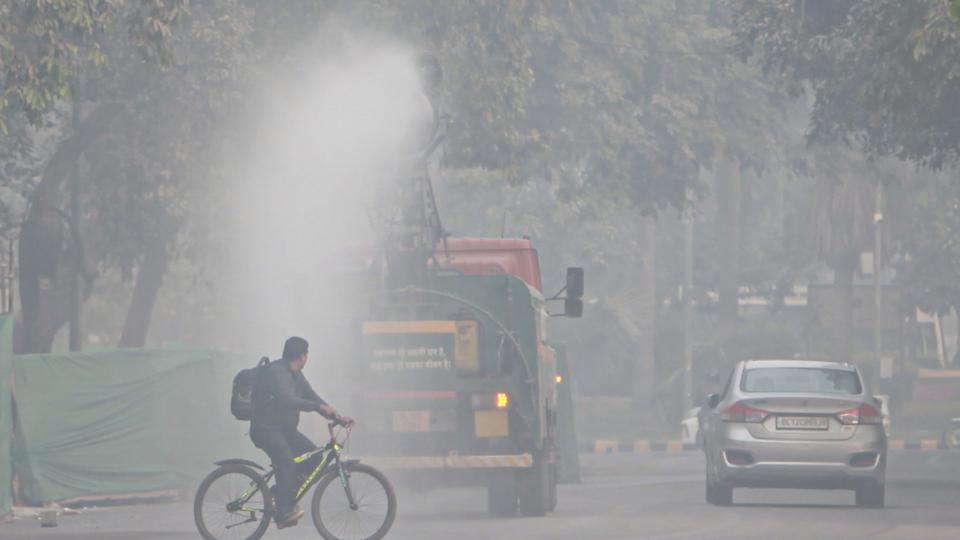
On Monday, EWS predicted ‘very poor’ AQI for Tuesday, yet Delhi slipped into ‘severe’.
On Tuesday, it projected ‘very poor’ air and an improvement on Wednesday; the AQI dropped marginally but stayed ‘severe’.
Wednesday’s bulletin again expected ‘very poor’ air for Thursday, but the AQI remained above 400.
As per CPCB, an AQI above 400 is “severe”, 301-400 “very poor”, 201-300 “poor”, 101-200 “moderate”, and 51-100 “satisfactory”.
The inaccuracy of forecasts has put the spotlight on the EWS, operated by the Indian Institute of Tropical Meteorology (IITM), Pune, under the ministry of earth sciences. IITM also manages the Decision Support System (DSS), which estimates pollution source contributions. IITM officials did not comment on the reasons behind the repeated misses.
Experts said multiple factors may explain the gap, including assumptions within the model that on-ground enforcement under Grap would reduce pollution. “The model assumes certain actions will kick in under Grap, leading to some improvement on that front. So this shows that some sources have not been cut down effectively as they should have. We have also seen that DSS and EWS are reliant on an older emissions inventory, meaning despite dynamic weather forecasts, the overall end product is inaccurate,” said Sunil Dahiya, founder and lead analyst at the environmental think-tank Envirocatalysts.
CPCB data showed only three cities in India recorded ‘severe’ pollution on Thursday -- Bahadurgarh (466), Rohtak (430) and Delhi (404).
Meteorological conditions have remained unfavourable since Tuesday, compounding the situation. Winds have been consistently slow, and low temperatures have triggered inversion, which is a layer of warm air lying above cooler air near the surface, trapping pollutants and preventing their dispersion.
“Winds were expected to increase marginally on Thursday, but that did not happen. They stayed between 5–7 km/hour through the day and became calm again at night,” said Mahesh Palawat, vice president at Skymet. No significant change in wind speed or temperature is expected over the next few days, he added.
The EWS bulletin on Thursday said Delhi’s AQI is expected to remain ‘very poor’ from Friday to Sunday. “The outlook for the subsequent six days from Sunday says the air quality is likely to be between ‘very poor’ and ‘severe’ categories,” it stated.
DSS data estimated that stubble-burning contributed 12% to Delhi’s PM2.5 on Thursday — lower than the season-high 22.4% on Wednesday. The contribution was 15.45% on Tuesday and 13.68% on Monday.
Farm fires’ impact
Punjab has recorded a sharp surge in farm fires this month, with 55% of all 4,662 stubble-burning cases reported in November alone, even as the Supreme Court pulled up the state government for failing to curb the practice. According to the Punjab Pollution Control Board (PPCB), 2,578 incidents were registered between November 1 and 12, despite 82% of the state’s 31.72 lakh hectares under paddy already harvested by October 31.
A senior PPCB official said the spike came as a surprise, noting that more than half the season’s farm fires occurred in the past 12 days, largely due to prolonged harvesting. “We expected harvesting to conclude by the first week of November as the season began 15 days early, but unfavourable weather delayed operations, leaving farmers with a shorter window to prepare fields for wheat,” the official said.
Until October 31, Punjab had recorded 2,084 farm fires from September 16 onward. The late-season surge has pushed the count up significantly, even though overall stubble burning cases this year are down 57% from last year’s 10,909 incidents, and 93% lower than the 71,000 cases recorded in 2020.
Punjab and Haryana have been directed by the Supreme Court to submit detailed reports within a week on the steps taken to curb stubble burning, with Punjab set to brief the court on its enforcement measures and the reasons behind the November spike.
Winds still sluggish
Palawat noted that while winds were northwesterly early in the morning, they shifted to westerly during the day, likely reducing the transport of stubble smoke. However, satellite imagery continued to show a thick plume of smoke stretching across the Indo-Gangetic Plain.
Within Delhi, 28 of the city’s 39 active air quality monitoring stations recorded ‘severe’ levels on Thursday. The most polluted locations included Wazirpur (458), Chandni Chowk (453) and Bawana (452).
On Tuesday, CAQM invoked Grap Stage 3 across NCR. Under these curbs, private or non-essential construction is banned; restrictions on BS-3 petrol and BS-4 diesel four-wheelers came into force in Delhi, Gurugram, Faridabad, Ghaziabad and Gautam Budh Nagar; and primary school classes up to Class 5 were directed to shift to hybrid mode until further orders, as per the Department of Education.
Meanwhile, the minimum temperature on Thursday was 10.6°C, three notches below normal, marginally higher than 10.4°C on Wednesday. The maximum was 26.3°C, two notches below normal. The minimum is expected to range between 9–11°C on Friday, with a maximum of 24–26°C.
(With inputs from Navrajdeep Singh in Jalandhar)


Stay updated with all top Cities including, Bengaluru, Delhi, Mumbai and more across India. Stay informed on the latest happenings in World News along with Delhi Election 2025 and Delhi Election Result 2025 Live, New Delhi Election Result Live, Kalkaji Election Result Live at Hindustan Times.


