New Delhi
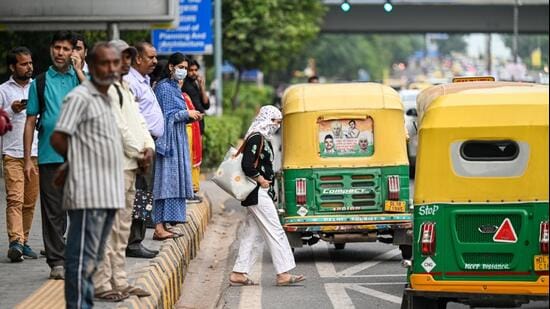
Public transportation in the Capital continued to be disrupted for a third consecutive day on Thursday, as a series of meetings among the transport department, private concessionaires and the protesting drivers failed to resolve the ongoing deadlock over wages and working conditions of contractual drivers employed by the concessionaires.
The additional pressure on the Metro prompted the Delhi Metro Rail Corporation (DMRC) to continue to operate eight additional trains with increased frequency—continuing arrangements made a day earlier—while keeping another eight trains on standby for services between 8am and 8pm, depending on passenger footfall.
Delhi transport minister Pankaj Singh said, “We held a series of meetings with all parties concerned. The agitating drivers are employed by the concessionaire and not Delhi Transport Corporation (DTC). We have spoken to them to ensure that drivers’ grievances are heard and resolved. We have also assured the drivers that all their legitimate demands will be met.”
The minister said that around 4,000 drivers on the DTC’s rolls have been asked to resume work on Friday to ease the disruption. Several contractual drivers are also expected to return to work, he added.
The DTC Employees Ekta Union, which represents both contractual drivers employed by concessionaires and those on the corporation’s rolls, has been demanding that the pay for contractual drivers be increased from around ₹862 per day at present to ₹2,000 per day. Other demands include payment for government holidays, annual bonus and social-security benefits, including medical cover. The union has also alleged that dearness allowance has not been revised for around 18 months and basic increments have not been provided since 2024.
{{/usCountry}}The DTC Employees Ekta Union, which represents both contractual drivers employed by concessionaires and those on the corporation’s rolls, has been demanding that the pay for contractual drivers be increased from around ₹862 per day at present to ₹2,000 per day. Other demands include payment for government holidays, annual bonus and social-security benefits, including medical cover. The union has also alleged that dearness allowance has not been revised for around 18 months and basic increments have not been provided since 2024.
{{/usCountry}}Union president Lalit Choudhary said on Thursday, “Meetings were held, but we have not been given any serious assurance or promise that our demands will be met. The concessionaire has not even agreed to increasing wages that are very low for us to even manage a small family in Delhi. If our demands are not met, the strike will continue.”
Public affected
The continued disruption pushed commuters towards the Metro, while many sought to fend off higher rates quoted by autorickshaws, e-rickshaws and app-based cabs. The Delhi Traffic Police also issued an advisory on Thursday warning of potential disruptions across the city because of the ongoing drivers’ strike and asked commuters to allow additional travel time.
A spot check by HT found commuters stranded or waiting for buses for hours at Vishwavidyalaya, Sarai Kale Khan, Green Park, ISBT, Indraprastha and AIIMS.
For 28-year-old Ravi Pandey, who earns a living by reading electricity meters, the absence of buses has meant long walks. Pandey said he covers around 100 houses and commercial establishments every day, and cannot afford to depend on autos for his entire commute.
“With a monthly salary of ₹18,000, I cannot afford to travel so much by Metro or auto. An e-rickshaw from Nagia Park to Vishwavidyalaya was charging me ₹50, so I preferred walking,” said Pandey, a resident of Shastri Park.
A 15-year-old student of Sardar Patel Vidyalaya, requesting anonymity, said, “Today, one DTC bus came, and the school had arranged private buses for all of us. But since all students thought that they have to arrange transportation for themselves, many took the Metro. There was a lot of chaos at the Metro station.”
Airport connectivity was also affected, due to which airport authorities advised passengers to plan their journeys in advance as bus connectivity to and from the airport could be impacted. Inter-terminal transfers were being managed through alternative arrangements.
Krishna Pal, 48, who works in ground handling at Delhi airport, said he preferred waiting for a bus because of the difference in fares. “The bus to Mahipalpur from ISBT costs ₹15, whereas the Metro through Express Metro line costs around ₹60. So, I decided to wait for the bus even if it gets slightly delayed,” Pal said.
At Indraprastha, Sanjay Mathur, 32, who runs a tea stall in Noida, waited nearly an hour before calling a friend to pick him. “I had come to visit a friend in Sarai Kale Khan; he told me about the strike but he said some buses are running. After waiting for an hour, I had to ask him to pick me up. I don’t have a smartphone; otherwise, I would have booked a bike taxi,” he said.
Neetu Devi, 35, a domestic worker who travels from Haiderpur in north Delhi to Vikaspuri in west Delhi, said she could not work on Thursday. “Somehow, I was able to find a bus plying on my route on Wednesday, but it was jam-packed. On Thursday, I couldn’t find a bus and told my employer I won’t be able to travel to work. Cabs are too expensive,” she said.
Stay updated with all top Cities including, Bengaluru, Delhi, Mumbai and more across India. Stay informed on the latest happenings in World News along with Delhi Election 2025 and Delhi Election Result 2025 Live, New Delhi Election Result Live, Kalkaji Election Result Live at Hindustan Times.
Stay updated with all top Cities including, Bengaluru, Delhi, Mumbai and more across India. Stay informed on the latest happenings in World News along with Delhi Election 2025 and Delhi Election Result 2025 Live, New Delhi Election Result Live, Kalkaji Election Result Live at Hindustan Times.