In a fresh mapping of pollution sources at Delhi’s 13 hot spots, the state environment department identified 57 sources of pollution—Mundka and Anand Vihar accounting for the most, at seven each—according to data shared by the department with the Commission for Air Quality Management (CAQM). In contrast, 67 sources of pollution were identified at these hot spots last year.
A senior environment department official said the fresh mapping exercise factored in previously identified sources, following checks on whether they were fixed. Dust and vehicular emissions remain the key sources of pollution, with new construction sites, such as the RRTS station in Anand Vihar and UER-2 road in Mundka, accounting for most of the newer sources, besides industrial operations.
These newer sources have been earmarked for focussed action, the official said. “The new list of sources has been shared with all agencies, including the nodal officer for each hot spot,” the official, not wishing to be named, said.
The move comes after a review meeting held by CAQM on November 8 to assess action taken to control pollution, especially at the hot spots. The Delhi Pollution Control Committee (DPCC) and the Central Pollution Control Board (CPCB) identified these hot spots in 2018 based on the annual PM 2.5 (particulate matter with a diameter of 2.5 microns or less) concentration of these locations clocking higher readings than Delhi’s mean.
The hot spots are Anand Vihar, Mundka, Wazirpur, Jahangirpuri, RK Puram, Rohini, Punjabi Bagh, Okhla, Bawana, Vivek Vihar, Narela, Ashok Vihar and Dwarka.
{{/usCountry}}The hot spots are Anand Vihar, Mundka, Wazirpur, Jahangirpuri, RK Puram, Rohini, Punjabi Bagh, Okhla, Bawana, Vivek Vihar, Narela, Ashok Vihar and Dwarka.
{{/usCountry}}Of these 13 hot spots, Anand Vihar has recorded the worst air quality index (AQI), at 394—just seven points short of “severe” air—since the implementation of Graded Response Action Plan’s (Grap’s) Stage-2 onOctober 22, according to the information shared with CAQM. After Anand Vihar, Jahangirpuri recorded an average AQI of 373, followed by Bawana and Wazirpur, each clocking an AQI of 373.
The best performers in this period are Narela and Okhla, both recording an average AQI of 334, the environment department said.
What’s ailing the hot spots
The main sources of pollution at Anand Vihar comprised road dust from buses commuting to and from the interstate bus terminal (ISBT), a damaged road section outside the ISBT, congestion on Chaudhary Charan Singh Marg and an NCRTC (National Capital Region Transport Corporation) RRTS station construction site.
At Mundka, the major sources were the construction site of Urban Extension Road-2 (UER-2), the Mundka industrial area, a DMRC casting yard and the Delhi-Rohtak highway.
In an analysis by HT of average PM 2.5 concentrations between October 1 and November 10 period from 2019 to 2024, a majority of the 13 pollution hot spots showed an improvement, but it has generally been below the citywide average of 11.1%. The improvement was greater than the city average only at Mundka (12%), Dwarka (12.4%) and Narela (13%). While data was missing for Ashok Vihar, Jahangirpuri and RK Puram showed a deterioration during this period. There was an increase of 29.1% at RK Puram and 0.7% at Jahangirpuri.
Anumita Roychowdhury, executive director, research and advocacy at the Centre for Science and Environment (CSE), said that although there has been an improvement, which is mostly down to sustained action, more needs to be done. “Even when there has been improvement, the pollution levels at these hot spots are still higher than the concentration of the city’s average. If we control pollution at these locations, the overall average also tends to improve,” she said, pointing to a detailed analysis at both RK Puram and Jahangirpuri.
“If there is an increase in concentration during this period, one may have to look at more minute sources of pollution there,” she added.
Remedial measures
The environment department official cited above said the sources of pollution have been mapped within a five-kilometre radius of continuous ambient air quality monitoring stations in each area, adding that 10% of Delhi’s total water sprinkler and mechanised road sweeper machines have been deployed at these hot spots.
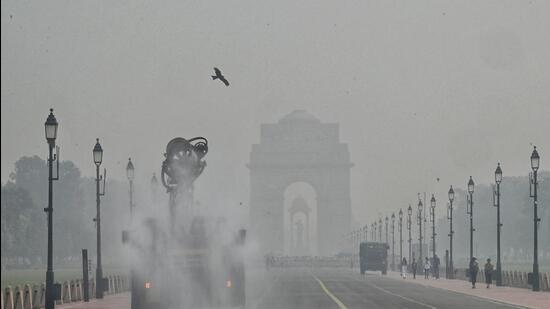
“This includes 22 of Delhi’s 227 water sprinklers and eight of 85 mechanised road sweeping machines in Delhi. A total of 60 anti-mobile smog gunsmobile anti-smog guns have also been deployed at hot spots to control dust,” the official said.
Further, the official said they also identified 105 spots that are vulnerable to garbage dumping, on the basis of dumping previously done there. “For improved traffic management, 84 enforcement teams of the traffic police are also on the ground,” the official said.
Since identifying the hot spots, the Delhi government said there has been an improvement of over 20% at most pollution hot spots in the Capital. Experts, however, said that despite focused action and claims of improvement, these locations continue to figure among the city’s most polluted when winter comes around.
“Even now, when Delhi’s AQI is ‘very poor’, a number of these hot spots stay in severe. This shows we have not been able to control the high background emissions there,” said Sunil Dahiya, founder and lead analyst at think-tank Envirocatalysts.
Stay updated with all top Cities including, Bengaluru, Delhi, Mumbai and more across India. Stay informed on the latest happenings in World News along with Delhi Election 2025 and Delhi Election Result 2025 Live, New Delhi Election Result Live, Kalkaji Election Result Live at Hindustan Times.
Stay updated with all top Cities including, Bengaluru, Delhi, Mumbai and more across India. Stay informed on the latest happenings in World News along with Delhi Election 2025 and Delhi Election Result 2025 Live, New Delhi Election Result Live, Kalkaji Election Result Live at Hindustan Times.