
 E-Paper



Delhi sees patchy rain, but no relief from stifling humidity
Delhi, according to IMD data, has already logged 323mm of rainfall till August 26, making it the wettest month of 2025.


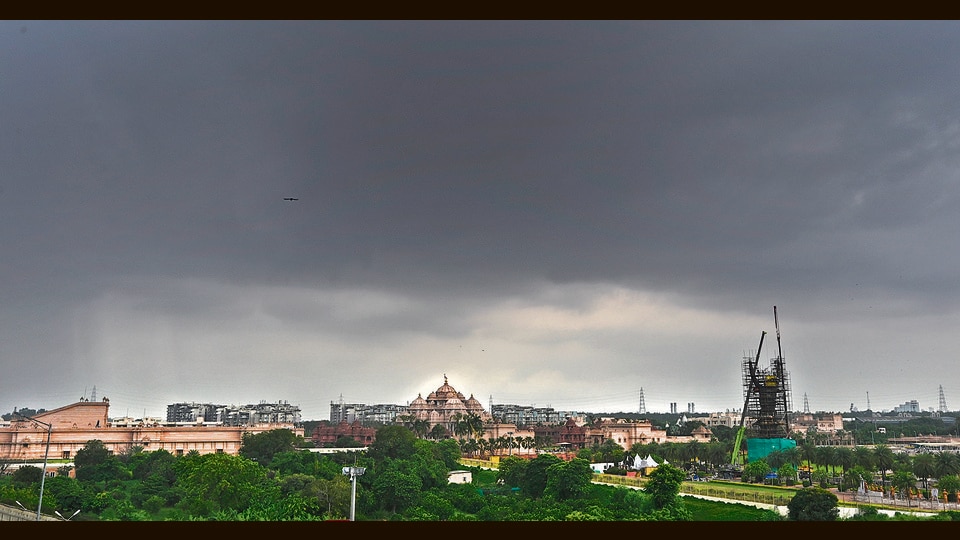
Several parts of the Capital reported sudden showers again on Tuesday, with overcast skies dominating the skyline and extending the spell of wet days that has defined August so far. The India Meteorological Department (IMD) has forecast that the rest of the month will likely remain damp, with light, patchy rain expected till August ends.
Delhi, according to IMD data, has already logged 323mm of rainfall till August 26, making it the wettest month of 2025. To be sure, August is typically the city’s rainiest month, with a long-period average of 233.1 mm, but this year it has already tipped into the “excess” category.
By comparison, July had recorded 259.3 mm, which was the season’s highest until now.
On Tuesday, rainfall was scattered but widespread.
Between 8.30am and 5.30pm, Safdarjung, Delhi’s base observatory, recorded 1.6mm of rain. Palam logged 8mm, Lodhi Road 1.1mm, Ridge 10.4mm, Ayanagar 5.1mm, Najafgarh 12.5 mm and Mayur Vihar 1 mm.
Yet, the relief was deceptive. When the rain paused, city residents grappled with muggy conditions.
Safdarjung recorded a maximum of 31.6°C – three notches below normal – while the minimum settled at 23.9°C, also three degrees below normal. Despite the relatively moderate temperatures, the day felt stifling because of high humidity, which pushed the “feels-like” temperature close to 42.3°C in the afternoon, weather scientists said. High humidity hampers sweat evaporation, the body’s natural cooling mechanism, which means even lower temperatures can feel oppressive.
IMD has forecast the maximum temperature for Wednesday to hover between 32–34°C and the minimum between 23–25°C. “The monsoon trough is south of Delhi. While heavy rain is unlikely, patchy showers with isolated intense spells will continue,” said an IMD official.
The department said a cyclonic circulation was persisting over south Haryana and adjoining northeast Rajasthan, extending up to 5.8 km above mean sea level and tilting southwards with height. In its daily weather bulletin, IMD noted that the monsoon trough continued to stretch across north India into the Bay of Bengal, intersecting multiple embedded cyclonic circulations – conditions that favour persistent wet weather in Delhi-NCR.
A season of excess
Delhi’s rainfall surplus has been building since early summer. May this year was the wettest on record, with 186.4mm – six times the normal 30.7mm. June brought 107.1mm, an excess of 45% over the monthly average of 74.1mm. In July, Delhi received 259.3mm, which was 24% above the norm of 209.7mm.
Now, with 323 mm in August, the city’s annual rainfall total has already crossed 886.3 mm, inching toward the 900 mm mark. Normally, Delhi receives 774.4 mm in an entire year, a figure it breached this year as early as August 14. That made 2025 the fastest since 2021 that the city surpassed its annual quota.
The pattern has been consistent over recent years. In 2024, Delhi crossed its annual rainfall on August 30; in 2023, it happened on August 20; in 2022, on October 10; and in 2021, as early as August 1.
Experts attribute the excess largely to the monsoon trough’s persistent position near Delhi-NCR, aided by frequent weather systems. “The trough has largely remained close to Delhi, feeding constant moisture. We have also seen a number of active western disturbances and low-pressure systems,” said Mahesh Palawat, vice president at private forecaster Skymet Weather.
The downpours have also delivered a rare environmental reprieve. Delhi’s air quality index (AQI) improved to 55 on Tuesday, compared to 62 a day earlier, edging close to the “satisfactory” category. The Central Pollution Control Board (CPCB) classifies AQI values between 0–50 as “good”, 51–100 as “satisfactory”, 101–200 as “moderate”, 201–300 as “poor”, 301–400 as “very poor”, and above 400 as “severe.”
The city’s best air day of 2025 so far came on July 15, when AQI touched 51, just shy of the “good” threshold.
For now, the monsoon’s capricious mix of rain, humidity and haze continues to rule the city’s weather, making August not only Delhi’s wettest month but also one of its most uncomfortable.


Stay updated with all top Cities including, Bengaluru, Delhi, Mumbai and more across India. Stay informed on the latest happenings in World News along with Delhi Election 2025 and Delhi Election Result 2025 Live, New Delhi Election Result Live, Kalkaji Election Result Live at Hindustan Times.


