Delhi’s minimum temperature rose across all five weather stations on Thursday, with Safdarjung recording a 1.7-degree Celsius jump in 24 hours to settle at 19.7 degrees Celsius, while Lodhi Road recorded the highest departure from normal at two degrees above average, according to India Meteorological Department data.
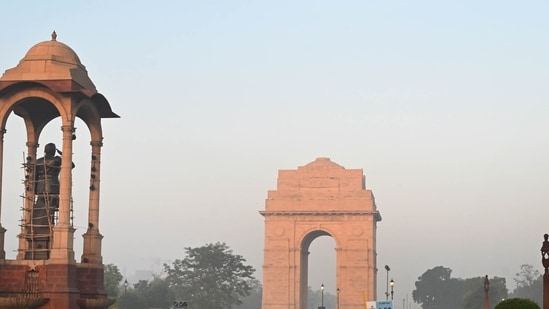
The capital's air quality remained in the poor category in the morning, with the Air Quality Index being recorded at 226.
Temperature rises
The minimum temperature at Safdarjung, Delhi’s base weather station, stood at 19.7 degrees Celsius, 1.3 degrees above normal, while Palam recorded a minimum of 18.7 degrees Celsius, 0.2 degrees below normal. The minimum temperature at Palam rose by 0.9 degrees Celsius compared with the previous day.
Lodhi Road recorded a minimum temperature of 19 degrees Celsius, two degrees above normal, following a 1.3-degree-Celsius rise in 24 hours. The Ridge recorded a minimum of 19.4 degrees Celsius, 0.1 degrees below normal, while Ayanagar logged 19.3 degrees Celsius, 0.5 degrees above normal.
The minimum temperature rose across all five weather stations compared with the previous day, with the increase ranging from 0.3 degrees Celsius at the Ridge to 1.7 degrees Celsius at Safdarjung.
Meanwhile, the maximum temperature recorded at Safdarjung on Wednesday was 32.1 degrees Celsius, 0.5 degrees below normal. Palam recorded a maximum of 29.5 degrees Celsius, 3.3 degrees below normal, while Lodhi Road and Ayanagar logged 31.8 degrees Celsius each.
{{/usCountry}}Meanwhile, the maximum temperature recorded at Safdarjung on Wednesday was 32.1 degrees Celsius, 0.5 degrees below normal. Palam recorded a maximum of 29.5 degrees Celsius, 3.3 degrees below normal, while Lodhi Road and Ayanagar logged 31.8 degrees Celsius each.
{{/usCountry}}No rainfall was recorded at any of the five stations in the 24 hours ending at 8.30am on Thursday, according to the IMD.
Delhi's AQI
According to data from 56 of 59 monitoring stations, Chandni Chowk, Vivek Vihar, and Jahangirpuri recorded air quality in the very poor zone, with readings of 307, 306, and 309, respectively.
Nineteen stations recorded air quality in the moderate zone while the remaining were in the poor category at 7.05 am on Thursday.
Delhi woke up to its foulest air in more than three months on Wednesday, as smoke from Dussehra celebrations, trapped by still, damp night air, pushed the AQ into the poor category and prompted the Commission for Air Quality Management (CAQM) to invoke Stage I of the Graded Response Action Plan (GRAP) across Delhi-NCR.
The AQI climbed from 179 on Tuesday to 245 at 4pm on Wednesday, the highest reading of the season and the worst since July 13, when it stood at 246. The 66-point jump was the third-largest the day after Dussehra in the past decade, and Wednesday’s reading was the worst for the day after the festival since 2021, when the index stood at 284.
Farm fires set to add to the burden
The Decision Support System for Air Quality Management in Delhi forecasts stubble burning's share of the city's pollution to rise from 3.9% on Wednesday to 7.4% on Thursday and 15.9% on Friday, and the India Meteorological Department and the Indian Institute of Tropical Meteorology expect the air to stay poor over the coming days.
Stay updated with all top Cities including, Bengaluru, Delhi, Mumbai and more across India. Stay informed on the latest happenings in World News along with Delhi Election 2025 and Delhi Election Result 2025 Live, New Delhi Election Result Live, Kalkaji Election Result Live at Hindustan Times.
Stay updated with all top Cities including, Bengaluru, Delhi, Mumbai and more across India. Stay informed on the latest happenings in World News along with Delhi Election 2025 and Delhi Election Result 2025 Live, New Delhi Election Result Live, Kalkaji Election Result Live at Hindustan Times.