Air quality in Delhi deteriorated marginally on Tuesday but remained in the “poor” category, with the hourly average air quality index (AQI) at 7am recording 277.
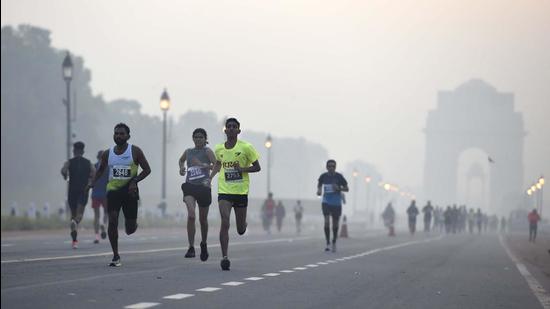
Central Pollution Control Board (CPCB) data showed that on Monday the overall AQI of Delhi was 207, also in the “poor” zone. India Meteorological Department (IMD) scientists, however, said that there is a forecast of strong, cool winds to blow from the eastern side of Delhi on Tuesday, which will help improve the air quality of the city late Tuesday.
Also Read | Worried about climate change? There’s a book for that
This will also help bring down the rising mercury levels in the Capital. On Monday, the maximum temperature was 34 degrees Celsius and the minimum temperature was 18.9 degrees Celsius.
Meanwhile, the average levels of various pollutants, including PM10, PM2.5 and nitrogen dioxide, in Delhi last year were the lowest since 2014, according to the Delhi Economic Survey report. Government data also showed that average levels of the major pollutants in the city have been decreasing steadily over the years.
The annual average concentrations of PM2.5, fine particulate matter that is about three per cent the diameter of a human hair and can lead to premature deaths from heart and lung diseases, decreased from 149 microgram per cubic meter (µg/m3) in 2014 to 101 µg/m3 in 2020, it said.
The annual average of PM10 also decreased from 324 µg/m3 in 2014 to 187 µg/m3 in 2020, according to the Economic Survey report, tabled by Deputy Chief Minister Manish Sisodia in the Delhi Assembly on Monday.
{{/usCountry}}The annual average of PM10 also decreased from 324 µg/m3 in 2014 to 187 µg/m3 in 2020, according to the Economic Survey report, tabled by Deputy Chief Minister Manish Sisodia in the Delhi Assembly on Monday.
{{/usCountry}}PM 2.5 levels below 40 µg/m3 and PM10 levels below 60 µg/m3 are considered safe in India.
The annual average for PM2.5 and PM10, at all the monitoring locations, exceeded the prescribed standards, the report said.
Nitrogen Dioxide’s annual average concentration has decreased from 82.45 µg/m3 in 2014 to 40.30 µg/m3 in 2020. The yearly average of carbon monoxide concentration has dipped to 1.27 mg/m3 in 2020. It was 2.07 mg/m3 in 2017, the highest in the last seven years. The safe limit for CO levels is 2 mg/m3. However, no significant variation was observed in the annual average value for Sulphur dioxide, which emanates during the burning of fossils fuels, between 2014 and 2020. The annual city average for SO2 at all the monitoring locations is within the prescribed standard i.e 50µg/m3, it said.
Various studies conducted in the wake of COVID-19-induced lockdowns have shown that air pollution levels have fallen significantly across the world due to the reduced traffic and restricted industrial activity.
(With agency inputs)
Stay updated with all top Cities including, Bengaluru, Delhi, Mumbai and more across India. Stay informed on the latest happenings in World News along with Delhi Election 2025 and Delhi Election Result 2025 Live, New Delhi Election Result Live, Kalkaji Election Result Live at Hindustan Times.
Stay updated with all top Cities including, Bengaluru, Delhi, Mumbai and more across India. Stay informed on the latest happenings in World News along with Delhi Election 2025 and Delhi Election Result 2025 Live, New Delhi Election Result Live, Kalkaji Election Result Live at Hindustan Times.