
 E-Paper



Delhi’s corrosive reality: Acid sales continue unchecked, unregulated
Over several days, a team visited eight neighbourhoods -- including affluent markets and crowded residential zones -- and was able to purchase acid

 Prefer HTon Google


Ten years since the Delhi government introduced the Delhi Poisons Possession and Sales Rules, 2015 to regulate the possession and sale of acid, these highly corrosive substances remain shockingly easy to procure across the national capital. A citywide check by HT showed that acid continues to be sold over the counter—without ID checks, without disclosure of purpose, and often without even a label, in clear violation of both state law and a 2013 Supreme Court order.
In 2013, prompted by a spate of gruesome acid attacks, the Supreme Court had imposed a nationwide restriction on the sale of acids like nitric, phosphoric, sulphuric, and hydrochloric. The ruling placed a string of regulations on sellers – vendors are required to seek licenses, maintain registers of buyers, ask for identification, and demand disclosure of intent. The Delhi government followed suit in 2015 by listing 40 corrosive substances under a special law, tightening the grip on acid sales within city limits.
In 2013, the Supreme Court, in Laxmi vs Union of India, laid down strict guidelines to regulate acid sales after a spate of attacks. It prohibited over-the-counter sales unless sellers maintained a register with buyers’ names, addresses, ID proof, and the stated purpose of purchase. Acid cannot be sold to anyone under 18, and all stock must be declared to the local sub-divisional magistrate within 15 days. Any undeclared stock or violation can invite confiscation of stock and fines of up to ₹50,000. The Union home ministry also issued advisories directing states and UTs to enforce these rules.
But a reality check by HT across the city found that all these safeguards were meaningless.
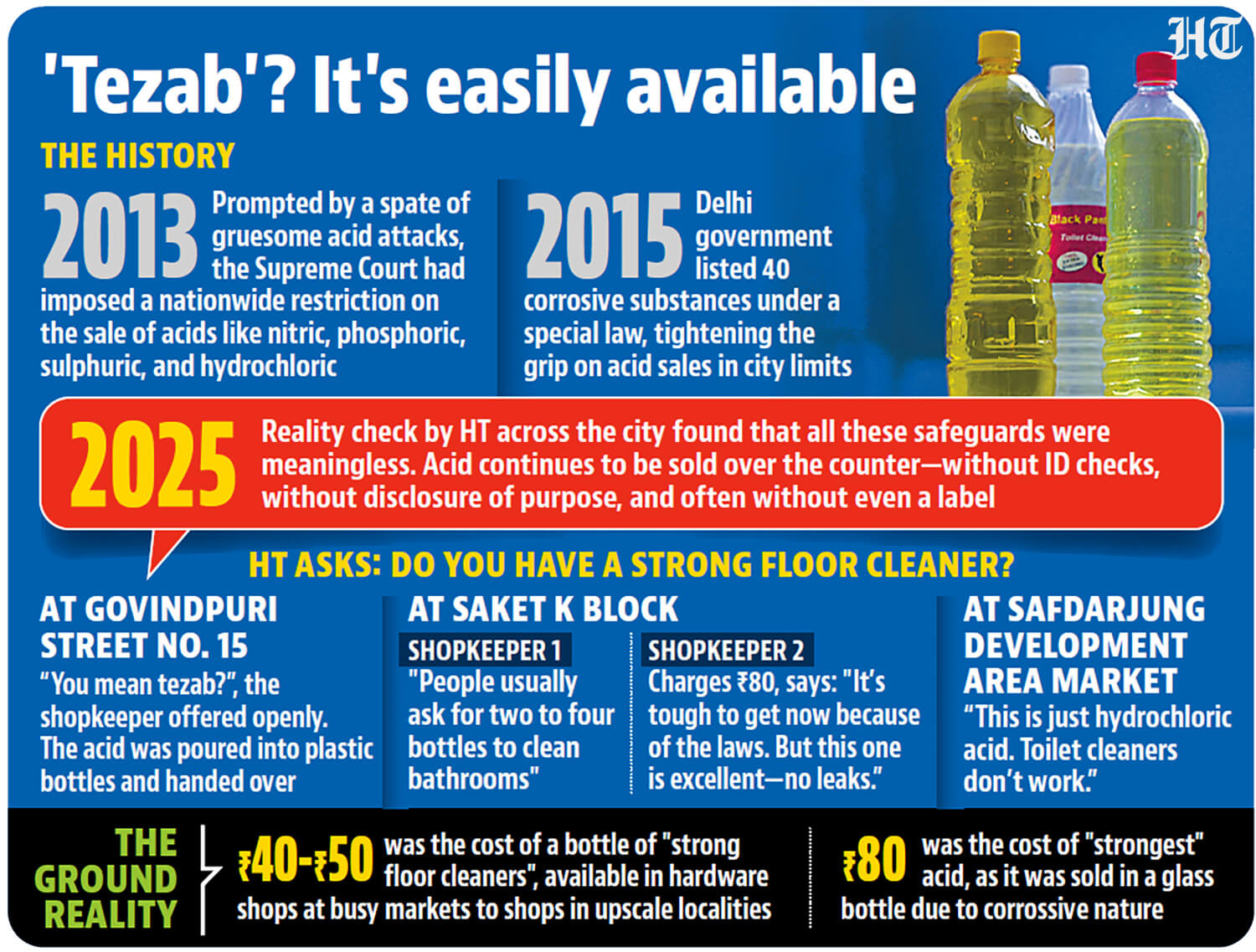
Over several days, a team visited eight neighbourhoods -- including affluent markets and crowded residential zones -- and was able to purchase acid from hardware stores, paint shops, chemical supply outlets, and even kirana stores. At no point was identification demanded, and no shopkeeper asked what the acid would be used for.
An easy market
In southeast Delhi, not far from a shelter home for acid attack survivors, a local shopkeeper sold a bottle of acid for ₹40 without hesitation. There were no questions asked, no warnings issued. The irony was painfully apparent -- the very substance that disfigured the women living in a nearby shelter, was available just down the street.
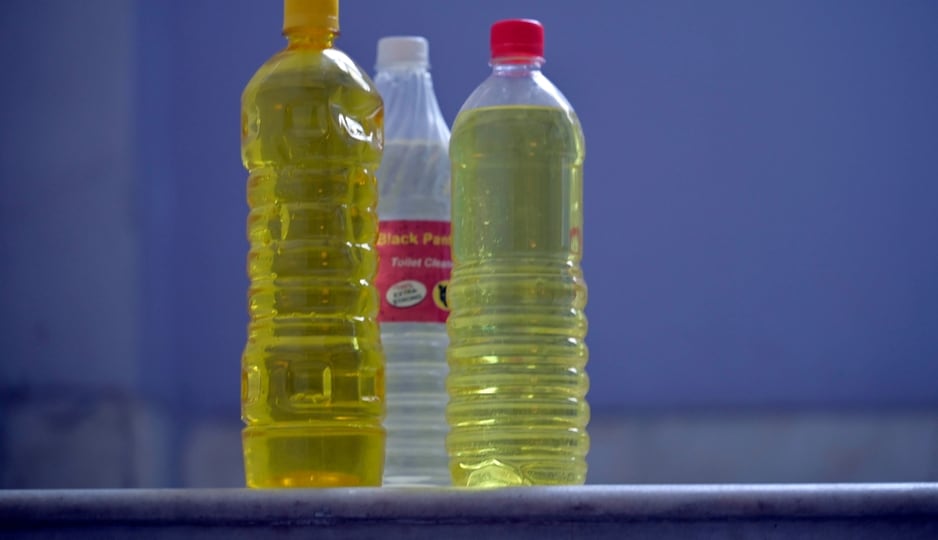
In Govindpuri’s Street Number 15, a bustling local market, a small paint and hardware store sold two bottles of yellow, unbranded liquid within minutes. All it took was a request for a “strong floor cleaner.”
“You mean tezab?”, the shopkeeper offered openly.
The acid was poured into plastic bottles and handed over for ₹50 apiece. No register, no record.
A similar exchange occurred in Jangpura, where another shopkeeper handed over a bottle with a smile. “It’s the most effective floor cleaner,” he said, cautioning only that it was “very strong.” The bottle had no label or indication of its contents.
Even in Saket’s upscale K Block, surrounded by homes and restaurants, two shops admitted to selling acid on pre-order. “People usually ask for two to four bottles to clean bathrooms,” one said. Another, who eventually sold a brown glass bottle for ₹80, justified the higher price by claiming, “It’s tough to get now because of the laws. But this one is excellent—no leaks.”
Again, no reasons were asked, no IDs sought.
At the Safdarjung Development Area (SDA) market — a bustling market with cafes, restaurants and shops — acid is sold discreetly. One kirana shopkeeper retrieved a bottle from a backroom and slipped it into a bag bearing the logo of a prominent e-commerce delivery service. “This is just hydrochloric acid,” he shrugged. “Toilet cleaners don’t work.”
In Mayur Vihar Phase I, at a market flanked by DDA flats, a small chemical shop stocked at least 10 unlabelled bottles. The shopkeeper offered bulk sales, asking for a name and phone number to follow up on larger orders.
In Yusuf Sarai, home to dozens of sanitaryware and hardware stores, a young shopkeeper sold sealed plastic bottles of acid for ₹50, claiming his regular customers included plumbers and painters. “We’ve been doing this for years,” he said.
Even Greater Kailash is not immune. In the heart of Zamrudpur village, a general store wrapped a bottle in a polyethylene bag and handed it over for ₹50.
“Everyone in GK buys from us,” the shopkeeper said. “What can we do? We just sell what people ask for.”
Online sales are no safer
HT found two wholesalers offering acid for home delivery. One of them—based in east Delhi—asked for a name and the reason for purchase. The second one, however, based IN Mumbai, readily offered nitric acid for “bulk” buyers. Another vendor confirmed orders over WhatsApp.
The Central Consumer Protection Authority (CCPA) has issued a safety notice warning against the sale of acid on e-commerce platforms. Citing Section 4(3) of the Consumer Protection (E-Commerce) Rules, 2020, it said no platform can engage in unfair trade practices. CCPA directed platforms to ensure acid sales comply with state rules or the Union home ministry’s 2013 guidelines, including verifying buyers’ government ID, age, and purpose, and requiring undertakings from sellers on regulatory compliance.
A system that fails survivors
From 2020 to 2025, Delhi Police and National Crime Records Bureau (NCRB) data show at least 35 acid attack cases were reported in the city. Survivors and activists say these numbers are an undercount – and point to an enduring pattern of lax enforcement and impunity.
Acid attack survivor and activist Shaheen Malik, founder of the Brave Soul Foundation, petitioned the Delhi High Court last year to impose a complete ban on over-the-counter acid sales in the capital. The court refused.
In its July 2023 judgment, the Delhi High Court said a blanket ban would harm “genuine users and businesses” and instead urged the Delhi government to better implement existing restrictions. It also recommended stricter penalties for violations and greater vigilance by enforcement agencies.
Malik, whose face was disfigured and vision impaired in a 2009 acid attack, called the judgment deeply disappointing. “Despite the Supreme Court’s guidelines, acid is available at the corner store or even with cycle vendors,” she said. “How do we justify that? If the government can’t enforce the rules, then a complete ban is the only answer.”
Her frustration is echoed by families of recent victims. In March 2023, a 17-year-old girl was attacked with acid in Dwarka. Her father blamed poor enforcement.
“To see your daughter in pain, her life destroyed for no fault of hers, is unbearable,” he said. “If the court won’t impose a ban, it must ensure the partial ban is actually followed. Track every bottle, every sale. Cleaners and alternatives exist -- why do we still allow this?”
What the police say; and what they don’t
Senior Delhi Police officials say that periodic raids are conducted on inputs about illegal acid sales. “When we get a tip, we alert the SDM and civic agencies. Raids are conducted, licenses checked, and violators fined ₹50,000 under the Poisons Act,” one officer said. “Most of the illegal sales happen in small outlets. But we keep catching them.”
Yet, as the HT ground visits reveal, these checks are patchy and inconsistent at best. In none of the 10 locations visited by HT was there any visible enforcement or compliance mechanism. No registers were found, no signs warning against illegal acid sales displayed.
Repeated attempts to get a comment from the Delhi government went unanswered.
Legal experts and activists argue that rules on paper mean little without robust implementation.
“It’s not lack of knowledge or difficulty of implementation, it’s a lack of empathy. Acid attack survivors are poor, and mostly women,” said Lawyer, Ali Zia Kabir Chowdhury, who has been fighting for many acid attack cases in India and is also associated with Brave Souls Foundation.
He added that we need a total ban on retail sale; and strict tracking, strict control and absolute liability on industrial consumption.
“Acid is used in few low-income households as a cleaner, who had jobs and still cleaned their households 50 years ago when there were no acids freely available. What difference will it make to the lives of future acid attack victims? There would be no future acid attack victims. No acid, no acid attack, no acid attack victims,” he said.
Concern, however, continues to fester with each bottle sold, each unrecorded transaction at a neighbourhood store, each story of a life burned beyond recognition.
Until the acid is taken off the streets – truly off – the scars will keep accumulating.


Stay updated with all top Cities including, Bengaluru, Delhi, Mumbai and more across India. Stay informed on the latest happenings in World News along with Delhi Election 2025 and Delhi Election Result 2025 Live, New Delhi Election Result Live, Kalkaji Election Result Live at Hindustan Times.


