This is a tea place, but no chai kettle is to be seen. Do observe the goings-on at the counter. Milk is slowly-slowly changing colour, from white to light brown. In the broad, shallow pan, the milk’s surface has developed a wrinkled skin. Malai is clinging to the sides. Beside the pan, a stocky metal vessel is sitting over a strong flame, its wide base narrowing towards a neck capped with a heavy lid. Two handles stick out from its sloping sides, making the vessel resemble some apparatus in a high school chemistry lab. See photo.
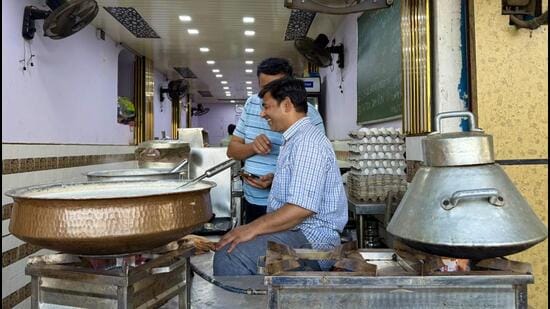
This is how Irani dum chai is being made at Irani Café in Old Delhi’s Urdu Bazar. Run by two cousins, the place is about two years old. Another Irani Café, on nearby Netaji Subhash Marg in Daryaganj, is of a similar age. Both are staging their presence in a part of the city where the chai is made by boiling tea and milk together, over and over again, in a pan.
But here, tea and milk lead separate lives until somebody makes an order.
The cousins refer to the stocky vessel by a name that sometimes sounds like “ticoction” and sometimes like “tikasan.” The tea is boiled in it, then transferred to a samovar, where it stays over a low flame. This second vessel is tall and cylindrical, with a broad lid and a little tap near the bottom.
Meanwhile, the milk keeps boiling in the broad pan until it turns brownish. On receiving an order, the man at the counter first ladles this milk into a paper cup. He then holds the cup beneath the samovar’s tap and flicks open the nalka. The blackish tea trickles down into the milk. Only now do the two become chai.
{{/usCountry}}Meanwhile, the milk keeps boiling in the broad pan until it turns brownish. On receiving an order, the man at the counter first ladles this milk into a paper cup. He then holds the cup beneath the samovar’s tap and flicks open the nalka. The blackish tea trickles down into the milk. Only now do the two become chai.
{{/usCountry}}The man offers his version of Irani dum chai’s journey. The tea came from Iran to Hyderabad, hence the name, he says, and from Hyderabad to Delhi.
Indeed, Hyderabad’s Charminar monument occupies much of the signboard above the entrance. The building itself is seamlessly integrated with its Purani Dilli surroundings. Overhead cables cross its weathered façade. Laundry hangs along an upper balcony belonging to New Azad Hind Hotel. (At the adjacent stall, Sadiq Bhai is serving the good old Dilli chai.)
The café stretches inward beneath rows of bright ceiling lights. Trays of eggs are stacked beside the counter. The menu is handwritten in coloured chalk on a green board, in English and Urdu. Irani dum chai and Irani malai chai, plus maska bun, malai bun, Osmania biscuit, special bread omelet, and butter jam bun.
Over in Daryaganj, the other café announces itself with large letters and a red heart: “I love Irani Café.” Chairs and round tables reach towards the busy pavement—Paris style! Food photographs line the walls. A poster introduces Bangalore benne dosa “for the first time in Old Delhi.”
Back in the Urdu Bazar café, a corner of the handwritten menu says, “Coming soon—tiramisu.”
Stay updated with all top Cities including, Bengaluru, Delhi, Mumbai and more across India. Stay informed on the latest happenings in World News along with Delhi Election 2025 and Delhi Election Result 2025 Live, New Delhi Election Result Live, Kalkaji Election Result Live at Hindustan Times.
Stay updated with all top Cities including, Bengaluru, Delhi, Mumbai and more across India. Stay informed on the latest happenings in World News along with Delhi Election 2025 and Delhi Election Result 2025 Live, New Delhi Election Result Live, Kalkaji Election Result Live at Hindustan Times.