Consider these misshapen, lumpy pieces. The colours range through different shades of brown, the texture of the surfaces from smooth to rough. Some pieces look as though they have been scooped out of the good earth and brought straight to the good bazar.
This is gur, or jaggery. Winter is the time for another mulakat with it. Preferably with a glass of piping hot malaidar milk. Or with sarson ka saag and makke ki roti.
Gur has also found its way into our sayings. Some aren’t sweet. “Gur khaye, gulgulon se parhez.” This is a perfect dig at hypocrisy: happily chomping on your piece of gur, but making a show of ascetic virtue by abstaining from the stuff made with it.
It is the season when grocery stores in Delhi’s Sadar Bazar, Gurugram’s Sadar Bazar and Ghaziabad’s Sita Ram Bazar (formerly Turab Nagar Market) display a range of gur that can leave even your next-door gur gourmand feeling ignorant. (Gurgaon, Gurugram’s old name, owes its gur to guru, not jaggery.)
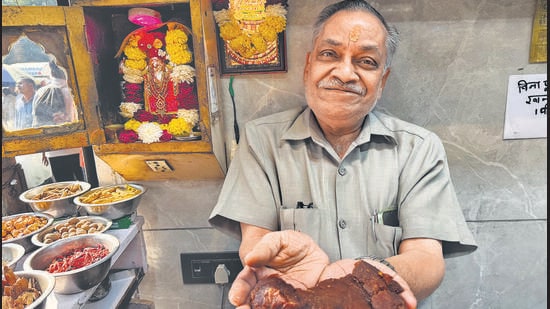
The gur varieties found these days in bazar shops include pedi, batasha, papri, moongphali, chaku, dahiya, and paneer. At Khari Baoli’s spice market, the 75-year-old shop Jamna Dass & Sons Traders is currently displaying Bareilly Gur Bina Chemical, Gur Patasha and Khajoor ka Gur. The last is super-sticky and very, very dark. See photo of the shop founder’s grandson, the venerable Ashok Gupta, holding a piece of Khajoor ka Gur.
{{/usCountry}}The gur varieties found these days in bazar shops include pedi, batasha, papri, moongphali, chaku, dahiya, and paneer. At Khari Baoli’s spice market, the 75-year-old shop Jamna Dass & Sons Traders is currently displaying Bareilly Gur Bina Chemical, Gur Patasha and Khajoor ka Gur. The last is super-sticky and very, very dark. See photo of the shop founder’s grandson, the venerable Ashok Gupta, holding a piece of Khajoor ka Gur.
{{/usCountry}}Much of the gur reaching Delhi comes from western UP, including Muzaffarnagar, Murad Nagar, Moradabad and Amroha. The arrival of fresh jaggery accompanies the harvesting of sugarcane, which starts by late October, says a gur vendor in Chirag Delhi village. In fact, some street vendors across the Delhi region who sell fruit during the rest of the year turn to gur for the cold months. Soon scores of carts in Gurugram’s Roshanpura will be heaped up with uneven lumps of gur lying beneath a transparent net to ward off flies.
And please keep an eye out for an unusual variety of jaggery, the gajar ka gur. It is made by combining sugarcane juice with carrot juice, then boiling the mixture in a karahi for about two hours. A vendor in Delhi’s Sadar Bazar carries it in a straw basket tied to the back of his motorcycle. The mitti-coloured lumps are embedded with coconut slices and sesame seeds. The gur is made back in the vendor’s village near Muzaffarnagar. He and his cousins spend the cold months selling it across the Delhi region, periodically returning home to prepare another batch.
Ironically, winter is also the time when a stall in Purani Dilli’s Pahari Imli puts away its gur sherbet, a rare drink, and starts selling diapers.
Lastly, a sweet saying: “Gur na de, gur jaisi baat toh kare.” Even if you have no sweet jaggery to give, at least talk as sweet.
Stay updated with all top Cities including, Bengaluru, Delhi, Mumbai and more across India. Stay informed on the latest happenings in World News along with Delhi Election 2025 and Delhi Election Result 2025 Live, New Delhi Election Result Live, Kalkaji Election Result Live at Hindustan Times.
Stay updated with all top Cities including, Bengaluru, Delhi, Mumbai and more across India. Stay informed on the latest happenings in World News along with Delhi Election 2025 and Delhi Election Result 2025 Live, New Delhi Election Result Live, Kalkaji Election Result Live at Hindustan Times.