In a significant overhaul plan for Delhi’s water supply, the Delhi Jal Board (DJB) has chalked out a ₹10,087 crore detailed project to reclaim Yamuna and revamp the city’s water infrastructure. Officials said on Sunday that this three-year plan has been presented to home minister Amit Shah and Delhi water minister Parvesh Verma for approval.
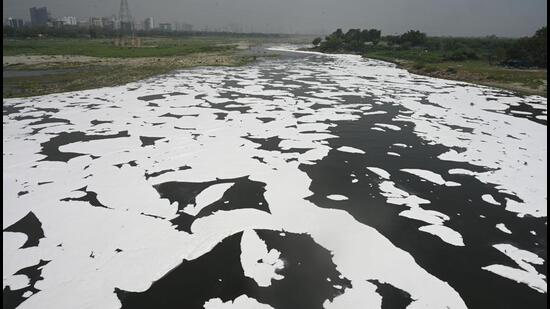
To be sure, the central government has a separate, long-term plan to clean the Yamuna, and DJB’s plan is not connected to that. The most extensive plan of the Delhi government so far, it comprises installing new sewage treatment plants (STPs), river rejuvenation schemes, fixing the broken pipes, and tapping rogue drains.
“The city cannot afford piecemeal fixes anymore. This is a consolidated plan that addresses every part of the water cycle — from source to sewer,” a DJB official asserted.
Of the 3,564mld (million litres per day) of sewage generated daily in the Capital, around 2,951mld is actually treated, despite the city having a total STP capacity of 3,470mld, the report by DJB, which HT has seen, said. DJB now aims to increase that capacity by 862mld through upgradation of old plants as well as construction of eight new ones.
Furthermore, DJB documents show that Delhi’s major STPs — including the Coronation Pillar, Yamuna Vihar and Okhla — will play a key role in restoring the river’s environmental flow.
{{/usCountry}}Furthermore, DJB documents show that Delhi’s major STPs — including the Coronation Pillar, Yamuna Vihar and Okhla — will play a key role in restoring the river’s environmental flow.
{{/usCountry}}“By September 2026, treated water from these plants will be released downstream of the Wazirabad barrage to help revive the Yamuna. At Coronation Pillar alone, 454mld of treated water is expected to be diverted into the river. These discharges are engineered flows that will reintroduce oxygen into stretches that have long been biologically dead,” the official explained.
Of the 22 drains that currently dump untreated waste into the Yamuna, only nine have been fully tapped, as per the report. The rest are in various stages of planning, with seven large drains — including those near the Delhi Gate and Sen Nursing Home — targeted for full treatment by December 2027. The report also adds that two major drains — in Najafgarh and Shahdara — are too massive to tap entirely, so partial treatment at their mouths will be taken up as an alternative.
Additionally, the interceptor sewer project is also being scaled up, particularly for the heavily polluted Najafgarh drain, where over 1,100mld of sewage from 108 sub-drains is being targeted for treatment through decentralised systems. The interceptor sewer is an initiative to intercept the sewage and treat it before it enters the Yamuna.
“Some of these drains run through multiple unauthorised colonies, so tapping them is as much about engineering as it is about community coordination,” the official added.
Of Delhi’s 1,782 unauthorised colonies, nearly half — 936 — still do not have proper sewer systems, according to DJB. The jal board is undertaking a detailed zone-wise mapping exercise to identify these gaps, with surveys and project formation set to wrap up by December this year. A phased programme for household sewer connections will follow, covering everything from funding needs to engineering designs.
In parallel, the Central Pollution Control Board (CPCB) will conduct inspections of all existing STPs and outfalls by July, to assess operational inefficiencies and feed into the revised roadmap by October this year, as per the plan.
Officials added that the plan also includes fixing the leaks in supply water. The city’s daily water demand stands at 1,250mld, but the current supply from DJB is 990mld, with around 260mld shortfall. Nearly half of this supply is lost to leaks, theft, and outdated metering, as per officials.
“The immediate focus is on boosting short-term availability. A project involving 452 tubewells is expected to add 26mld by September. Another 50mld will come from the second phase of the Dwarka water treatment plant (WTP), although its raw water source is yet to be finalised,” the official said.
DJB has also planned connectivity with three dams, Renukaji in Himachal Pradesh, and Lakhwar and Kisau in Uttarakhand, which could collectively add 435mld to Delhi’s supply after 2032. Officials said that funding has already begun and DJB has released ₹214 crore to HPPCL (Himachal Pradesh Power Corporation Limited) for Renukaji, and smaller amounts for the other two projects.
Additionally, the project report contains scaling up of smart metering across the city, and a new billing collection system. As of now, 2.9 million consumers have active connections, and bill payment compliance is low. The last tariff revision was done in 2018. Along with the infrastructure overhaul, DJB is also planning higher engagement with public awareness campaigns and a revamp of its own institutional structure.
Stay updated with all top Cities including, Bengaluru, Delhi, Mumbai and more across India. Stay informed on the latest happenings in World News along with Delhi Election 2025 and Delhi Election Result 2025 Live, New Delhi Election Result Live, Kalkaji Election Result Live at Hindustan Times.
Stay updated with all top Cities including, Bengaluru, Delhi, Mumbai and more across India. Stay informed on the latest happenings in World News along with Delhi Election 2025 and Delhi Election Result 2025 Live, New Delhi Election Result Live, Kalkaji Election Result Live at Hindustan Times.