New Delhi: The Delhi government announced the odd-even car rationing scheme on Monday as a desperate measure to curb spiralling pollution levels, with the city’s average air quality index (AQI) remaining in the severe zone for at least four days, even as experts maintained that the measure may be too little, too late and the Opposition slammed the government saying that “things are going out of control”.
Also Read | Odd-even rule back in Delhi on Nov 13 as curbs scaled up
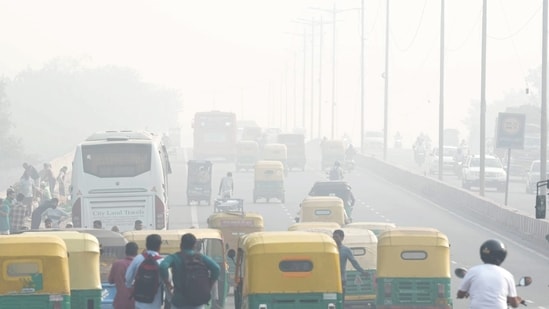
The plan, first implemented in Delhi in 2016 and repeated in 2017 and 2019, has been a matter of debate with no comprehensive study backing the step in its efficacy to curb vehicular pollution. The odd-even scheme is part of the restrictions mandated under Grap-4, when the AQI reaches severe+plus levels (above 450).
Announcing that the scheme will begin a day after Diwali — on November 13, till November 20 — Delhi environment minister Gopal Rai said data will be reviewed at the end of week, along with pollution levels during the time when the curb will be imposed, to assess the need for continuation of the scheme.
A study by a team of scientists from IIT-Delhi, IIT-Kanpur, IITM-Pune, CSIR and the TERI in 2016 showed the odd-even scheme had a limited impact of 2-3% on pollution caused by vehicles.
While the finer operational details of quantum of fines, restriction timings and exemptions will be decided in a meeting on Tuesday, experts were divided over the efficacy of the scheme and the number of exemptions.
Also Read | Delhi pollution: What is Odd-Even rule?
In the previous editions, the exempted categories included two-wheelers, EVs, vehicles driven by women, taxis, physically disabled people, VIPs, and emergency and defence vehicles.
Sunil Dahiya, analyst at the Centre for Research on Energy and Clean Air (CREA), argued that the move is needed immediately and not next week. “We don’t know what the air quality will be then, but we do know that Delhi’s air has been severe for five straight days and such emergency measures are needed now and not later,” he said.
Anshuman Tiwari, 37, who commutes between Noida and Barakhamba Road, said the exercise is futile, until more polluting vehicle segments such as two-wheelers were targeted. “It reduces congestion and travel time, but since I had an even-numbered car, commuting on odd-days was extremely difficult as cabs would overcharge. As long as a car has a PUC certificate, it should be allowed to ply,” he said.
{{/usCountry}}Anshuman Tiwari, 37, who commutes between Noida and Barakhamba Road, said the exercise is futile, until more polluting vehicle segments such as two-wheelers were targeted. “It reduces congestion and travel time, but since I had an even-numbered car, commuting on odd-days was extremely difficult as cabs would overcharge. As long as a car has a PUC certificate, it should be allowed to ply,” he said.
{{/usCountry}}Shah Mohammad Faisal, who works with a multinational company in Gurugram, said no such scheme could make a difference until the public transport system was strengthened.
“The government must have some scientific data to back the efficacy of steps such as odd-even. It’s a disruptive and cosmetic move at best,” he said.
The Bharatiya Janata Party (BJP) opposed the move calling it a “punishment for people of Delhi”. Delhi BJP president Virendra Sachdeva said, “In the past when this scheme was implemented, Delhi has never experienced any qualitative improvement in air. By bringing the odd-even scheme, the government is punishing Delhiites for its own failure to curb pollution.”
Delhi Congress chief Arvinder Singh Lovely said, “Things are out of government control and now they are taking temporary measures for curbing pollution. We support the measures taken by the government, but we appeal to them to go beyond temporary measures in these two months. They should improve roads, strengthen the public transport system and plan for curbing local pollution sources. There should be long-term plan to mitigate pollution levels at every hot spot.”
Stay updated with all top Cities including, Bengaluru, Delhi, Mumbai and more across India. Stay informed on the latest happenings in World News along with Delhi Election 2025 and Delhi Election Result 2025 Live, New Delhi Election Result Live, Kalkaji Election Result Live at Hindustan Times.
Stay updated with all top Cities including, Bengaluru, Delhi, Mumbai and more across India. Stay informed on the latest happenings in World News along with Delhi Election 2025 and Delhi Election Result 2025 Live, New Delhi Election Result Live, Kalkaji Election Result Live at Hindustan Times.