Yet another building collapse in the Capital on Tuesday, which claimed two lives in east Delhi’s Jwala Nagar, renewed questions about the effectiveness of the Municipal Corporation of Delhi’s (MCD) annual dangerous-building surveys and the urgency of implementing a citywide structural safety plan proposed by the Union home ministry last month. It also exposed the vulnerability of thousands of structures standing on shaky foundations, often without adequate regulatory oversight by civic agencies.
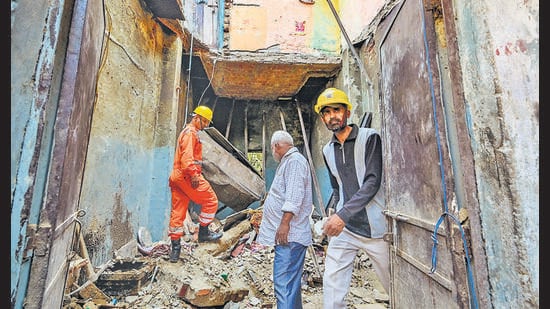
An MCD report on the collapse said the building, spread over 20 square yards, was situated on encroached railway land, approximately 24 metres from the railway line. The civic body estimated that the structure was 40-50 years old and had a roof made of red stone slabs.
“The building was old and situated in close proximity to the railway line, vibrations caused by the movements of trains may also have contributed to the incident. This aspect has emerged during the local enquiries and may be considered as one of the possible contributing factors,” the report said.
The collapse has also brought into focus the large number of structures that have come up on public land and the regulatory challenges in acting against them. A senior municipal official said the building was located on public land, but illegal structures built before 2014 could seek protection under the Delhi special provisions laws.
However, MCD has failed to identify the structure as dangerous in its annual survey, raising questions about the effectiveness of the exercise, particularly as a series of building collapses have been reported across the city this year.
{{/usCountry}}However, MCD has failed to identify the structure as dangerous in its annual survey, raising questions about the effectiveness of the exercise, particularly as a series of building collapses have been reported across the city this year.
{{/usCountry}}The civic body did not respond to HT’s requests seeking comment on why the Jwala Nagar building had not been flagged.
Illegal structures built in Delhi before June 2014 are protected from punitive action under the Delhi Laws (Special Provisions) Act, passed by Parliament. Experts have argued that a provision originally intended to remain in force for just a year has become a loophole, and that the government needs to revisit it when the current extension expires in December 2026.
The law initially provided protection against sealing for one year, but was subsequently extended in 2007, 2009 and 2011, and thereafter every three years until December 31, 2026. HT has recently reported that another extension is being considered. In the recent Chandni Chowk building collapse, the owner was also attempting to exploit the loophole by paying property tax for non-existent floors, so that the building’s age could fall in a grey zone.
Experts have also questioned the methodology used by the MCD for its annual dangerous-building survey. Municipal teams largely rely on visual inspections to identify cracks, tilting walls and other visible signs of structural distress. This means officials often assess buildings externally and determine whether they pose a risk based largely on visible damage, rather than through detailed structural assessments.
A mammoth citywide exercise
The limitations of such inspections assume greater significance as the Capital prepares for a proposed citywide fire and structural safety survey. Last month, following a series of building collapses in Delhi, the Union home ministry directed the MCD to prepare a roadmap for auditing every house and building in the Capital, including those in authorised and unauthorised localities.
Civic officials said a report had been submitted to the Union government, but carrying out the exercise across the city would be a mammoth task.
“We have submitted there are more than 4 million building structures in Delhi. If one man assesses a house even in one hour, it will require 40 lakh working hour. If this needs to be carried out in one year or two years, the reverse calculations will lead to the manpower requirement,” an official said, requesting anonymity.
The proposed exercise, however, would not involve scientific structural assessments either. Instead, it would entail filling out survey forms recording details such as the building’s age, area and availability of fire or building plans.
“Based on the data from this survey, a policy will later be made on how to proceed with this problem. The Union government will also decide whether such a survey should be carried out,” the official said.
Stay updated with all top Cities including, Bengaluru, Delhi, Mumbai and more across India. Stay informed on the latest happenings in World News along with Delhi Election 2025 and Delhi Election Result 2025 Live, New Delhi Election Result Live, Kalkaji Election Result Live at Hindustan Times.
Stay updated with all top Cities including, Bengaluru, Delhi, Mumbai and more across India. Stay informed on the latest happenings in World News along with Delhi Election 2025 and Delhi Election Result 2025 Live, New Delhi Election Result Live, Kalkaji Election Result Live at Hindustan Times.