E-Paper



Delhi fountains a hassle to run amid water woes
New Delhi Municipal Council, the civic body overseeing the Lutyens’ Delhi, has installed six stone fountains each along the Sardar Patel Marg and near the India Gate

 Prefer HTon Google


Decorative fountains have been installed on key avenue roads under the Capital’s beautification project ahead of the G20 summit but keeping them running and securing water for them is proving to be a challenge, officials said on Wednesday.
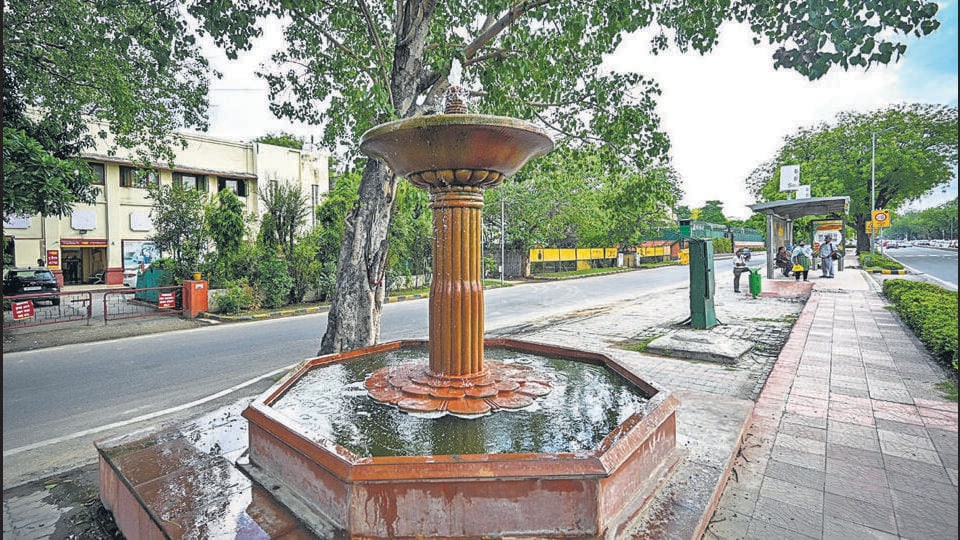
New Delhi Municipal Council, the civic body overseeing the Lutyens’ Delhi, has installed six stone fountains each along the Sardar Patel Marg and near the India Gate, while 25 more stone fountains will be put at other strategic locations, including C hexagon junction of Akbar road and the Sher Shah road .
A senior official associated with the maintenance of the fountains said that the major challenge is the low availability of water and the scorching heat, as no new pipelines were laid to supply water to these fountains.
“We have a serious water problem. It is a daily struggle to arrange water from different sources. There are no immediate water sources, especially near the ridge area, and we did not have any time to undertake digging work for laying the pipelines for these fountains,” the official said, asking not to be named.
After grappling with solutions, the civic body is presently managing to keep the fountains going by deploying tankers to fill the fountain bases with treated water. NDMC has around 70 fountains in public spaces under two divisions.
“We have been directed by the lieutenant governor’s office to keep the fountains running from 8am to 11pm and the evaporation alone empties the recirculating water in just two days,” the official said.
A typical such fountain comprises of an octagonal base with a cylindrical column and a hemispherical bowl attached at top. When the fountain operates at full water capacity, the water percolating out of its top base is expected to create an inverted umbrella of water surface but it is rarely the case and the umbrella is reduced to a trickle.
During a spot check on SP Marg on Wednesday, HT found that yellowish treated water was being circulated in the fountain at some spots, while the water was also scattering to the periphery of the fountains. The water was also leaking on the attached staircases leading to the service lanes.
Dharmendra Kumar, a security guard at a nearby hotel on SP Marg, said that NDMC workers are seen emptying tankers every other day.
Narendra Bhandari, who was walking his dogs on the footpath near BRS party office, said that the location of the fountains could have been more appropriate. “They have been installed in middle of footpaths. While a circular pathway has been developed around them, it remains damp due to persistent water leakages or when it overflows,” Bhandari said.
A second official managing the fountains said that the installation is easier than keeping them running.
“NDMC pipelines for raw water have hardly any water left at this point of the Ridge and due to the slope, the pressure is also low. Whatever water reaches in this area, it is used by the horticulture department. The second problem is the 13-hours running time of these fountains in the scorching heat. It has led to motor burnout multiple times. Now, we have decided to keep standby pumps so that they can be operated on alternate basis,” the official added.
An official from the horticulture department said that most of the 156 borewells have been closed down for saving ground water, and water is being arranged through water tankers, besides using treated water.
Another NDMC official said that the civic body is trying to operationalise and keep all the five dozen fountains running.
NDMC’s spokesperson did not respond to HT’s queries for a response. The LG office’s office also did not comment on the matter.