As a child, Muneeb Ahmed Khan hesitated to tell his teachers and friends that Mahatma Gandhi, the Father of the Nation, whose name found mention in his textbooks, once spent several days etching out the intricacies of the Independence struggle in his Old Delhi house. At Sharif Manzil, the 305-year-old haveli where his great-great grandfather, freedom fighter Hakim Ajmal Khan, was born, each corner bears memories of India’s attempts to wrench itself of British occupation.
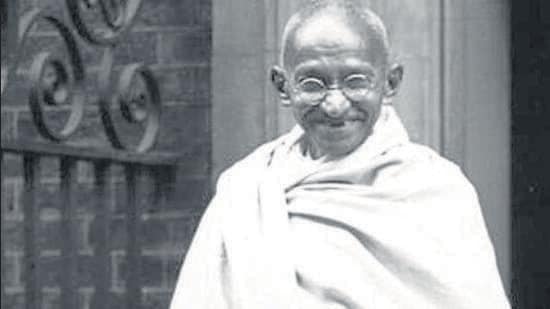
“When I was in school, I worried that my classmates would mock me if I said Mahatma Gandhi lived in our house. Who would have believed it? It is true though,” Muneeb, a 45-year-old lawyer, said with a laugh.
Gandhi’s association with a string of landmarks in Delhi – including the Qutbuddin Bakhtiar Kaki Dargah in Mehrauli, Pataudi House in Daryaganj and Birla House, where he was assassinated – is well documented, but the Mahatma’s formidable footprints spread far and wide across several lesser-known parts of the national capital, especially the Walled City.
From eating urad dal at Sharif Manzil and visiting the ailing mother of a trusted aide in Katra Kushal Rai, to inaugurating a Swadeshi store in Chandni Chowk and living in a two-room house in Valmiki Colony in Gole Market, Gandhi left a deep imprint on the Old City.
Sharif Manzil was once home to several photos of Gandhi. But not anymore.
{{/usCountry}}Sharif Manzil was once home to several photos of Gandhi. But not anymore.
{{/usCountry}}“My father has seen these photos. In 1947, a portion of our family migrated to Pakistan... They took some of these photos with them. The rest were sold by tenants over the years,” said Muneeb.
For years, he heard stories of Gandhi and Ajmal’s bonhomie.
“When Gandhiji reached Delhi, Hakim saab received him and brought him home. He introduced him to senior Indian National Congress leaders. My grandfather told me that at the time, Gandhiji used to wear a suit and tie, then slowly moved to kurta-pyjama, and an achkan too on a rare occasion,” recalled Muneeb.
Sharif Manzil holds a historic spot in the history of India’s Independence struggle. Jawaharlal Nehru, Sardar Vallabhbhai Patel, and Shaukat Ali Khan, were among a plethora of freedom fighters, who met to forge the way forward for a nation taking slow steps towards Independence.
“The national leadership used to convene there and it’s where Gandhiji first met Maulana Azad,” said Muneeb, who is the 17th generation inhabitant of the once sprawling haveli.
Gandhi, Munbeeb said, stayed at Sharif Manzil four or five times in his early years in Delhi, and subsequently made Birla House his home. “My grandfather would often recall that Gandhiji used to enjoy the urad dal our khaansaama (cook) made at home, and sometimes he would go to Company’s Garden (behind Town Hall) for his evening walks,” said Muneeb, who now lives in Sharif Manzil with his wife,their two children, and his father Masroor Ahmed Khan.
About a kilometre away from that haveli, through the snaking lanes of the Walled City, Gandhi, on September 15, 1924, inaugurated the Hindustan Times press – a two-storey building on Burn Bastion Road, now known as Naya Bazar.
“Every word and sentence published in the paper should be weighed. There should not only be no untrue statements but also no suggestio falsi or suppressio veri,” he said at the time.
Historical records suggest the Mahatma inaugurated a raft of endeavours associated with the Independence movement, including a Swadeshi handloom factory inChandni Chowk on November 21, 1920.
Vijay Goel, Bharatiya Janata Party (BJP) leader and vice-chairman of Gandhi Smriti, told HT that Gandhi also lifted the wraps off the Ayurvedic and Unani Tibbi College, which later came to be known as Tibbia (Medical) College in Karol Bagh, on February 13, 1921, and also attended a meeting at the Marwari Pustakalya in Kucha Mahajani, Chandni Chowk in 1916.
“Gandhiji visited more homes, havelis, but most of them don’t exist anymore. Markets have come up there instead,” said Goel.
One such mention of Gandhi’s visit to Old Delhi is found in Old Delhi silver trader and freedom fighter Brij Krishna Chandiwala’s book Bapu ke Charanon Mein, which was translated to English – At the Feet of Bapu. Gandhi, according to the book, lived at his home, Chandi Wali Haveli in Old Delhi with his family.
Chandiwala writes, “[In October 1936] I wrote to him (Gandhi) a letter at once saying, ‘If you could kindly break journey here, while on your way back to Wardha, I would be extremely grateful. My mother is ailing and would like very much to see you.’ I got his reply by return post assenting to my request, greatly to my relief and satisfaction. He arrived at Delhi on October 27th, and when he got off the train he said, ‘I have no other business here other than to see your dear mother and Begum Ansari.’ So he drove straight to my residence and went up to the first floor where my mother was lying. After spending a few minutes with her he left to see Begum Ansari...”
Little is known about the condition of the Chandi Wali Haveli now, though.
Apart from leading the freedom struggle, Gandhi also attempted to resolve traders’ financial problems, at a time when Old Delhi was the nerve centre of business in Delhi.
One Gandhi’s first meetings with traders of Chandni Chowk was in the late 1930s at the Hardinge Library, now known as Hardayal Municipal Heritage Public Library.
Jai Prakash Agarwal, a senior Congress leader, a four-time MP from Delhi and an Old Delhi resident, grew up hearing stories of this meeting.
“My grandfather, Lala Ram Chander Mal, organised that meeting because he was a senior member of the municipal committee at the time. He was also a cloth merchant and could relate to the traders’ problems. The story goes that Gandhiji spent hours at the library listening to peoples’ problems and then suggested solutions. My grandfather would tell us how he kept following up on the issue for the next few months,” said Agarwal, 79.
In 1942, Gandhi returned to the library after Ram Chander Mal organised another meeting with the traders – this time for the Mahatma to seek their support.
“It was a strategic meeting to discuss preparations for the Quit India movement. My father told me that important decisions regarding the movement were taken at this meeting at the Hardinge library,” said Agarwal.
Away from the Walled City, Gandhi spent a year in a tiny room, four-foot wide and 10-foot long, in Valmiki Mandir, along Mandir Marg in central Delhi, between 1946 and 1947.
“He stayed there from October 1, 1946, to June 1, 1947,” said Swami Krishan Saha Vidyarthi Maharaj, the Mahamandaleshwar, or head priest, of the temple. At the peak of the freedom struggle, Gandhi held political meetings in the room and also taught children there.
“Before Gandhiji came to live here, the room was used as a classroom for students of the Valmiki Samaj. When my grandfather offered him this room, Gandhiji said the classes must continue. Sometimes, he would teach them too,” said Maharaj.
The room has now been turned into a museum – a small table with a pen stand used by Gandhi in those days, pillows he used as support for his back, his takht (bed) with a crisp white bedsheet and a large photo of Gandhi, with a garland around it.
In fact, Prime Minister Narendra Modi launched the Swacch Bharat Mission a decade ago from the Valmiki temple on October 2, wielding a broom for the first time to start the sanitation drive at the Valmiki tenements adjacent to this temple.
“My father told me that Gandhiji would sit on a wooden parapet outside the temple for his evening meditation. He also held his larger public gatherings here. We were told that Lord Mountbatten would often visit him here,” said the Mahamandaleshwar.
Even though he kicked off some of his most important movements in other cities, Delhi remained an important pitstop and point of contact for Gandhi, who remains enmeshed in the culture and memory of the city where he was slain.
Stay updated with all top Cities including, Bengaluru, Delhi, Mumbai and more across India. Stay informed on the latest happenings in World News along with Delhi Election 2025 and Delhi Election Result 2025 Live, New Delhi Election Result Live, Kalkaji Election Result Live at Hindustan Times.
Stay updated with all top Cities including, Bengaluru, Delhi, Mumbai and more across India. Stay informed on the latest happenings in World News along with Delhi Election 2025 and Delhi Election Result 2025 Live, New Delhi Election Result Live, Kalkaji Election Result Live at Hindustan Times.