The headline should have read “The disappearing havelis of Dilli dehat,” but choosing the current one, one may declare that the villages of Delhi are a Delhi that existed before the distinction between Old and New Delhi. These havelis hold social histories of communities that have lived and sustained the land of the city longer than the urbanised city.
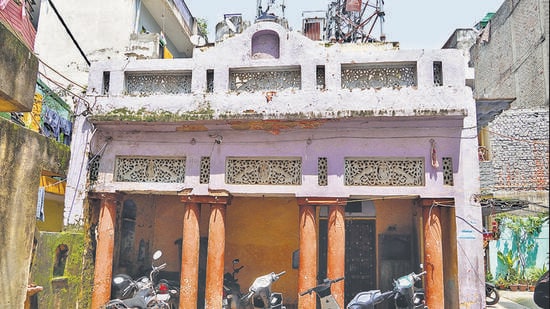
The haveli of Delhi dehat was organised as a sequence of spaces that moved from public to private. A visitor entered through a large wooden gate into the baithak, where guests and relatives from outside could stay and where the male members of the family slept. Beyond it lay the chowk, a central courtyard with stairs on one or both sides, a kitchen at one end with a raised platform for washing utensils, and a storage room at the other. The men of the family could use this semi-private space for meals and common ceremonial occasions. At the far end were the kothadas or obras, the private rooms usually occupied by women and children. The heli bhitar in Munirka is a fortress-type haveli with a grand entrance, a central lobby, and arcades on either side that open onto a courtyard of two-storeyed rooms, which could house 10 to 15 families. Courtyards, entrances and enclosed rooms were part of the social and familial structure of the village and not merely architectural features.
These buildings were heritage in a village long before the city grew around them. Oral histories suggest that in most villages havelis were built after Independence, when land acquisition enabled families to build. Residents did not need official recognition to treat them as significant. An old haveli was a landmark associated with families, elders, celebrations and memories of the village before urbanisation. Its significance was produced through collective memory as much as through physical form, and its heritage value lies precisely in this relationship between architecture and social life.
{{/usCountry}}These buildings were heritage in a village long before the city grew around them. Oral histories suggest that in most villages havelis were built after Independence, when land acquisition enabled families to build. Residents did not need official recognition to treat them as significant. An old haveli was a landmark associated with families, elders, celebrations and memories of the village before urbanisation. Its significance was produced through collective memory as much as through physical form, and its heritage value lies precisely in this relationship between architecture and social life.
{{/usCountry}}The irony of what followed is that the villages made room for the city and were then squeezed by it. Delhi officially has 357 revenue villages, and many lost their agricultural land to colonies, institutions, roads and other urban uses. The settlements that had been attached to fields, grazing grounds and village commons became densified pockets called urban villages. Families that had lost their land, and with it a part of their identity, were left with the house as the one asset they could still put to use. On scarce and expensive land, a large, low-rise haveli appears as low value, while a multi-storey building of rental rooms appears as high value, because every extra floor generates rent. The courtyard house is therefore gradually replaced by the rental building, and villagers turn their own homes into monetised assets to recover some of what the city took.
Katwaria Sarai illustrates the consequence. One of its old havelis was partly demolished and now lies in ruins, surrounded by multi-storey rental structures, since the economic logic of the rental market values vertical floor area over the spatial qualities or historical significance of the old house. The loss extends beyond a building, because the haveli embodied a social geometry of joint family, kinship and shared courtyards, and the rental building that replaces it organises a more transient and individualised life around smaller units of occupation.
Other pressures compound this. Many havelis occupy the older cores of villages, along narrow and densely built streets that make expansion difficult, and some are divided among several branches of an extended family, which raises complicated questions of inheritance. As households grow they move to the periphery or rebuild elsewhere, and the family home is abandoned, not because it lacks a history but because it has lost its immediate usefulness and economic value. In this way a living building becomes a relic. Some are encroached upon, subdivided or converted to commercial use, and residents who once remembered a gathering place increasingly describe the same structure as a khandar, a ruin.
The challenge is also institutional. Delhi’s history has been read largely through its forts, tombs, mosques, baolis and colonial buildings, and this has produced a hierarchy in which structures that can be enclosed, landscaped and restored are more readily recognised than those embedded in living settlements. The Lodi-period tombs in Lodi Garden are protected and presented within a landscaped public space, while village havelis stand among multi-storey buildings, narrow lanes and intense commercial activity. The difference is spatial and institutional and not necessarily architectural. A privately owned, inhabited and modified haveli does not fit the monument model, so its value cannot be judged by architectural criteria alone.
The question is not whether every haveli should be frozen in its present form, nor whether villages should be preserved as imagined versions of a rural past. The task is to identify which surviving havelis have architectural, historical, social or cultural significance and to conserve them without severing them from the settlements around them. This begins with a village-level inventory recording features, age, owner history, condition and surroundings, supported by drawings, photographs, maps and oral histories that recover how the buildings were used. Selected havelis could then become part of village heritage trails or precincts, with conservation and adaptive reuse allowing them to keep functioning within the modern village.
2047 would be 100 years of Indian independence. What would we have to say about our villages when we reach our target of Viksit Bharat? A quote by Gandhi references the early imagination of Modern India: “When our villages are fully developed, there will be no dearth in them of people with a high degree of skill and artistic talent. There will be village poets, artists, linguists and research workers.” Having taken the fields, the city now offers the village the only compensation it recognises — the chance to monetise its own courtyards until nothing remains of the culture that needed them.
Anica Mann works on archaeology and contemporary art in Delhi while Dr. Shekhar Tokas is an Assistant Professor of Urban Studies at Dr. B. R. Ambedkar University. The views expressed are personal
Stay updated with all top Cities including, Bengaluru, Delhi, Mumbai and more across India. Stay informed on the latest happenings in World News along with Delhi Election 2025 and Delhi Election Result 2025 Live, New Delhi Election Result Live, Kalkaji Election Result Live at Hindustan Times.
Stay updated with all top Cities including, Bengaluru, Delhi, Mumbai and more across India. Stay informed on the latest happenings in World News along with Delhi Election 2025 and Delhi Election Result 2025 Live, New Delhi Election Result Live, Kalkaji Election Result Live at Hindustan Times.