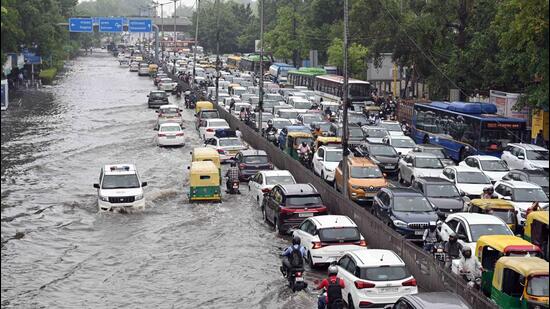
Delhi’s Safdarjung station received 228.1mm rain in the 24 hours ending at 8.30am on June 28, only 7mm short of the station’s highest recorded rain for a day in June. This is also close to India Meteorological Department’s (IMD) 244.5mm rain threshold that classifies it as “extremely heavy” rain. Does this mean that the water-logging reported on June 28 across the city was just the result of intense rain? While an extreme weather event will indeed increase the chances of water-logging, an HT analysis suggests that Delhi’s water-logging problem may be independent of the type of rain it receives. In fact, reading rain data with Yamuna’s water levels suggest that the problem may be largely man-made.
One reason why rain does not appear to be the reason behind Delhi’s flooding is that the UT has become drier over years. For example, in the decade ending 2020, Delhi averaged 512.5mm rain annually, according to IMD’s gridded database. This is 25% less than the 1961-2010 average for Delhi, considered the Long Period Average (LPA) up to 2021.
Is it possible that rain in Delhi has become more intense although it is receiving less rain? That is indeed possible. However, long-term data at high frequency – for an hour or three hours – is not publicly available. IMD’s intensity categories for 24-hour rainfall do not suggest an increase in the intensity of rain in Delhi. While total annual rain decreased by 25% in the 2011-2020 decade compared to LPA, rain of “rather heavy” or higher intensity (rain of 35.5mm or more in 24 hours) decreased by 64%. On the other hand, moderate rain (7.6-35.5mm in 24 hours) decreased by 7%. It is only rain of even lower intensity (all classified as different types of light rain) that increased by 6%.
To be sure, even rain classified as moderate for a 24-hour interval can overwhelm an old drainage system if its concentrated in a few minutes. While there is no way to check intensity at smaller time intervals, there is a roundabout way to check whether Delhi drains its water efficiently when it gets heavy rain even for a 24-hour interval. This is because most of Delhi lies to the west of Yamuna, a region at a higher elevation. This means the city’s runoff naturally drains into the river. This is also what the 2018 Drainage Master Plan (DMP) report for Delhi prepared by the Indian Institute of Technology, Delhi says. “The drainage morphology of Delhi is defined in a large measure by the Aravalli foothills and connected outcrops. Under these influences, a principally easterly storm water movement is indicated from the higher elevations in the West towards Yamuna in the East,” the report says.
{{/usCountry}}To be sure, even rain classified as moderate for a 24-hour interval can overwhelm an old drainage system if its concentrated in a few minutes. While there is no way to check intensity at smaller time intervals, there is a roundabout way to check whether Delhi drains its water efficiently when it gets heavy rain even for a 24-hour interval. This is because most of Delhi lies to the west of Yamuna, a region at a higher elevation. This means the city’s runoff naturally drains into the river. This is also what the 2018 Drainage Master Plan (DMP) report for Delhi prepared by the Indian Institute of Technology, Delhi says. “The drainage morphology of Delhi is defined in a large measure by the Aravalli foothills and connected outcrops. Under these influences, a principally easterly storm water movement is indicated from the higher elevations in the West towards Yamuna in the East,” the report says.
{{/usCountry}}If Delhi’s natural storm water movement is towards the Yamuna, there should be some correlation between the rain received and the water level in the river, if the city does not have a drainage problem. However, an HT analysis suggests that there is hardly a correlation between the two (See chart).
HT obtained data on Yamuna’s water level at the Delhi Railway Bridge station for measuring it from the Central Water Commission (CWC). This data is available since 1970. While the data has gaps, it allows one to check the change in water level from the previous day for 93 of 162 days of heavy rain (rain of 35.5mm or more in 24 hours) recorded in IMD’s gridded data since 1970. Since IMD’s rain data for a day is for the 24 hours ending at 8.30am, and water can take time to drain, HT checked the change in water level for three intervals. These intervals were: from 8am of the previous day to 8am of the day of record; from 8am of the previous day to 1pm of the day of record; from 8am to previous day to 6pm of the day of record. These intervals were also chosen because the water level data for these three hours (8am, 1pm, and 6pm) has the least gaps. However, change in water level in any of these intervals does not show a correlation with rain in Delhi. This lack of correlation was also true across decades since 1970. This is not surprising since HT reported on flooding at Minto Bridge as early as 1958.
To be sure, a lack of correlation is also possible if Yamuna’s water level rises because of rain or release of water upstream, such as during last year’s floods. However, on some occasions, Yamuna’s water level has also decreased despite heavy rain in Delhi. Out of the 93 days of heavy rain for which this analysis was possible, Yamuna’s water level decreased 19 times in the 8am-to-8am interval, 15 times in the 8am-to-1pm interval, and 23 times in the 8am-to-6pm interval. This would not happen in a highly concretised city (which does not allow water to seep underground) if water’s flow was not being choked before reaching the river.
That is exactly what appears to be happening in Delhi – and the prime reason for the Capital’s drowning.
Stay updated with all top Cities including, Bengaluru, Delhi, Mumbai and more across India. Stay informed on the latest happenings in World News along with Delhi Election 2025 and Delhi Election Result 2025 Live, New Delhi Election Result Live, Kalkaji Election Result Live at Hindustan Times.
Stay updated with all top Cities including, Bengaluru, Delhi, Mumbai and more across India. Stay informed on the latest happenings in World News along with Delhi Election 2025 and Delhi Election Result 2025 Live, New Delhi Election Result Live, Kalkaji Election Result Live at Hindustan Times.