Every winter, residents of Kirari in northwest Delhi wake up to a think blanket of smoke enveloping the entire area. It is mostly because of open burning of piles of waste every evening.
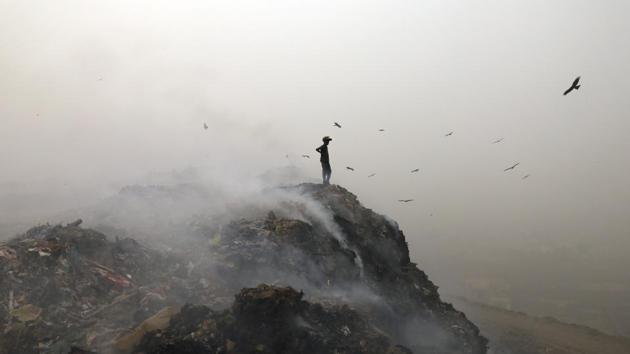
This year too, complaints have already started pouring in and the Delhi Pollution Control Committee (DPCC) has slapped the North Delhi Municipal Corporation with a fine of Rs 1 crore for its failure to control these fires, which are one of the major local contributors to air pollution in Delhi.
“During a surprise inspection we found that the garbage was being burned beside the main road since morning and no official action was taken by the local municipality against the burning,” said Gopal Rai, Delhi environment minister.
Local residents said many open spaces along the main road have become a dumping site for local waste and every now and then someone lights these piles on fire, enveloping the entire area in a grey blanket.
Rekha Rani, a resident of Kirari Harijan Colony, said that sometimes the fire rages so wild that the flames and the resultant smoke can be seen from several kilometres away.
{{/usCountry}}Rekha Rani, a resident of Kirari Harijan Colony, said that sometimes the fire rages so wild that the flames and the resultant smoke can be seen from several kilometres away.
{{/usCountry}}“You will see garbage dumped in any open space that is available here and every other day you find it lit up. During winters, eyes start burning and it becomes difficult to breathe,” Rani said.
Experts have also pointed out that as Delhi faces its annual winter air pollution emergency, curbing open waste burning could prove to be proverbial Achilles’ heel.
Data provided by Delhi Fire Services (DFS) control room shows that between September 15 and October 15, 127 complaints of open waste burning were received from across the city. Officials attending these calls said that some of these fires had turned unmanageable. In fact, over the last ten days five major garbage fires were put off by fire fighters.
On Sunday, the DFS received calls about 28 such fires.
On October 11, a vacant plot near the Ashram intersection saw a major fire, which took over two hours to control. Similarly, on October 15, a fire was also reported from northeast Delhi’s Bhajanpura, DFS officials said.
DFS chief, Atul Garg said, “DFS teams have been actively contributing to pollution control measures in the city. Apart from controlling the frequent garbage fires, our teams have also been sprinkling water on the roadside and open spaces to control dust.”
Kripal Singh Ranawat, a shop owner near Bhajanpura police station, said waste collection and management is a major problem in these areas and some of the privately employed waste collectors often dump waste on road sides and on open plots and set it on fire.
“Pillars of flyovers and boundary walls are coated with soot, so if the agencies do not believe us they can see this as proof of how frequently burning happens in these areas,” Ranawat said.
DPCC control room data also shows that over the last 10 days, teams had to intervened at 52 places where open garbage burning was spotted. Officials said that while monitoring teams are on-ground monitoring such burnings, they are also relying heavily on complaints being received from resident welfare associations (RWAs) and the general public.
“Our teams are also patrolling areas in the night because waste is usually burnt at night,” said a senior DPCC official.
In Dwarka, residents complained that vacant plots have been turned into dumping grounds and despite repeated complaints to the pollution control agencies and the local municipalities, waste burning continues.
“Garbage burning is common in Dwarka and in its surrounding areas. The (Winter) season has begun and the government must set up a 24×7 helpline for reporting garbage burning to control pollution. It normally happens in vacant DDA (Delhi Development Authority) plots,” Karamvir Anil Parashar, activist and resident of Dwarka tweeted, along with pictures of smoke emanating from garbage fires.
Experts agreed that waste management is an area where authorities need to work harder.
Anumita Roychowdhury, executive director (research and advocacy), Centre for Science and Environment (CSE), said waste management can be tackled with strict enforcement.
“Waste burning is an offshoot of the larger problem of waste disposal and management. Agencies will need to step-up action not just during winters but all year long in order to control this,” said Roychowdhury.
A senior official of the north corporation said that the agency is doing its best to control cases of open burning in their areas.
“While you can take prompt action against other polluting sources, preventing waste burning is difficult. The action in such a case is taken afterwards when the damage is done. What we can do is douse such fires immediately to prevent any further damage. Complete control can only come with awareness and cooperation from the public,” the official said.
Stay updated with all top Cities including, Bengaluru, Delhi, Mumbai and more across India. Stay informed on the latest happenings in World News along with Delhi Election 2025 and Delhi Election Result 2025 Live, New Delhi Election Result Live, Kalkaji Election Result Live at Hindustan Times.
Stay updated with all top Cities including, Bengaluru, Delhi, Mumbai and more across India. Stay informed on the latest happenings in World News along with Delhi Election 2025 and Delhi Election Result 2025 Live, New Delhi Election Result Live, Kalkaji Election Result Live at Hindustan Times.