
Sign in

Gurugram society uses colour-coded system to tackle waterlogging

The colour-coded markings using painted pillars and poles, signal safe passage with green, caution with yellow, and avoidance with red

Published on: Nov 11, 2024, 07:25:58 IST
Share
Share via
  • facebook
  • twitter
  • linkedin
  • whatsapp
Copy link
  • copy link

Faced with persistent monsoon waterlogging, residents of Tatvam Villas in Sector 48 have implemented a colour-coded marking system to help commuters safely navigate flooded roads. The initiative, gaining attention for its effectiveness, uses green, yellow, and red markers to indicate varying levels of water depth, aiming to reduce traffic congestion, vehicle stalling, and accidents, residents said.
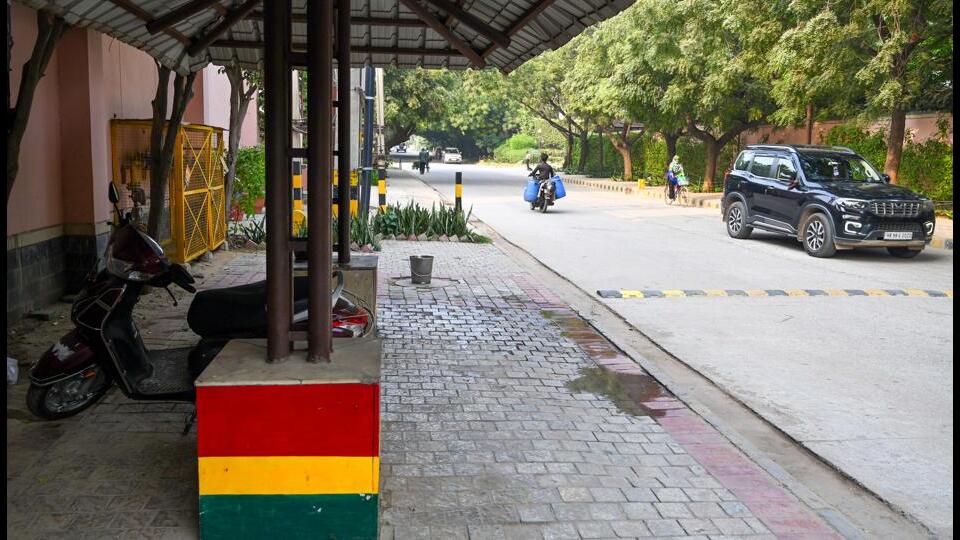
One of the colour-coded marking at the society. (Parveen Kumar/HT Photo)

The colour-coded markings, set up along the revenue road and surrounding areas using painted pillars and poles, signal safe passage with green, caution with yellow, and avoidance with red. The system, pioneered by resident Manjeev Aggarwal, has reportedly helped prevent vehicles from getting stranded in floodwaters, an issue that previously led to traffic jams and required cranes for vehicle rescue. According to residents, the markings eliminated vehicle stranding incidents during the last monsoon season, a first for the area.

“This simple colour-coded system has proven so helpful that during the last rainy season, we noticed no vehicles got stuck in the flooded water,” said GS Walia, head of campus management at Tatvam Villas. “In previous years, many vehicles would get stranded, causing traffic snarls and requiring police assistance to clear up,” she added. Residents believe the colour-coded markings allow drivers to quickly assess water depth and proceed safely, minimising the need for external assistance.

Calling the system “a simple, innovative, and cost-effective solution,” Anil Puri, another resident, noted its potential to save lives, property, and resources. “The core focus was to create something visual that can warn drivers of hazards without needing constant supervision. It’s effective, easy to implement, and incredibly helpful,” Puri added.

Dr Gaayatri Bala Chhabra Juneja, a member of Tatvam Villas’ RWA, said that the initiative has eliminated uncertainty for drivers during heavy rainfall. “This idea has demonstrated how a straightforward solution can significantly impact the community’s safety and help prevent waterlogging incidents,” she added.

Juneja added that RWA members will monitor the markings throughout the monsoon, repainting as necessary. Additionally, they are exploring options for more weather-resistant paints to enhance durability, she said.

On Monday, residents are set to meet with the Gurugram deputy commissioner to propose expanding the system citywide. They hope local authorities will consider implementing colour-coded markings in flood-prone areas across the NCR, creating a model to improve commuter safety and mitigate waterlogging issues.

Meanwhile, Aggarwal suggested the system could be scaled to other flood-prone areas in the NCR, especially underpasses. “If implemented in places like underpasses, this system could prevent incidents where drivers unknowingly drive into hazardous water depths, leading to stalled vehicles and traffic congestion,” he added. The colour-coding serves as a quick visual alert, reducing risks of engine damage and accidents, he added.

  • Leena Dhankhar
    ABOUT THE AUTHOR
    Leena Dhankhar

    Leena Dhankhar is Senior Editor and Bureau Chief, Gurugram, at Hindustan Times, where she has spent over 17 years chronicling the transformation of one of India's fastest-growing urban regions. From starting her career as a crime reporter to leading the Gurugram bureau, her journalism has been defined by investigative reporting, in-depth storytelling and an unwavering focus on public interest. Over nearly two decades, she has reported extensively across crime, politics, civic governance, elections, real estate, environment, courts, sports, education and entertainment, covering Gurugram, Faridabad, Nuh and Palwal. Her reporting has exposed several major scams and systemic failures, including insurance frauds, waste management irregularities, illegal arms manufacturing units in Nuh, illegal mining in the Aravallis, organised crime networks and governance lapses affecting millions of residents. Known for her investigative work and exclusive stories, Leena has reported on high-impact national issues, including the Nicaragua charter flight carrying Indian migrants that was turned back amid allegations of human trafficking, exposing the growing network of illegal immigration rackets. Her work has also focused on gang wars, prison administration, juvenile crime, women and child protection systems, the functioning of the Juvenile Justice Board and Child Welfare Committee, and environmental challenges such as pollution, waterlogging and deteriorating civic infrastructure. Beyond hard news, Leena has extensively documented Haryana's rich heritage, forests and wildlife, bringing attention to the state's historical landmarks, biodiversity, conservation efforts and ecological challenges through immersive reportage and feature writing. Her journalism has consistently gone beyond breaking news. She has documented Gurugram's rapid urbanisation through long-form narratives and enterprise reporting on issues ranging from pothole-ridden roads, flooding and waste management to the changing social fabric of India's Millennium City. She also writes widely read feature columns, including The Outsider, Changemaker, and Concern for Gurugram, profiling people, places and ideas shaping the city's identity. Leena is the author of Gurugram School Murder, published by Juggernaut Books, a deeply reported account of one of India's most high-profile school murder investigations. She is currently working on her second book, an investigative work exploring some of India's most significant scams and fraud investigations. Beyond print journalism, she has expanded her storytelling through public speaking and digital media. She is a TEDx speaker and has produced podcasts exploring Gurugram's transformation, civic challenges and untold stories. Her work reflects a commitment to narrative journalism that combines rigorous reporting with compelling storytelling. A law graduate with an MBA in Human Resources, Leena brings a multidisciplinary perspective to her reporting, particularly on governance, public policy and legal affairs. She has travelled extensively across India to pursue investigative assignments, often reporting from remote locations and conflict-prone areas in search of stories that matter.Read More