LUCKNOW Two days after Samajwadi Party (SP) chief Akhilesh Yadav indicated that the Congress had expressed a desire to contest 181 of Uttar Pradesh’s 403 Assembly seats, the Congress has signalled flexibility on seat-sharing, making it clear that candidate winnability and mutual respect will take precedence over numerical demands in negotiations for the 2027 Assembly elections.
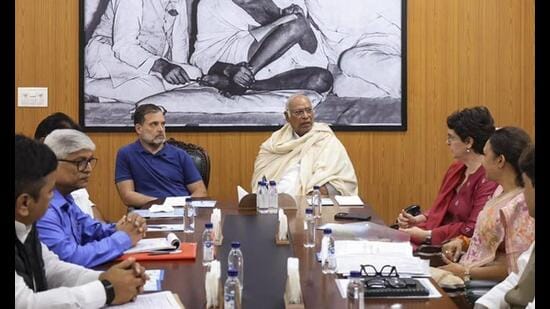
The development follows a meeting on Monday at the residence of Congress president Mallikarjun Kharge in New Delhi, attended by senior party leader Rahul Gandhi. Gandhi is also expected to launch the Congress’s campaign for the 2027 UP Assembly elections in the first week of December.
After the meeting, UP Congress president Aradhana Mishra said Gandhi had made it clear that the alliance should prioritise the selection of the strongest candidates rather than get caught up in numerical demands.
“For the seat-sharing meeting with the SP, Rahul Gandhi has said the focus should be on choosing the best candidate instead of going by numbers, to ensure that the alliance wins. The onus for the discussion is primarily on state office-bearers Rajendra Pal Gautam and Imran Masood,” Mishra said.
Gandhi has left for a three-day academic visit to the US, and the seat-sharing exercise is expected to be taken forward before his return.
{{/usCountry}}Gandhi has left for a three-day academic visit to the US, and the seat-sharing exercise is expected to be taken forward before his return.
{{/usCountry}}Party sources indicated that national general secretary (organisation) KC Venugopal could also be part of the discussions. Mishra also underlined the role of Congress leader Priyanka Gandhi Vadra in the party’s organisational affairs in UP.
“Priyanka Gandhi has been an integral part of UP’s party organisation,” she said.
Meanwhile, Akhilesh Yadav, who was in New Delhi for the launch of Congress Parliamentary Party chairperson Sonia Gandhi’s debut memoir, stressed that the alliance would work on the basis of mutual respect and the relative strength of candidates.
Explaining the proposed approach, Yadav said: “The INDIA alliance will fight together, and we will also make seat adjustments and respect each other. For instance, if there are two seats, one candidate may be proposed by them and another by us. The candidate who is best suited will be fielded.”
The conciliatory tone marks a shift from the tensions that characterised relations between the two partners in the INDIA bloc in Uttar Pradesh before the 2024 Lok Sabha elections. Their differences had come into the open after the Congress refused to accommodate the SP in the Madhya Pradesh Assembly elections in November 2023, triggering a war of words between the allies.
However, the two parties eventually reached a seat-sharing arrangement for the 2024 Lok Sabha polls, announcing the agreement at a joint press conference in Lucknow. The alliance went on to deliver a strong electoral performance, with the INDIA bloc defeating the BJP in Uttar Pradesh.
The Congress’s initial demand for 181 Assembly seats may not translate into its final share, particularly in view of the negotiations that preceded the 2024 Lok Sabha polls. Ahead of those elections, the Congress had initially sought 37 of UP’s 80 parliamentary seats but eventually agreed to contest 17 in alliance with the SP, winning six.
Political observers believe the current demand should be viewed in that context rather than as the party’s final bargaining position.
The 181-seat list, a copy of which is with Hindustan Times, includes 135 general-category seats (74.59%), 45 Scheduled Caste-reserved seats (24.86%) and one Scheduled Tribe-reserved seat (0.55%) out of the state’s total 403 Assembly constituencies.
Congress sources said the seemingly ambitious demand was part of the party’s initial strategy. The party had contested 114 seats in alliance with the SP in the 2017 Assembly elections but won only seven, with a vote share of around 6.25%.
Although the SP has yet to formally name its representatives for the seat-sharing exercise, preliminary discussions are expected to establish the framework for negotiations, with the final decision resting with the respective party leaderships.
Separately, discussions were also held at a meeting involving Priyanka Gandhi Vadra and Congress Legislature Party leader Virendra Chaudhary on the constitution of the UP Congress state executive, election committee and campaign committee. The state unit is expected to propose names for these bodies this week.
Among the constituencies figuring prominently in the Congress’s initial demand are seats in its traditional strongholds of Rae Bareli and Amethi. These include Rae Bareli Sadar, Bachhrawan, Harchandpur, Salon, Sareni, Unchahar, Tiloi, Jagdishpur, Gauriganj and Amethi.
The party has also identified several constituencies in the state capital, Lucknow, including Mohanlalganj, Malihabad, Bakshi Ka Talab, Sarojini Nagar and Lucknow East.
In districts where the Congress has a sitting Member of Parliament (MP), the party intends to contest at least three seats. Its strategy involves staking a claim to two seats in some districts, and at least one seat in the remaining districts.