When it comes to public transportation, many people in India prefer double-decker sleeper coaches to avoid the rigmarole of train journeys. However, Uttar Pradesh has recently experienced a spate of major road mishaps involving double-decker buses operated by private operators, with these vehicles often failing to meet prescribed standards for body construction and frequently flouting other safety norms.
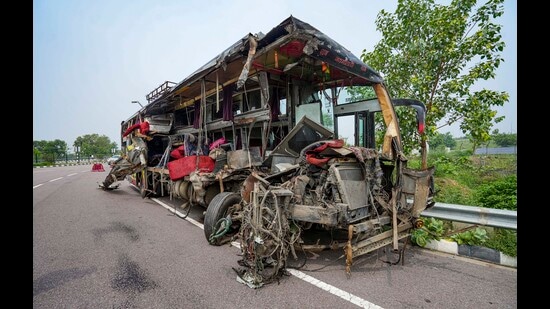
Some of the major accidents within the state’s jurisdiction are:
*In May 2024, an overloaded inter-state private bus veered off the road and overturned, seriously injuring several passengers near Hardoi. The bus was carrying 70 Nepalese passengers from Lakhimpur to Mumbai.
*On July 10, 2024, an uncontrolled speeding private bus rammed into a tanker from behind, killing 18 people and injuring several others on the Agra-Lucknow Expressway near Unnao.
*And a day later after Unnao accident, on July 11, 2024, another private bus collided with a truck near Hathras, killing at least two people and injuring 16 others.
*In July 2022, as many as eight people were killed and 16 others injured when a Delhi-bound double-decker bus rammed into another double-decker bus parked outside a restaurant on the Purvanchal Expressway near Barabanki.
*In July 2020, a private bus overturned after ramming into a stationary SUV, killing six persons and injuring 36 others on the Lucknow-Agra expressway near Kannauj.
{{/usCountry}}*In July 2020, a private bus overturned after ramming into a stationary SUV, killing six persons and injuring 36 others on the Lucknow-Agra expressway near Kannauj.
{{/usCountry}}One thing common to all the above cases is that the bus involved in each accident was invariably a double-decker, breaching all possible rules. Post-mishap inquiries in all the above cases found these double-decker buses to be habitual offenders flouting rules regarding fitness, permit, body construction, etc., without any fear of being punished, with the enforcement agencies turning a blind eye to the organised practice.
“To maximise profits, the private operators often compromise passengers’ safety by not making the bus body as per the Automotive Industry Standard (AIS), increasing the seating capacity, and changing the layout. Owing to such reasons, the towering double-decker buses often veer off the road at high speed or meet with accidents in other ways,” additional transport commissioner (road safety) PS Satyarthi pointed out.
“A three-member committee found that the bus involved in last week’s Unnao accident did not comply with AIS-119 standards,” said Satyarthi.
He also added that since most of the double-decker buses were covered with an all-India permit, they are supposed to have two drivers on inter-state routes. “But they generally do with one driver on long routes, because of which the over-fatigued driver sometimes loses control over the steering resulting in tragedies,” he stated.
An official from the UP State Road Transport Corporation (UPSRTC) said that one of the main reasons double-decker buses are more prone to accidents is their higher centre of gravity. Due to their design, they are more likely to tip, especially when navigating sharp turns.
“The risk ups many times when such buses are not manufactured as per the prescribed layout,” he added.
SaveLife Foundation head Piyush Tewari echoed the same point saying that double-decker/sleeper coaches are generally unsafe due to the way they are built, often locally, in gross violation of safety rules.
“The government of India has recently amended AIS 119 pertaining to manufacturing sleeper buses to make them safer,” he said.
The rules, as was evident from the recent Unnao accident, are being followed only in breach.
The recent mishaps, according to Satyarthi, have brought to light the urgent need for stricter enforcement of safety norms and rigorous inspections of private operators’ fleets to ensure compliance with the new regulations.
“We are committed to disciplining these buses as action against them is being taken every day since the Unnao accident,” he claimed.
The UPSRTC, meanwhile, said on Tuesday that following the instructions of chief minister Yogi Adityanath on Saturday, the transport department’s action against unauthorised buses (including double-deckers) operating without permits and fitness certificates had resulted in an additional daily income of approximately ₹2 crore for the corporation.
“The number of passengers has also increased by around 200,000 daily. If this campaign continues for a month, the transport corporation is expected to generate substantial revenue,” UPSRTC chief general manager Ajit Kumar Singh said.