Days before the Prime Minister Office’s October 14 review meeting on air pollution in Delhi and National Capital Region (NCR), Uttar Pradesh chief secretary (CS) Durga Shankar Mishra has issued a slew of directions to officials and asked them to strictly curb the incidents of stubble and garbage burning in the state.
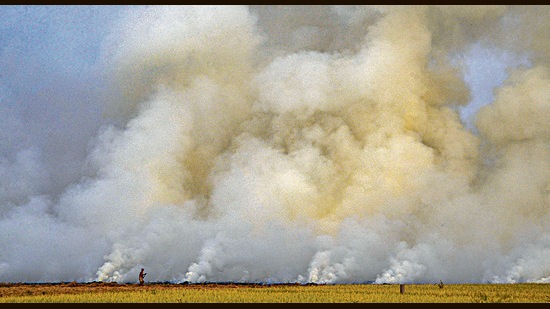
In a government order issued to all divisional commissioners, district magistrates and district police chiefs on Monday, the CS has asked the officials to ensure legal penal action is taken against farmers found burning crop residues, and also create awareness among them about the negative impact of stubble burning on the environment.
“The chief secretary’s directions come only a few days before the principal secretary to the Prime Minister is scheduled to hold a meeting with Delhi, Punjab, Haryana and U.P. to take stock of the situation arising from air pollution in Delhi and the NCR,” a senior agriculture department official pointed out.
The burning of crop residues and garbage is seen as a major cause of air pollution in the NCR, where the air quality worsens every year in the October-November period when paddy harvesting is done.
The directions issued, however, are applicable to the entire state and not just the U.P. districts falling under the NCR. The CS, in the GO, also fixed the target for collection of crop residues from farmers for use at stray cattle centres during the current financial year.
{{/usCountry}}The directions issued, however, are applicable to the entire state and not just the U.P. districts falling under the NCR. The CS, in the GO, also fixed the target for collection of crop residues from farmers for use at stray cattle centres during the current financial year.
{{/usCountry}}Reiterating that banning stubble burning is mandatory as per the order passed by the Supreme Court in MC Mehata vs Union of India, 1985 and another passed by the National Green Tribunal (NGT) in the Ganga Lalvani vs Union of India, the CS asked the officials to stop incidents of stubble burning through communication, education and information activities in villages as well as through enforcement of legal provisions.
“The director of NCR, too, has written to states on October 4, 2022, asking them to effectively prevent the incidents of stubble burning by farmers,” Mishra pointed out in the GO, in which he added that a nodal officer should be appointed for each cluster of revenue villages, and who should be tasked with making farmers aware of the legal and environmental implications of burning crop residues.
The lekhpal, he said, must be held accountable for any incident of stubble burning in a village under his jurisdiction. “Police officers have been asked to ensure legal action against those found violating the law related burning of crop residues. Sub-divisional magistrates (SDMs) have been asked to constitute mobile squads for the purpose,” the order read.
“The government not only withdrew cases lodged against more than 850 farmers for burning stubble in 2019 and 2020 but also directed the police not lodge fresh cases against the farmers following which no FIRs were registered against any farmer for burning crop resides in 2021,” a home department official revealed.