History merges with the timeless appeal of valour in the quest for freedom at the sleepy village of Kakori, about 20 km from the state capital, and the 120-year-old Chhedi Lal Dharmshala in a busy lane of Aminabad in the heart of Lucknow. The two sites pulsate with the spirit of patriotism even 100 years after the Kakori Train Action that dealt a blow to the British government’s prestige.
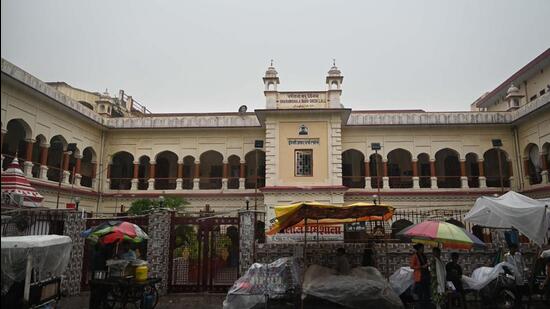
A visit to Room No. 227 on the first floor of the Chhedi Lal Dharmshala conjures images of the day when Ram Prasad Bismil and his nine fellow freedom fighters might have come in while quietly planning the Kakori Action for August 8, 1925 initially. The room is the only renovated one at the dharmshala.
“We thought it should be honoured in the name of those who gave up their lives for the cause of freedom. We got the room renovated in 2019,” said dharmshala manager Ram Nath Gupta.
In his book ‘Lucknow ka Krantiteerth’, Udai Khatri, historian and son of freedom fighter Ramkrishna Khatri, mentions that most of the revolutionaries stayed at Chhedi Lal Dharmshala, not as a group but as strangers.
“At the decided time, they all assembled and began walking towards the railway station. However, once they reached it, they found out that they missed the Number 8 down-train from Shahjahanpur to Lucknow, making them shift their plan for the next day,” the book mentions.
{{/usCountry}}“At the decided time, they all assembled and began walking towards the railway station. However, once they reached it, they found out that they missed the Number 8 down-train from Shahjahanpur to Lucknow, making them shift their plan for the next day,” the book mentions.
{{/usCountry}}They decided to take no chances and left Lucknow to reach the previous station and boarded the train on August 9. Three of them –Ashfaqullah Khan, Rajendra Nath Lahiri and Sachindra Nath Bakshi – took second class tickets. The others, including Ram Prasad Bismil, Chandrashekhar Azad, Mukundilal, Murarilal, Kundanlal, Banwarilal and Manmathnath Gupta, travelled third class and spread over the entire train, said Prof Aroop Chakrabarty, former head of the medieval and modern history department of Lucknow University.
“Those in the second class pulled the chain, the abrupt stoppage led to some commotion. The members jumped out to execute the plan. One of them rushed towards the engine while another headed to overpower the guard and take charge of the railway treasury,” Chakrabarty said.
“Carrying Germany-made Mauser pistols, they were quick to overpower the guard who was made to lie down on his belly. Two men stood on each side of the railway line while another group pushed out the heavy iron safe carrying railway collections from the stations on the route. Two of them who carried a huge hammer and chisel got into action on the safe. They fearlessly worked on the mission, however, when they saw a train progressing near them, they became a bit panicky, but they continued to accomplish the task and the train whistled off,” he said.
Mita Bakshi, granddaughter of freedom fighter Sachindra Nath Bakshi who faced trial in the case, said the mission was planned to get more funds to buy more Mauser pistols from Germany.
“The members of Hindustan Socialist Republican Association had accomplished several small missions in villages and all those involved in any of these missions were taken under trial as part of the Kakori Train Action case,” Mita Bakshi said.
As per an archival document (Hindustan Times has a copy) , a case was registered in the name of 28 people under Sections 121 (A) and 120 (B) of the Indian Penal Code read with Sections 396 and 302 of IPC after the three complaints by an English officer Horton.
“Mr Horton explains the cartridges which were recovered from the scene of the train dacoity – He says that were ten 300 bore German pistol cartridges. Three other and two more similar cartridges were marked respectively. Out of all these cartridges, twelve were marked DWMKK and one of these was loaded. All these were Mauser pistol cartridges,” the document reads.
It also mentions that cash worth ₹3541, 3 paisa and 6 annas, GC notes worth ₹1012 and vouchers worth ₹125 and 14 paisa were carried away by the freedom fighters. Once the revolutionaries were arrested, the case began at Roshan-ud-daula Kachehri in December where Syyed Amin-ud-din was assigned as the special magistrate.
‘Lucknow ki Chaya Mein,’ a book by Ramkrishna Khatri, gives an account of the trial.
“A large number of people turned up outside the court and once our handcuffs were opened, one could not make out a difference between those accused and the public. Sighting the situation, police sought permission (for the freedom fighters) to be brought with bedis (cuffs with chains around the neck). However, we refused to wear the bedis, police forced us to wear them. They had two lorries and each lorry had five to six individuals at a time. While forcefully tying bedis, one amongst us, Vishnu Sharan Dubish got hurt in the leg on which we raised slogans - ‘Bharat Mata ki Jai’, ‘Bhartiya Prajatantra ki Jai’ and ‘Vande Matram while reaching the kachahari,” the book reads. Another passage in the book mentions Basant Panchmi day in 1926 when revolutionaries tied saffron handkerchiefs and sang ‘Rang de Basanti Chola’ on their way. The next day, several people with saffron caps turned up from Kanyakubja College (now Jai Narain PG College) to the court and all sang ‘Rang de Basanti Chola’. After a six-month trial at the Roshan-ud-daula Kachehri, the court shifted to a special sessions court with Hamilton as the special judge at the Rink Theatre (where the General Post Office stands today). The trial continued there for 10 to 11 months.
Historian Ravi Bhatt said when the revolutionaries were in prison, some jailers and employees brought their family members to see them as a mark of respect.
A letter by Sachindra Nath Bakshi to the Home Member of Government of United Province, mentions some demands made by them. It included at least 12 annas’ diet as per their preference, one standard daily newspaper, dress, bedsheets and cots along with soaps, toothpaste, toothbrushes, indoor games.
When freedom fighters assembled for action
The Kakori Shaheed Smarak stands tall at Bajnagar village. Clad in dhoti-kurta, Munnilal Rajput (75), the caretaker with a wooden stick, recounts an eyewitness account he heard from his grandmother.
“My grandparents were devotees at a temple situated on the Shaheed Smarak compound. My grandmother told me that she was performing puja on August 8, 1925 (the day before the Kakori Train Action) when a group of young men entered the premises and began planning something. After some time, they left for the station but they failed to board the train. However, they turned up again at the same time and, barring a few others, went to the station again and the rest is history,” Rajput said.
He said that he considers the freedom fighters as revered as the deities in the temple.
“I spend my entire day at the Smarak, cleaning the statues and helping the visitors to the place,” he added.
The room of freedom fighter Ramkrishna Khatri has paintings of many freedom fighters. Khatri’s grandson Rohit Khatri said that his grandfather got them painted when he was alive and the family has maintained the legacy.