Lucknow’s past may be cherished, but it should not be romanticised at the cost of its present, additional chief secretary basic and secondary education and author Partha Sarthi Sen Sharma said at the Gomti Book Festival at the University of Lucknow on Sunday. He said the city’s culture and traditions were constantly evolving and there was no point in deciding that everything about the past was good and everything in the present was bad.
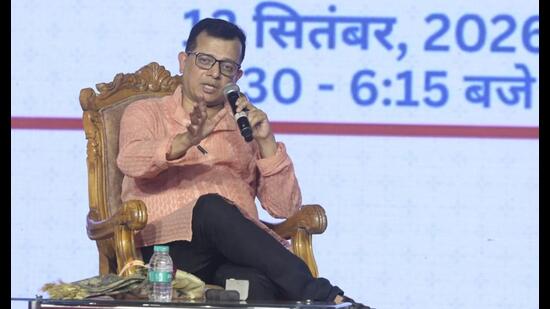
“The city has a mix of people representing the 19th century and the 22nd century as well. The city’s culture and tradition are not static. They will evolve and it is a continuous process,” Sen Sharma said.
He said the Lucknow of 50 years ago would be different from the city of 100 or 150 years ago. “You cannot point a finger and say this was good and that was bad. One should not think that everything was good in the past and everything is bad in the present,” he said.
Novel on Lucknow
Sen Sharma said he wants to write a historical novel based in Lucknow and Delhi, spanning 1916 to 2026 through the journey of two or three families. “It will be a story of modern contemporary Lucknow,” he said.
Talking about his novel ‘Lucknow diaries: of love and longing,’ he said, “it was on three friends brought up in Lucknow - a story of three individuals: one went on to become a journalist, another a politician and one becomes an IAS officer. And they have their own love stories. The book will have a slice of Lucknow University too,” he said.
{{/usCountry}}Talking about his novel ‘Lucknow diaries: of love and longing,’ he said, “it was on three friends brought up in Lucknow - a story of three individuals: one went on to become a journalist, another a politician and one becomes an IAS officer. And they have their own love stories. The book will have a slice of Lucknow University too,” he said.
{{/usCountry}}The bureaucrat said he had been able to balance his professional life with writing. He said colleagues would not say that he mixed the two or failed to do justice to his professional responsibilities because he was writing books.
Limits of an IAS officer-author
“When an IAS officer writes, he knows that he cannot write such things which are even remotely against the government. An IAS officer as an author cannot write many things,” he said.
Asked if he would write about issues he could not touch upon as a bureaucrat after retirement, Sen Sharma said, “Not necessarily. It is not that I wanted to criticise the government and I could not. Once I retire there will be no time restrictions but having said that, it has to be seen how much will be left in me to write a book by then.”
Quizzing and his latest book
Speaking about his interest in quizzing, Sen Sharma said he prepares multiple-choice questions that require some thought, with three options often being close to the correct answer.
His recent book, ‘The Viksit Bharat Quiz Book’, takes readers through India’s story through questions. He said it was not a guide to cracking competitive exams but sought to encourage curiosity about India’s past and present.
He said he wrote the book because he did not have the time or mental space to travel and write a travelogue.