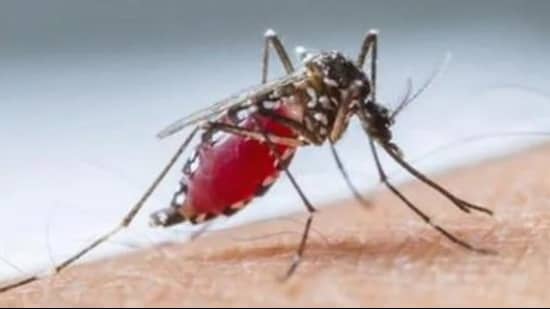
Continuous rainfall over the last three days has increased the risk of vector-borne diseases such as dengue, malaria and chikungunya in the city, with waterlogging reported in several localities.
Health officials said surveillance and preventive measures have been intensified across all eight zones of Lucknow. Teams have been deployed in vulnerable areas to distribute medicines and spread awareness.
“Teams in all eight zones are keeping a close watch. Medicine distribution and awareness activities are being carried out,” said Yogesh Raghuwanshi, district health education and information officer in the office of the chief medical officer (CMO).
Each zone has a malaria inspector and his team assigned multiple wards. The teams identify potential mosquito-breeding sites, conduct house-to-house surveillance and carry out source reduction. Around 250 households were checked on September 25 alone, officials said.
Notices are also being issued to owners of premises where mosquito larvae are found, they added.
Multiple medical mobile units (MMUs) have been deployed for several weeks, with residents continuing to visit the units for consultation and medicines.
Chief medical officer, Dr NB Singh has directed all urban and rural health centres to remain prepared and ensure adequate stocks of medicines, including anti-snake venom (ASV) and other essential drugs related to vector-borne diseases, officials said.
Government hospitals have also been put on alert to manage patients reporting with dengue, malaria, chikungunya and other illnesses that may increase after prolonged rainfall and waterlogging.
{{/usCountry}}Government hospitals have also been put on alert to manage patients reporting with dengue, malaria, chikungunya and other illnesses that may increase after prolonged rainfall and waterlogging.
{{/usCountry}}District malaria officer Ritu Srivastava said continuous rain has both advantages and challenges.
“Due to continuous rain in the last couple of days, the accumulated larvae have been washed out, we expect. Also the temperature has significantly reduced in the last couple of days and no humidity is present. If this continues, we can surely control vector-borne diseases,” Dr Srivastava said.
She said the crucial period will be after the rain stops.
“As the rain completely stops, our teams will focus on vulnerable areas or areas where more cases are found. Source reduction, anti-larval spraying and fogging is what we do on a regular basis after the rain stops with coordination with other departments,” she said.
Dr Srivastava said across the city there are 110 wards and five malaria inspectors with their dedicated teams.
According to official data, from January 2026 till date, the city has reported 255 dengue cases, 251 malaria cases and 18 chikungunya cases. No case of Japanese Encephalitis (JE) has been found in the city for the last four years, officials said.