Burning effigies of demon King Ravana is a common feature at many places in Dussehra.
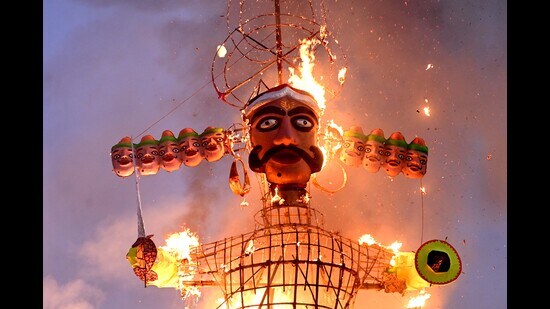
But in Kanpur and its neighbouring districts, Ravana’s effigy is not always set on fire.
Derapur Ram Leela in Kanpur has the tradition of tossing the effigy of Lanka Teela. A former chairman of the organising committee, Daya Shankar Shukla says its tradition, of late, has seen some change. Now the practice takes place on Ekadashi in line with the scriptures, and not on Dussehra.
He says even after Lord Rama’s arrow hit his navel region, Ravana breathed his last on Ekadashi.
Similarly, the effigy is not burnt in Kanjihari in Kanpur Dehat where Ram Leela goes on for nine days, but minus the part where Lord Rama shoots the arrow at Ravana. Ram Kumar Dixit, 80, says this Ram Leela is 300 years old and never in its history was Ravana’s effigy burnt.
This was done on the advice of some sages from Chitrakoot. During Dussehra, the characters presented the Rama-Ravana battle, he says. The portrayal of Ravana’s killing was on ‘trayodashi’ (13th day).
Bhagwati Mishra, 83, says Ravana was a greater scholar and, out of respect, his effigy is not burnt there.
{{/usCountry}}Bhagwati Mishra, 83, says Ravana was a greater scholar and, out of respect, his effigy is not burnt there.
{{/usCountry}}In Kannauj, Ravana’s effigy is burnt instead on Sharad Purnima. Shiv Kishore Mishra, the organiser of this Ram Leela held every year since 1880 on Gwala ground, says Ravana died on Sharad Purnima and so his effigy was not burnt on Dashami.
Similarly, Ravana’s effigy is not burnt at the main Ram Leela in Unnao, where it was first staged 146 years ago. The tradition has remained unchanged since, says Pradeep Tiwari.
In Shivala, Kanpur, Ravana is worshipped on the occasion of Vijaya Dashami. The premises have a small temple where priests perform the rituals. Sagar Narayan Tiwari says Ravana was a great king and a scholar par excellence, and he is worshipped because of his virtues.