LUCKNOW The 18th BRICS Academic Forum organised at Lucknow University on Monday saw experts from academia and policymakers from BRICS nations emphasising the importance of upholding sovereignty, opposing unilateralism and fostering coordinated roles to promote global peace. They also underscored the need for fostering academic and scientific cooperation, apart from the organisationsfocus on economics.
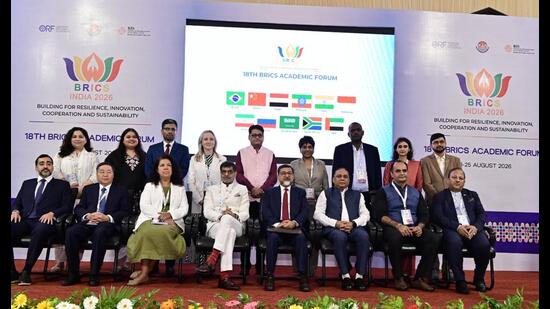
These were discussed during the inaugural session of the forum and a panel discussion ‘Investing in Resilience: A Systematic Imperative’ at the Malviya Auditorium of LU.
“Apart from economic aspects, BRICS must think about fostering academic and scientific cooperation. In a complex multipolar system, foreign policy strategies based on diversification require knowledge and expertise across different countries and regions,” said one of the panelists, Haroldo Ramanzini Junior, associate professor, Institute of International Relations, University of Brasilia (Brazil).
He said the 2020s had been marked by growing global instability and there was escalation of unilateralism, violations of sovereignty, increasing global military expenditures and the expansion of conflicts.
“Since President Donald Trump returned to power in January 2025, the current foreign policy of the United States has increased uncertainty and geopolitical tensions while weakening the foundations of international cooperation. In Latin America, the US has been using different strategies to establish a zone of dominance,” he said while terming some BRICS and Global South countries as important voices in support of a more legitimate, less selective and multipolar international order.
Sameera Malakmurad, learning and development specialist, Mubadala Group, United Arab Emirates, said that BRICS countries should not only respond to the crisis, but need to be ready beforehand.
{{/usCountry}}Sameera Malakmurad, learning and development specialist, Mubadala Group, United Arab Emirates, said that BRICS countries should not only respond to the crisis, but need to be ready beforehand.
{{/usCountry}}“This means investing in education, skills, health, youth, women and opportunities for future generations as well,” she added.
Earlier, the day began with an inaugural session where Harsh V Pant, vice-president, Observer Research Foundation, India; Jai Prakash Saini, vice-chancellor, LU; Samir Saran, president, Observer Research Foundation, India, spoke about BRICS and the collective work being done by BRICS nations.
Sudhakar Dalela, secretary (economic relations) and BRICS Sherpa, ministry of external affairs, said India convened over 400 meetings, of which over 350 concluded with substantive outcomes.
“Five broad themes are linked to the forum’s priorities: Investing in resilience; innovation for people, planet and enterprise; scaling sustainability and emerging technologies. For example, on innovation, the action plan on innovation-led growth for BRICS startups promotes startup collaboration, innovation exchange, cross-border incubation, financing and market access, including a proposal for a BRICS incubator network. On resilience, the BRICS Logistics Supply Chain Cooperation Framework strengthens the resilience and sustainability of cross-sector transport logistics through technical exchanges, knowledge sharing, and capacity building, which reflects the growing synergy between ideas and action within BRICS,” said Dalela.
It was followed by a formal launch of the BRICS compendium: Building for resilience, innovation, cooperation and sustainability. Jing Zhao, deputy secretary-general of the China Council for BRICS think-tank cooperation, China, proposed four actions: building an independent Global South knowledge system beyond Western theory, fostering an innovative mindset, enhancing cooperation efficiency via the Global South think tank alliance and prioritizing youth talent exchange.
Alireza Khoda Gholipour, director general-designate and director for Asian Studies, Institute for Political and International Studies (IPIS), Iran, in his virtual address, emphasised that BRICS needs more than expansion - deeper mutual understanding and evidence-based narratives to prevent misunderstandings. “There is a need for permanent intellectual networks, joint research, fellowships, not just conferences,” he said.