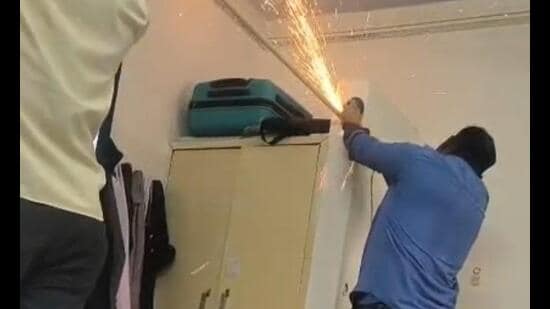
Struggling to contain a spate of suicides by hanging on its campus, the Indian Institute of Technology (IIT), Kanpur, has begun removing embedded pipes used by students to dry clothes from hostel rooms and installing spring-loaded devices in ceiling fans.
These devices are specially designed to trigger an alarm and automatically lower the fan’s height if the weight applied to it exceeds a certain limit, a mechanism intended to prevent students from using the fixtures to harm themselves.
ALSO READ | ‘World is not for me’: 21-yr-old IIT-B student dies by suicide
The pipes, fixed to walls, are being removed from halls 1 to 3, older hostel buildings, which have nearly 1,500 rooms in total. The spring-loaded devices will be installed in every ceiling fan across all 14 hostels of the institute.
The measures come in the wake of nine student suicides in two years. IIT Kanpur alone accounted for 30% of the 30 suicides reported across 23 IITs in the country last year, according to Dheeraj Singh, founder of a global IIT alumni support group and an alumnus of the 2004 batch.
Prof Manindra Agarwal, director, IIT-Kanpur, confirmed the steps, saying they were being taken on the recommendation of an external committee formed last year. “The pipes are only in one or two hostels. The devices are being installed in all hostels in line with the recommendation. The pipes have been removed, and device installation will take some time,” he said.
{{/usCountry}}Prof Manindra Agarwal, director, IIT-Kanpur, confirmed the steps, saying they were being taken on the recommendation of an external committee formed last year. “The pipes are only in one or two hostels. The devices are being installed in all hostels in line with the recommendation. The pipes have been removed, and device installation will take some time,” he said.
{{/usCountry}}Students on campus said the removal of pipes in three hostels was nearly complete and that they had been informed device installation would begin next week. The most recent suicide this year set off a sharp reaction on campus, with students confronting authorities, laying siege outside their residences and holding candlelight vigils.
Under mounting pressure, a three-member committee was constituted, headed by Dr Dhananjay Kumar, head of psychiatry department at GSVM Medical College, to examine the factors behind the deaths.
A student gymkhana office-bearer said the committee had spoken to students, most of whom supported the removal of pipes and installation of the devices. “You can say it is a collective decision to prevent students from taking any extreme step,” he said.
Another student, however, described the suicides as the result of a collective failure. “The problem is structural — everyone knows all is not well within IIT Kanpur. Such steps only serve to hide the structural lapses that are affecting students, lower-rung employees and even faculty members.”
Prof Agarwal said the underlying structural issues were being addressed. He cited the problems faced by PhD scholars with their supervisors as one area of focus and said the institute was setting up a 24x7 external counselling hotline for students. “There are many things students do not want to share with people directly associated with them. This is being done on the recommendation of the committee,” he said.