Union power secretary Alok Kumar was in the city last week to participate in the sectoral session on ‘Sustainable Development Through Renewable Energy’ at Uttar Pradesh Global Investors’ Summit (UPGIS). Having led the state’s energy sector for a significant amount of time, he put forward a number of suggestions to improve the efficiency of the state’s power distribution companies (discoms). In an exclusive conversation with Brajendra K Parashar, Kumar spoke at length on different issues, including the controversial smart metering project and the state’s reluctance to import coal. Excerpts:
In your address at the sectoral session of UPGIS, you advised discoms to speedily roll out the ambitious smart prepaid metering. Please elaborate.
The speedy rollout and execution of the smart prepaid metering project being implemented across the country under the Centre-funded Reforms-Based and Result-Linked Revamped Distribution Sector Scheme are very essential for discoms to reduce their losses and increase bill collection efficiency. The results of smart meters already installed in many states, including UP, under the old schemes are encouraging. However, UP’s collection efficiency (the proportion of money recovered from consumers with regard to the billed amount) is unsatisfactory.
But Madhyanchal Vidyut Vitran Nigam Ltd (MVVNL), one of the five state-owned discoms in UP, has cancelled the smart prepaid metering tender that was to be awarded to a company of the Adani group even after the latter was found to be the L1 among all bidders.
This is none of our concern. Awarding and cancelling a tender is the states’ prerogative and they are free to award the smart metering project to any company they want to by following the due tendering process. Our only concern is that UP, or any other state for that matter, should not keep sitting on the smart metering project. We have told UP discoms to finalise tenders at the earliest without any delay. The first phase of meter installation in big cities must be completed by this December.
{{/usCountry}}This is none of our concern. Awarding and cancelling a tender is the states’ prerogative and they are free to award the smart metering project to any company they want to by following the due tendering process. Our only concern is that UP, or any other state for that matter, should not keep sitting on the smart metering project. We have told UP discoms to finalise tenders at the earliest without any delay. The first phase of meter installation in big cities must be completed by this December.
{{/usCountry}}It is learnt that you recently called a meeting of UP Power Corporation Ltd (UPPCL) officials in Delhi in this regard.
The meeting was not about the new smart prepaid metering tenders but the old ones. UPPCL has had some issues with Energy Efficiency Services Ltd (EESL), a Government of India enterprise, and the meeting was to thrash out those issues.
The state has not agreed to import expensive foreign coal for the purpose of blending it with domestic coal despite the power ministry’s repeated advisories and directions. Has the ministry accepted the state government’s stand on the issue?
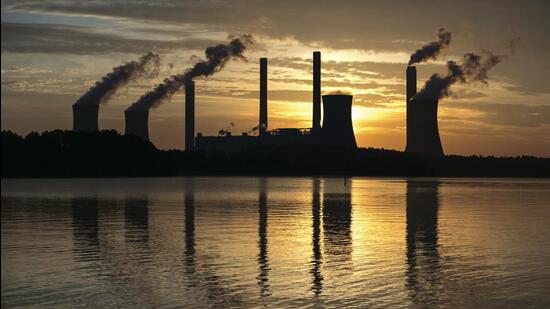
Not at all. We have advised UP to reconsider its decision on coal import. We have told all the states that providing additional coal rakes to them will not be possible when they feel the coal crunch at thermal plants if they do not import the same. Since the demand for power is increasing in the country, and so is for coal, blending is necessary to augment coal stocks at thermal plants.
During the three-day GIS, UP signed MoUs worth around ₹8 lakh crore for private investment in renewable energy alone against the total intents worth ₹35 lakh crore. How do you see this?
In fact, the state needs even bigger investments in the renewable energy sector. This is because UP’s renewable purchase obligation (RPO) is around 8% vis-a-vis the national average of 24%, which means of the total power that UP discoms buy and sell to consumers, renewable power comprises a meagre 8%. Their target, now, should be to get the maximum number of MoUs converted into actual investments and projects.
Climate change is a worldwide concern. The energy sector, especially fossil power, accounts for the highest amount of CO2 emissions in India. The way demand for power is increasing in the country emissions will further increase. Any roadmap to deal with this situation?
India is a developing nation and cannot lower its pace of development. So, the demand for power is bound to increase with the increase in developmental activities, all resulting in more CO2 emissions. What we can do is reduce the emission intensity (rate) while making efforts to get more and more power from non-fossil (renewable) sources. Energy efficiency is another area we are continuously working on to mitigate the situation.
Increasing the air-conditioning space is a matter of concern and needs to be controlled, especially by industrial and business establishments. We are amending the Energy Conservation Act under which energy conservation targets will be fixed for big industries.
At the summit, you advised UP to be smart about its power procurement. What does this mean?
UP should not engage in long-term power purchase agreements (PPAs). The state does not require the same amount of power throughout the year. It is only during certain months in a year when the demand is very high requiring the availability of more electricity. The state, however, has to pay a huge amount of money as fixed charges to producers even if it buys no power from them in the months when the demand is low. UP is paying a whopping ₹10,000 crore annually as fixed charges only to producers because of avoidable long-term PPAs it entered into in the past.