MUMBAI: At a brainstorming session on Tuesday, titled ‘Making Mumbai a Liveable, Modern City’, civic chief Bhushan Gagrani, retired IAS officer R C Sinha, and architect P K Das addressed the impact of the frenetic infrastructure boom on the city and its residents. The discussion delved into the implications of the new transport corridors, including the Coastal Road, the Atal Setu and the Metro rail lines, and whether they were, in fact, adding to Mumbai’s challenges.
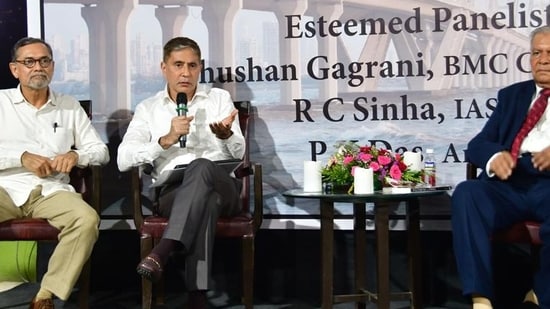
Gagrani remarked on the significant changes underway in Mumbai, highlighting a visual transformation that was likely to spur socio-economic shifts as well. Drawing parallels with historical urban development, he noted that what Mumbai was experiencing was comparable to the transformation of Manhattan under the Commissioner’s Grid Plan of 1811, which was completed around 1875. The civic chief pointed out similarities in the challenges faced, including urban planning and topography issues, and emphasised the importance of addressing these within various socio-economic contexts.
Citing the Mumbai-Pune Expressway, a project initiated by Sinha, as an example of how infrastructure can drive broad economic benefits, Gagrani explained that though it was initially met with apprehension and opposition, the project had a transformative impact on Pune, turning it into a major IT export centre, an automobile hub, and a research and development centre. “Without this connectivity, Pune’s rapid development and economic opportunities might not have materialised,” he said.
The BMC chief underscored that infrastructure projects, particularly those enhancing connectivity, yield benefits beyond mere commuting convenience. These projects can have substantial, often unforeseen, socio-economic impacts. As an example, he predicted that the Coastal Road and Mumbai Trans Harbour Link (MTHL) would transform the real estate market over the next five to ten years, bringing equilibrium to both residential and commercial sectors.
{{/usCountry}}The BMC chief underscored that infrastructure projects, particularly those enhancing connectivity, yield benefits beyond mere commuting convenience. These projects can have substantial, often unforeseen, socio-economic impacts. As an example, he predicted that the Coastal Road and Mumbai Trans Harbour Link (MTHL) would transform the real estate market over the next five to ten years, bringing equilibrium to both residential and commercial sectors.
{{/usCountry}}Reflecting on the rapid pace of change, Gagrani quoted a Hindi song, ‘Kya koi nayi baat nazar aati hai hum mein/ Aaina humein dekh ke hairaan sa kyun hai?’ He interpreted this line to convey the idea that the speed of transformation was so astonishing as to even surprise the mirror, but he viewed this positively.
Activist and architect P K Das of PK Das & Associates, however, raised critical concerns about the ongoing development projects in Mumbai. He questioned the tangible benefits of these projects, despite the considerable fervour, financial investment and government support they receive.
The architect argued that while improvement was evident, “it is crucial to assess who actually benefits from it”. “To understand the dynamics of development in Mumbai, both the positive and negative impacts must be discussed,” he said.
Das also highlighted a pressing issue that is always overlooked: the neglect of Mumbai’s natural, ecological infrastructure, and stated that the failure to integrate this into urban planning could lead to a bleak future and existential crisis for both the people and the city.
“Mumbai’s natural areas span 140 square km, while the buildable area is 240 square km,” he said. “However, development plans and infrastructure initiatives focus exclusively on the 240 square km, disregarding the ecological areas that include approximately 800 km of nallahs (drainage channels), four major rivers, hills, wetlands, creeks, beaches, and waterfronts.”
The urgency of considering ecological infrastructure stems from the climate crisis, which Das views as a primary responsibility. “Rising temperatures in Mumbai have created a heat island effect, significantly impacting the city’s liveability,” he said. “This phenomenon leads to heat stress, which adversely affects both the mental and physical health of residents, reducing their productivity and harming the city’s economy.”
The activist said the trend of growth in Mumbai was compelling, with each major project contributing to physical expansion. “However, construction practices, particularly those involving high-rise buildings and mega infrastructure projects, exacerbate the heat island effect and associated health impacts,” he said. “Numerous studies have documented the severe health consequences in rehabilitation colonies and working-class settlements, highlighting the adverse effects of dense construction without sufficient open spaces.”
Das criticised the ‘Build more’ mania prevalent in Mumbai, where the powers that be have a pervasive belief that increased construction will solve all urban problems. He warned that this mindset was detrimental, as it overlooked the essential role of ecological infrastructure in mitigating climate impact and ensuring a sustainable future for the city.
Stay updated with all the Breaking News and Latest News from Mumbai. Click here for comprehensive coverage of top Cities including Bengaluru, Delhi, Hyderabad, and more across India along with Stay informed on the latest happenings in World News.
Stay updated with all the Breaking News and Latest News from Mumbai. Click here for comprehensive coverage of top Cities including Bengaluru, Delhi, Hyderabad, and more across India along with Stay informed on the latest happenings in World News.