
 E-Paper



Jai Bhim Nagar residents live to tell the tale of life on the streets
BMC defies ban on razing informal settlement in monsoons; FIR filed against civic officials and accomplices

 Prefer HTon Google


MUMBAI: On June 6 this year, even as Mumbai skies were yet to be darkened by monsoon clouds, and the weather bureau had announced that the season’s downpour was at least three days away, defying a government mandate, the Brihanmumbai Municipal Corporation, (BMC) aided by police reinforcement, razed 650 homes in the informal settlement of Jai Bhim Nagar, Powai. Around 3,000 residents – most of them daily wagers -- were rendered homeless.
In February, 2001, the state had imposed a ban on demolitions of unauthorised constructions between June 1 and September 30 –Mumbai’s wettest months – through a government resolution (GR).
After the act, in late June, Congress leader Naseem Khan approached Bombay high court, on behalf of the residents, to have an FIR filed against the demolitions, through lawyer Rakesh Singh. HC took cognisance of the case and instructed that a special investigation team (SIT) be formed to probe BMC action. After investigations, an FIR was filed against BMC officials, the builder who owns the land and accomplices, on October 5. HC has instructed SIT has to file a status report of the case by November 18.
Meanwhile, displaced residents continue to live in a miserable state. Around 100 families remain on the streets, while the remaining 550 have rented places for ₹10,000 month and moved away.
“We have spent entire nights crouched up, wet and shivering, clutching tarpaulin sheets over us to stop it from flying off, to protect ourselves from rain,” said Bablu Vishwakarma, a member of one of families, who have been living on the streets since then. On certain nights in July when the city received over 250mm of rain, he and many others “saw our things floating away”.
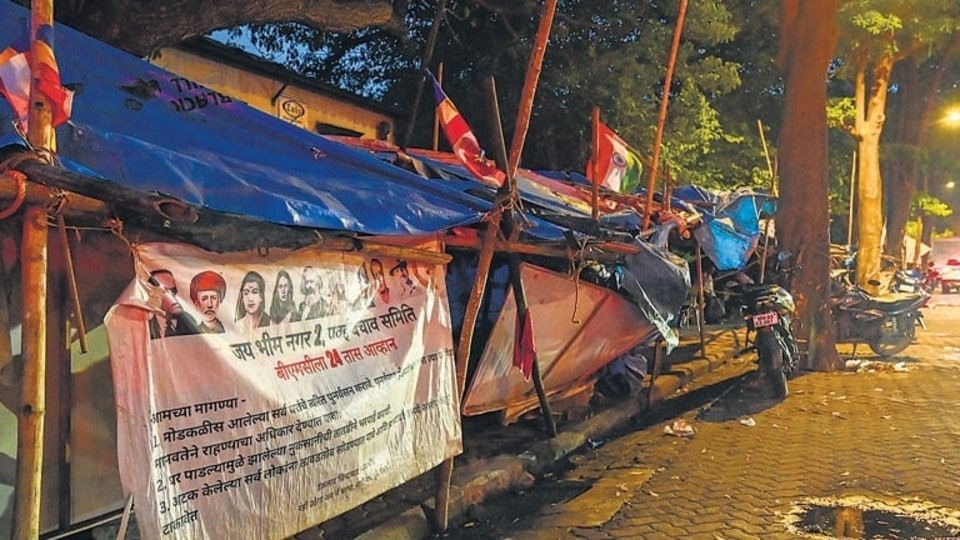
The residents are scattered at the two ends of the ground that they once called home for almost 30 years. Most homes are makeshift tents constructed out of bamboo and tarpaulin.
The ground is littered with stories of paradox – a baby sleeps quietly nestled within a dupatta tied to two bamboo poles, in another part residents are seen winding down after a day’s work in joviality and camaraderie; and then there are days when residents spot snakes slithering in their homes.
When Sahebrao Pawar, spotted one, he shifted his charpoy on the road. “I packed off my scared children to my sister’s house for the night. We already have mosquitoes to deal with, and the nets we sleep under are turning ratty,” he said.
Basic necessities are also compromised. “The BMC sends one tanker a day at irregular times, which is insufficient,” said Adarsh Priyadarshi, an IIT Bombay student from the Jai Bhim Nagar Bachao Samiti, which is helping the residents with food supplies and books for children. He said people here use rainwater for drinking and cooking.
Priyadarshi added that despite the demand, the S-Ward officer Dhanaji Hirlekar had purportedly told them that “even this supply will be stopped soon”. Hirlekar did not respond to HT’s calls to present his side of the story.
Mobile toilets close by are also used for bathing and washing clothes. A resident, Indu, said the toilets “are extremely filthy as no one cleans them”. And since the toilets are shut by 9pm, people need to “hide behind a tree or cross the road to answer to nature’s call”.
Joblessness among some, adds to their duress.
Pawar gets work only once a week, since the time he lost his steady job after he was “sent to prison for throwing stones at the police when the demolition was on”. He was one of the 56 people charged, including six women who were let go without jailtime. Another one was Nilesh Dhotre. “I am the sole breadwinner of my family consisting of elderly grandparents,” said Dhotre, 21, who is educated till Class 10 only. He has been begging for his job as an office assistant back since being freed.
Now, as the monsoons have departed, the October heat has brought on fresh grief. “It is too hot to sleep inside without lights or fans. We will have to live amidst the dust and noise of the roads,” said Pawar, who hope the government might give them “alternate accommodation by Diwali”.


