Faith and water, each indispensable. Together, infinitely potent. Every belief system co-opts water’s metaphysical valency in rituals. In Zoroastrianism, it is furthered into the divine feminine, Ardvisura Anahita. Every fire temple houses a well; as did traditional Parsi dwellings, their niche aglow with oil-lamps after dusk, Imagine then the mystic pull of one that has anchored this tiny community for 300 years and witnessed Mumbai fulfil its manifest destinies. Pushed inland by reclamations, today it stands between Churchgate station and Flora Fountain, serenely aloof from the wave of pedestrians and traffic surging past.
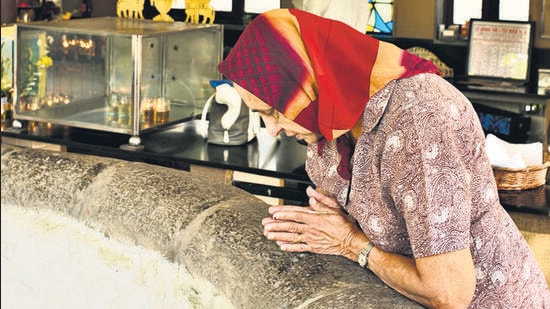
Bhikha Behram Well is named after the Mumbai merchant who sank it in 1725. He’d made a tidy sum dealing in imported British goods, some say even gunpowder. But he didn’t just hire a gang to go blow a hole in the ground. Like Old Testament Joseph, like Martin Luther King 238 years later, he did so on the instructions of a divine dream. One, he didn’t obey straight away. Not because he was too busy, too forgetful or simply because he too believed like his wife, that the interrupted sleep was merely the result of too much indulgence at dinner. He didn’t do so because the missus had scoffed that the precisely specified spot was too impractical. One, it was too close to the sea and could only yield brackish water. Two, it was too far from their home, so even if the water did turn out to be potable, it would be an expensive schlep to get it there.
The dream reappeared, more insistent. A worried Bhikha Behram sought permission from the British authorities. They laughed him out of court on the same logic, and when they heard it was on the prompting of some dream, they roared and threw him out. The dream occurred a third time, the voice now brooking no delay.
{{/usCountry}}The dream reappeared, more insistent. A worried Bhikha Behram sought permission from the British authorities. They laughed him out of court on the same logic, and when they heard it was on the prompting of some dream, they roared and threw him out. The dream occurred a third time, the voice now brooking no delay.
{{/usCountry}}This put Bhikha Behram in a greater quandary because word of his hare-brained project had got around, and friends had begun to mock, much like Joseph’s brothers, ‘Behold the dreamer cometh’. He sank into depression taking his business with him. Mrs. Cynic finally told him to go ahead with the mission so that they could get on with their lives.
A relieved Seth Bhikha Behram unilaterally ordered his men to start digging. Almost as soon as pickaxe broke ground, it unleashed a subterranean spring of clear, sweet water. The level hasn’t dropped despite the prodigious amounts drawn from it for three centuries.
During the 1896, bubonic plague, it was among the very few of Bombay’s proliferating wells uncontaminated and unsealed, thus quenching the whole city’s thirst. Bhikha Behram had also built a trough alongside serviced by a water mill since Zoroastrianism preaches care for all Ahura Mazda’s creations.
As late as the 1970s, the well augmented the niggardly supply from BMC’s antiquated pipes in the old Fort area, bhistis, carts even private cars lining up to take their fill.
Bhikha Behram well’s secular bounty is far outweighed by its sanctity.
Dr Ramiyar Karanjia, who heads Mumbai’s Zoroastrian madresa, Dadar Athornan Institute explained, “In Zoroastrian texts, water is presided over by the spirit, Avan or Aban. She is bestowed adjectives like ardvisura (strong) and anahita (pure), also used together as her name. Fire is allegorically referred to as the son of the Supreme being, Ahura Mazda: ‘Athro ahurahe Mazdao Putra,’ but Ardvisura Anahita, ranking a close second, is the only divine being with bodily attributes.”
Dr Shernaz Cama of Parzor, the UNESCO-recognised foundation to preserve Parsi Zoroastrian heritage, elaborated: “Ardvisura Anahita is celebrated in the Ava or Aban Yasht, among the longest of Avestan hymns.; her source is atop the mythical mountain Hukairya in the Star region and her descent from the heavens is reminiscent of that of the Ganga. ‘Strong and bright, tall and beautiful of form…Ava will give strength and swift horses to men, knowledge to priests and teachers, while women will be her special care.’ She comes ‘dressed in the finest beaver skins. Of gold are her mantle, shoes, earrings, necklace and diadem of a hundred stars. Her chariot is drawn by four white horses, representing wind, rain, cloud and sleet.’ Reliefs in her likeness were made during the Achaemenian and Sasanian times.” She has a counterpart in Hellenic art.
Zoroastrian scholar retd. Justice Rohinton Nariman spoke proudly of the presciently ecological message preached over 3,000 years ago. “Zarathushtra enjoined followers never to pollute any of the elements, and if polluted, restored to their pristine state. In the Videvda-- the only one of the 21 nasks or compilations to have survived in entirety -- the Prophet asks, ‘Where is the third place in the world where the land is the happiest?’ to which Ahura Mazda replies, ‘Such a place is the land where an Ashavan has planted more wheat, oil and fruit trees than anyone else, and people have brought water to dry lands and ploughed the watery lands.”
Unsurprisingly, over its long innings, Mumbai’s Bhikha Behram Well has acquired a reputation for miracles, curing people (and even their pets) as well as granting other boons to those who pay here to Ardvisura Anahita. In fact, outsiders commonly refer to it as the ‘Parsi wishing well’.
Alas, even the sacred is subject to secular violation. But faith triumphs in court as much as in consciousness. Bhikha Behram’s doughty trustees won a 16-year-long case against a toilet-cum-primary health centre-cum- drinking water block constructed in 1997 right next to the well by Rotary Club (Sunrise). In 1994, they had managed to ward off hawkers encroaching from nearby Fashion Street.
A decade later, outraged citizens, under the aegis of the Public Concern for Governance Trust, held a peaceful candlelight vigil at Azad Maidan after vandals shattered the well’s stained-glass panels and stole its skylight. Multi-faith leaders joined in prayer. Over the years, the Shapoorji Pallonji and Godrej groups have generously supported restoration and renovation, the late Sohrab Godrej personally supervising beautification.
Most recently, it was feared that Metro Line 3’s tunnel --to be excavated just 15m to its south – would compromise the well’s water table. Fortunately, their anxiety was laid to rest by the all-clear given by geologist Dr P S Ramakrishna whom they commissioned in 2015.
Sacred Bhikha Behram no Kuvo has warded off decay and desecration for 300 years, and is a steadfast part of Mumbai’s secular heritage.
-------------------------
Waternamah: 300 years of Mumbai’s Bhikha Behram Well, a collection of essays on this universal lifeforce, edited by Bachi Karkaria will be launched on March 21, 2025
Box
Heritage architect Kavas Kapadia refers to ‘Anahita temples’ built around natural sources of water during the Achaemenian and Parthian periods. The ruins of one remain at Kangavar near Hamadan in Iran. Kapadia has studied indigenous water systems across a Zoroastrianism-influenced Central Asia which express its importance and therefore its conservation. Iran’s qunat bringing water to a destination from a faraway source; Afghanistan’s gabarband (check dams); tanka still in use in Gujarat’s Bharuch. On a field visit there, Dr Cama was asked, ‘Will you drink our tanka nu pani, or should we get a Bisleri?’ She chose the former.’ Naturally.
Stay updated with all the Breaking News and Latest News from Mumbai. Click here for comprehensive coverage of top Cities including Bengaluru, Delhi, Hyderabad, and more across India along with Stay informed on the latest happenings in World News.
Stay updated with all the Breaking News and Latest News from Mumbai. Click here for comprehensive coverage of top Cities including Bengaluru, Delhi, Hyderabad, and more across India along with Stay informed on the latest happenings in World News.