
 E-Paper



Pawar's latest gambit
The Nationalist Congress Party president's decision to step down and take a backseat in active politics is a calculated, political move


A week ago, Sharad Pawar, addressing a programme organised by the youth wing of the Nationalist Congress Party (NCP) at Chembur in Mumbai said, “We need to create new leadership in the party.” “The time has come to turn the bread else it will burn. This is the right time to do it, without which things will not work,” he said.
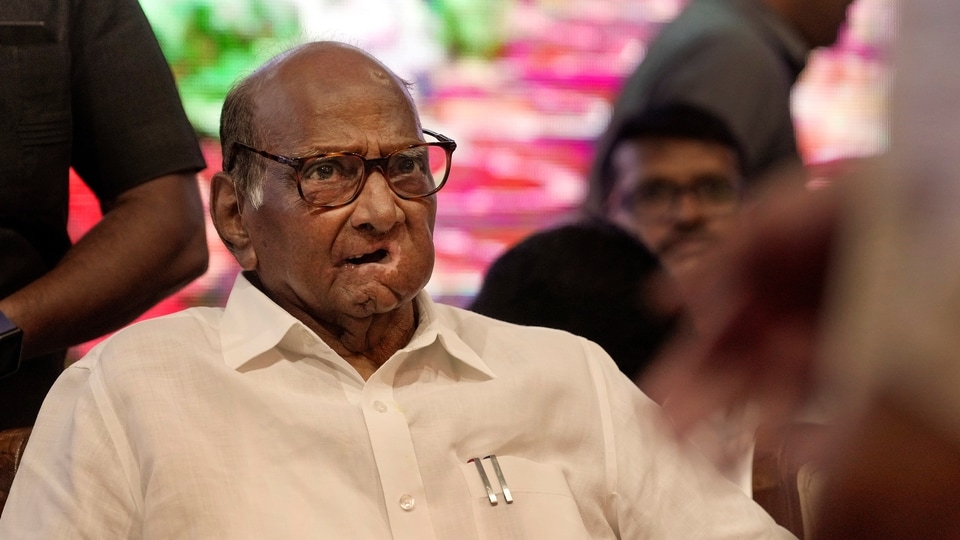
On Tuesday, 82-year-old Pawar announced that will step down as the chief of the NCP, a party he formed in 1999. The crowd of party workers who had gathered at the YB Chavan Centre Auditorium in south Mumbai to attend the launch of an updated edition of Lok Majhe Saangaati, Pawar’s Marathi autobiography, were caught by surprise. His move comes in the backdrop of speculations swirling around nephew and senior party leader Ajit Pawar’s keenness to join hands with the Bharatiya Janata Party (BJP).
According to a close aide of Pawar, other senior leaders in the party have also been advocating an alliance with BJP of late. “He is under pressure from within the party to go with the BJP. So far, he has refused to accept their demand even as there is risk of a split in the party,” the aide, who refused to be named, said. On his part, Ajit Pawar has said that he would never leave the NCP. The 63-year-old son of senior Pawar’s older brother, Anantrao, is also on the committee that has been formed to decide on the election to the NCP president’s post that is now vacant.
At the fag-end of his political career, Sharad Pawar was battling one of the biggest challenges in his life: keeping his 23-year-old party intact. The veteran of many political battles had to use all his experience and skill to keep his flock together and retain his control over the party. This also comes at a time when he was getting ready to play a larger, national role in bringing the opposition parties together for a wider coalition against the BJP ahead of the general elections in 2024.
According to NCP insiders, Pawar told party leaders that those who wanted to side with BJP were free to make their own decisions. He would continue to fight with the party.
“This is not the first time Pawar is facing a tough battle. In 1980, most of his colleagues left his party, Congress (S), but he did not budge. In 1987, he joined the Congress and soon became chief minister. At any point of time, he had the strength and following to get 50 to 60 MLAs elected in Maharashtra,” his aide said.
Pawar formed the NCP in 1999 and won 58 seats in that year’s assembly elections. Ahead of 2019 elections, a significant number of legislators including his long-time colleagues such as Madhukar Pichad, Padmasinh Patil and Vijaysinh Mohite-Patil quit his party to join the BJP. The NCP still won more seats (54) compared to 41 it had won five years ago.
A public life
Sharad Pawar dates the start of his political career on May 1, 1960 — the day the state of Maharashtra was formed with YB Chavan as CM — when he joined the Pune City Youth Congress. Six years later, he became a first-time legislative assembly member from Baramati at the age of 27. The constituency has remained his stronghold, and his daughter, Supriya Sule, is now the NCP parliamentarian from there.
Pawar became a key figure in national politics in the early 1990s. He was considered a top functionary in the P V Narasimha Rao-led government that brought economic reforms. As Congress lost power at the Centre in 1996, Pawar tried to establish his dominance in the party and also retain his position in national politics. When the short-lived Atal Behari Vajpayee-led government collapsed, leading to new elections in 1998, Pawar brought all opposition parties together in Maharashtra and won 38 out of 48 Lok Sabha seats in the state.
He also became the opposition leader in Lok Sabha. However, a showdown with Sonia Gandhi loyalists around this time led to him being expelled from the party. He formed the NCP and contested the Lok Sabha and assembly elections held again in 1999. While the Vajpayee-led BJP returned at the Centre, Pawar ensured a Congress-NCP alliance government in the state.
Pawar remained friendly towards the Congress and served as agriculture minister for two consecutive terms of the United Progressive Alliance (UPA) led by Manmohan Singh. However, the emergence of Narendra Modi as a dominant political force, limited Pawar’s role in national politics.
More recently, Pawar was one of the opposition leaders who took the initiative to unify opposition parties against the BJP in the run up to the 2019 general elections, joining the Congress-led group to contest the parliamentary polls. Though the BJP-Shiv Sena saffron alliance won the majority in the 2019 assembly elections, the two parties fell out over the issue of chief ministership. Making use of the development, Pawar stitched together a coalition of three parties — NCP, Shiv Sena and Congress — to form the Maharashtra Vikas Aghadi (MVA) and claimed power in the state. The coalition almost didn’t come through: in an early morning move, Ajit Pawar took oath as deputy CM with Devendra Fadnavis as CM. The same day, he returned to the NCP fold, no doubt after senior Pawar’s intervention.
The Uddhav Thackeray-led MVA government lasted barely 19 months: it fell last year after a split in the Shiv Sena when Eknath Shinde corralled close to 50 leaders and joined forces with the BJP.
Now, faced with the possibility of a split in the NCP, Pawar had his task cut out. A setback in Maharashtra would also mean losing his influence in national politics.
“He has always been popular with the people and has significant influence in western, north and central Maharashtra. He could always get a certain number of MLAs elected,” a senior NCP leader, who did not wish to be named, said.
“Things, however, are different this time around. The challenge is being posed by his nephew who has been handling the party organisation for almost two decades and is popular among the party MLAs. About a dozen party legislators, including Ajit, are fearing trouble by agencies such as the Enforcement Directorate and probes into their assets,” he said.
Fighting back
In his newly-released, updated autobiography, senior Pawar said that he “was not aware” of Ajit Pawar’s bid to form the government with Fadnavis in 2019.
Following that incident, Pawar gave bigger roles to his daughter and Baramati member of Parliament Supriya Sule and state NCP chief Jayant Patil in handling the organisation. No major decisions are taken without them being on board – indeed, both of them will form part of the committee to decide on the election to select the new NCP president. Several key appointments in the party organisation have also been made by them. Even the administration of the party is now under their control. Patil heads NCP's legislative unit after Ajit’s removal from the post following his 2019 rebellion.
This time around, Ajit Pawar and some other leaders’ apparent interest to join hands with the BJP did not catch him by surprise, another senior party leader who did not wish to be named, said. Pawar deputed Patil and other senior leaders to get in touch with MLAs to figure out how much support Ajit Pawar had. The message that toeing Ajit’s line would mean rebellion against Pawar was conveyed to the legislators. They were also cautioned about the consequences of a rebellion with elections barely a year away.
In the past two weeks, Pawar has attended a number of party functions and reached out to them. He also held daily parleys at Silver Oak (Pawar’s residence in south Mumbai) and Y B Chavan Center at Nariman Point where both he and daughter Supriya Sule have offices.
“At the state level, Pawar is still seen as a political game changer. He can set the agenda even when he is not in power. A classic example was formation of MVA government in 2019,”said Padmabhushan Desphande, a Mumbai based political analyst. “The fact that Shinde-Fadnavis government’s industries minister Uday Samant met Pawar twice in connection with protests of local villagers against proposed oil refinery at Barsu in Ratnagiri, indicates the influence he still has,” he added.
As all parties in Maharashtra gear up for the Supreme Court’s verdict on the petitions on the split in Shiv Sena and the formation of the government under Eknath Shinde, BJP strategists have identified Maharashtra as one of the states where a strong opposition could lead to them losing Lok Sabha seats in 2024. As such, weakening the MVA is a political requisite for the ruling party.
At the book release function on Tuesday, Pawar said that he will continue to work in the fields of “education, agriculture, sports and culture” through the social institutions. What happens in the coming days will reflect Pawar’s continued influence and strength in Maharashtra as well as in national politics.
 ABOUT THE AUTHORShailesh Gaikwad
Shailesh Gaikwad is political editor and heads the political bureau in Hindustan Times' Mumbai edition.In his career of over 20 years, he has covered Maharashtra politics, state government and urban governance issues.Read More


