She was an endearing Punjaban dadi in the iconic serial Jassi Jaissi Koi Nahin, the embittered mother in Doghi, the wronged widow in Govind Nihalani’s Tamas. With each role, her voice and body language underwent a complete transformation with all the dexterity of a practiced magician.
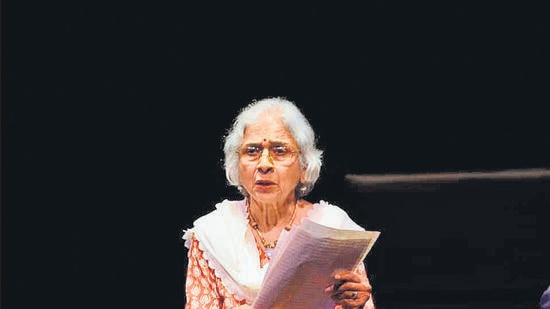
Behind the scenes, though, Uttara Baokar was a constant and peaceful presence. Lovingly addressed as maushi/ma’am by everyone on sets—she was by all accounts— an affectionate, unassuming figure who wore her achievements with humility.
The respectful ease she dealt with people and reassuring presence will be fondly remembered by her contemporaries who grieve her loss. A curtain has certainly fallen on an era.
For Uttara Baokar belonged to a generation of actors who specialised in an increasingly lost language. A language that prioritised complete commitment to one’s craft, irrespective of the commercial concern. To say nothing of an unerring command of diction, voice modulation and body language—the very cornerstone of her training at her alma mater the National School of Drama, in Delhi, where she studied and taught. Along with actors Surekha Sikri, Om Puri, Jyoti Subhash and Manohar Singh, she symbolised the Golden Age of Hindi theatre. In the words of writer, lyricist, and film director Shrirang Godbole, “She was an important representation of Marathi theatre and talent on the national stage. Fastidious about her work, she deeply studied each part she did. Well-travelled, well-read, and thoroughly trained, she could be relied upon to play her part to perfection.”
Noted actor Mrunal Kulkarni who played her daughter in Sumitra Bhave’s Welcome Home points out the singularity of Uttara’s life and focus. “Her craft came first and last. Unlike younger generations of actors, she did not have to associate with allied activities or marketing to promote her work. In that sense, there was no existential question of what came first---‘the egg or the chicken’—in her mind. She was in no doubt. Her work was all that mattered,” she shares. “What’s more, her life was proof of the fact that one didn’t need vast sums of money to lead a rich and full life. Despite her principled, unbending stance as far as work went, she was a kind person, and very easy to talk to. She treated all of us as equals, and I am so grateful to have known her.”
{{/usCountry}}Noted actor Mrunal Kulkarni who played her daughter in Sumitra Bhave’s Welcome Home points out the singularity of Uttara’s life and focus. “Her craft came first and last. Unlike younger generations of actors, she did not have to associate with allied activities or marketing to promote her work. In that sense, there was no existential question of what came first---‘the egg or the chicken’—in her mind. She was in no doubt. Her work was all that mattered,” she shares. “What’s more, her life was proof of the fact that one didn’t need vast sums of money to lead a rich and full life. Despite her principled, unbending stance as far as work went, she was a kind person, and very easy to talk to. She treated all of us as equals, and I am so grateful to have known her.”
{{/usCountry}}Actor Sonali Kulkarni who worked with her in Doghi, Restaurant and Bandh Jharokhe underlines the discipline of her approach. “It was her ability to completely change her body language through her gestures and choice of attire that made her work so impactful. She could convey nuance beautifully—her work was never repetitive. She was also able to play characters from diverse backgrounds, ever so convincingly,” she says. “Work aside, she was great fun to be with. She had a beautiful singing voice and a vast oeuvre of old Hindi songs that she would dip into, as we travelled together. Oh, I will miss her so much.”
Filmmaker Sachin Kundalkar said, “I am deeply saddened by the loss of not just a towering figure but a very influential figure in my professional journey. I first met her on the sets as a youngster assisting Sumitra Bhave in Doghi. She then went on to play an important role in my first directorial venture Restaurant.” He further added, “She was a master at voice modulation. Few actors are as in control of their voice as she was. It was the one thing that really added dimension and depth to each part she played.”
Uttara’s student, noted writer and actor Abhiram Bhadkamkar points to her approachability and dedication. “For a scene from my book Inshallah, that was no more than one and a half pages long, she was happy to painstakingly carry out a detailed reading with attention to each word and line. She kept expressing her joy at reading her students’ work. She was enthusiastic about encouraging new talent—and so very humble to the end.”
Actor-writer Vibhawari Deshpande would agree. “I remember that she was the judge at the Purushottam Karandak, the much-celebrated annual inter-collegiate Marathi one-act play competition. Our play won the prize for the best play, and I won the best actress award. She told me to keep writing and experimenting with the work I did. The effusive appreciation from such a great actor still warms my heart.”
Do they make ‘em like that anymore?
Stay updated with all the Breaking News and Latest News from Mumbai. Click here for comprehensive coverage of top Cities including Bengaluru, Delhi, Hyderabad, and more across India along with Stay informed on the latest happenings in World News.
Stay updated with all the Breaking News and Latest News from Mumbai. Click here for comprehensive coverage of top Cities including Bengaluru, Delhi, Hyderabad, and more across India along with Stay informed on the latest happenings in World News.