
 E-Paper


Solapur farmers turn to Mumbai for jobs amid drought
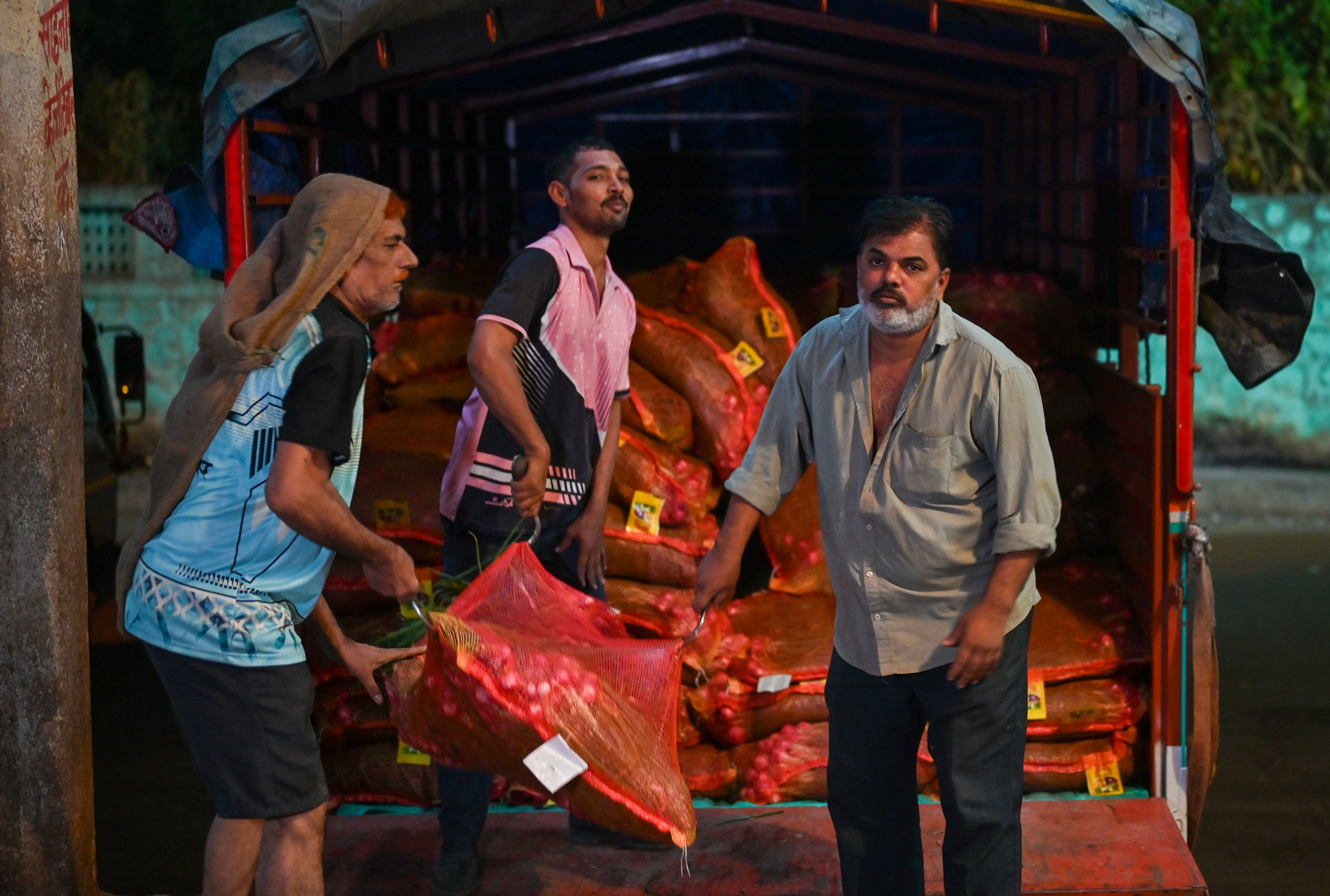
Hussain is among 40 to 50 farmers from Solapur district affected by drought who have come to work as daily wage labourers at the Vashi APMC market.

 Prefer HTon Google


At 12.15am, while most of Mumbai was asleep, 65-year-old Moroddin Hussain was waiting for a truck loaded with vegetables to arrive at the Agricultural Produce Market Committee (APMC) market in Vashi. For the past few weeks, the farmer from Akkalkot tehsil in Solapur district has been spending his nights unloading vegetable trucks instead of looking after his three-acre farm back home.

For Hussain, this has been one of the worst agricultural years. He spent nearly ₹16,000 to ₹17,000 on sunflower seeds and hired a tractor to prepare his field. But with little or no rain, his crop dried up, leaving him with nothing to harvest.
“I heard from people in my village that several farmers from our tehsil were coming to Mumbai to look for work. So, I also decided to come here. Whenever I get work, I earn ₹700 a day,” he said, struggling to hold back his tears. His children work as masons in the village, and the family is trying to manage its expenses with whatever little they earn.
Hussain is among 40 to 50 farmers from Solapur district affected by drought who have come to work as daily wage labourers at the Vashi APMC market. Dependent on their farms for their livelihood, these farmers are now unloading vegetable trucks to support their families. With crops failing and little work available in their villages, many have been forced to leave their homes in search of employment.
While ministers were visiting homes of drought-hit farmers to celebrate Diwali with them, several others from the same farming community are spending the festival away from their families, working in Mumbai to make ends meet.
“Drought has been declared in all 11 tehsils of Solapur district. Many farmers from the district are coming here looking for work, and several others have called me asking if they can also come,” said Kishor Chavan, a supervisor (mukadam) who brings workers from his village to the APMC market.
Also Read | Raj Thackeray cancels MNS Diwali celebrations over drought situation in Maharashtra
Chavan himself has been coming to the market for the past few years whenever rainfall is poor in his village. However, this year, the situation is worse. The poor harvest has also affected the number of vegetable trucks arriving at the market, reducing the work available for labourers. “Workers are paid only for the days they get work. The number of people contacting me this year has almost doubled. I have had to tell many of them not to come because there is not enough work for everyone. Some have started looking for other kinds of daily wage jobs as well,” he said. Chavan added that agricultural incomes in the district have remained low for the past three years, affecting the earnings of farming families. He, too, could not return to his village for Diwali.
Mohammad Mujar, who has been working at the APMC market for the past 20 years, said the farmers arriving from Solapur were in a desperate situation. Most own three to six acres of land, but their fields have produced little or nothing this year. “They have no crops to sell and no work available in their villages. They come here and earn ₹700 a day. After spending money on food and accommodation, they send whatever they can save to their families. The situation is very difficult. Even here, we are finding it hard to provide work to everyone,” he said.
The scale of the crisis is reflected in the rainfall figures. All 11 tehsils of Solapur district -- North Solapur, South Solapur, Barshi, Akkalkot, Mohol, Madha, Karmala, Pandharpur, Sangola, Malshiras and Mangalwedha -- have been affected by drought.
According to a report by a local official, the district has recorded a rainfall deficit of around 58% compared with its average, one of the highest in the state.
Sangola has recorded a 52% deficit, while Mohol has received only 193.2mm of rainfall. The shortage of rain has also affected groundwater levels.
Compared with the 2015 drought, 47% more wells in the district have recorded a fall in water levels. Several villages are now dependent on water tankers to meet their drinking water needs.
The local government report also highlighted that both Kharif and Rabi crops have suffered. The lack of moisture in the soil has also raised concerns about the sowing of Rabi jowar, an important crop for the region.
For 27-year-old Shivsharma Koli, coming to Mumbai to work as a labourer was something he had never imagined. He owns six acres of farmland where he had grown sunflower and tur dal. However, the crops failed, leaving him without an income.
“For the first time in my life, I have had to take up manual labour. My parents and wife are back home, and there was no work available in the village. So, I came here a month ago,” he said. Koli earns ₹700 on days when he gets work and stays in a rented room in Turbhe, for which he pays ₹2,000 a month. “After spending on food and other expenses I try to send as much money home as possible. My family depends on me, and I have to support them,” he said.
Mehboob Kheraj, 43, who owns six acres of farmland, has also come to Mumbai after losing his crops. He had grown sugarcane and tur on his land but received almost nothing from the harvest. With a family of eight to support and children pursuing college education, he said the situation had become difficult to manage.
“We are entirely dependent on farming. With no rain this year, we have suffered huge losses. We had no other option but to come here and work as labourers,” he said. Kheraj said this was the third consecutive year of agricultural losses for his family. While excessive rainfall affected the crops last year and poor rainfall affected production the year before, this year the family has been left with almost nothing. “At least in the previous two years, we managed to get some harvest. This year, there is nothing. Many farmers in our village are facing the same situation,” he said.
Solapur district officials said the government plans to provide employment to farmers under the Viksit Bharat – Guarantee for Rozgar and Ajeevika Mission (Gramin).
The growing migration of farmers from Solapur to Mumbai and Pune is also worrying academics.
Prabhakar Kolekar, associate professor of sociology at Punyashlok Ahilyadevi Holkar Solapur University, said the scale of migration this year is much higher than in previous years.
“The drought situation in Solapur is very serious. Many people are moving towards Pune and Mumbai in search of work. Those looking for short-term employment generally go to Pune and find work in construction, while those seeking longer-term employment move to Mumbai,” he said.
Kolekar said migration from the district was not new. Educated youth often move to cities such as Hyderabad, Bengaluru and Pune for jobs, while skilled workers migrate to Mumbai and Pune. However, the movement of farmers who have land of their own to other cities for daily wage work is a worrying development.
He added that some educated youngsters who had returned to farming after working for two to four years were now going back to formal jobs because of repeated agricultural losses.
“This is a major loss for the district. Agriculture is the main source of livelihood for most people here. If agro-based industries are set up in the district, people will have more employment opportunities and will not have to migrate to other cities,” he said.
Also Read | Drought-hit talukas to get dedicated medical aid cells via CM Relief Fund
Kolekar warned that if the situation did not improve, the migration of farmers this year could become permanent, given the scale of their losses.
The Punyashlok Ahilyadevi Holkar Solapur University has decided to study the impact of the drought across the district. The university has asked colleges in different areas to assess the situation in their respective regions and submit information.
“We want to understand the ground situation in different parts of the district and prepare a report based on the information collected by the colleges,” said university vice-chancellor Prakash Mahanvar.
Considering the existing drought situation, the government plans to provide employment to as many people as possible under the Viksit Bharat – Guarantee for Rozgar & Ajeevika Mission (Gramin), said Solapur district collector S Karthikeyan.
The scheme will be implemented from December 1. “It will include drought-related works such as tree plantation, deepening of wells and other water conservation activities to provide local employment to people,” said Karthikeyan.


Stay updated with all the Breaking News and Latest News from Mumbai. Click here for comprehensive coverage of top Cities including Bengaluru, Delhi, Hyderabad, and more across India along with Stay informed on the latest happenings in World News.


