The Maharashtra government is mulling a proposal that would make the redevelopment of thousands of old buildings in the Mumbai airport’s funnel zone financially viable for builders, by allowing the clubbing of FSI.
According to officials aware of the developments, the proposal involves allowing developers to club the unutilised floor-space index (FSI) from a funnel-zone redevelopment with another project. The state will decide on the proposal after receiving a report from the Brihanmumbai Municipal Corporation (BMC) on where such additional FSI should be granted and how it should be used, officials said.
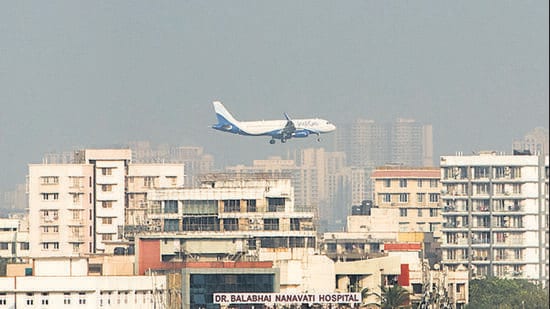
The issue affects thousands of decades-old, dilapidated buildings in areas such as Vile Parle, Santacruz and Kurla, which are in the funnel zone or flight path of the Chhatrapati Shivaji Maharaj International Airport (CSMIA). Buildings in the funnel zone have height restrictions, which prevent developers from using the entire FSI otherwise available to a redevelopment project, making it financially unviable. FSI determines how much floor area can be constructed on a plot in relation to its size.
A policy decision on the matter has been pending for several years. Among the options discussed have been allowing the unutilised FSI to be converted into transferable development rights (TDR), which is essentially a tradable certificate, and concessions in the permissible height restrictions.
{{/usCountry}}A policy decision on the matter has been pending for several years. Among the options discussed have been allowing the unutilised FSI to be converted into transferable development rights (TDR), which is essentially a tradable certificate, and concessions in the permissible height restrictions.
{{/usCountry}}Now, the state government is mulling a proposal involving FSI clubbing. “According to the proposal, a developer can use the balance FSI from the funnel zone elsewhere in Mumbai. This proposal is based on a similar concept used in the redevelopment of cessed Mhada buildings under Regulation 33(7), clause 22, which permits developers to integrate two or more separate projects into a single unified plan to maximise the viability of the project,” said an official aware of the developments.
For instance, if a redevelopment project is entitled to 10,000 sq ft of FSI but height restrictions allow the developer to construct only 7,000 sq ft, the remaining 3,000 sq ft can be used in another project outside the funnel zone.
“Legislators Parag Alavani and Amit Satam raised the issue in a meeting with chief minister Devendra Fadnavis,” said another official familiar with the matter. “Accordingly, the urban development department has sought a report from the BMC. As the BMC is the planning authority in Mumbai, it will give its opinion on where the FSI potential for buildings affected by funnel zone restrictions should be granted and how it should be utilised. It should also examine whether the additional FSI can be merged with adjoining or nearby developments,” the official added.
Alavani, an MLA from Vile Parle, said the BMC’s report is awaited. “Chief minister Fadnavis and deputy CM Eknath Shinde are positive on the issue of redevelopment of old buildings falling in the funnel zone of Mumbai airport. Various options were discussed so far. Now, I hope that the FSI clubbing proposal would resolve this long pending issue once the BMC submits its report,” he said.
Stay updated with all the Breaking News and Latest News from Mumbai. Click here for comprehensive coverage of top Cities including Bengaluru, Delhi, Hyderabad, and more across India along with Stay informed on the latest happenings in World News.
Stay updated with all the Breaking News and Latest News from Mumbai. Click here for comprehensive coverage of top Cities including Bengaluru, Delhi, Hyderabad, and more across India along with Stay informed on the latest happenings in World News.